Abstract
Chinese jujube (Ziziphus jujuba Mill.) is highly resistant to environmental stress and can be easily cultivated, thus many jujube cultivars are being developed. However, the same cultivars had been cultivated with different names. Thus, systematic management is required to protect the intellectual property of different varieties. To aid systematic control of jujube cultivars, this study presents efficient markers for distinguishing cultivars through identification of morphological characteristics and relationships among 25 jujubes. Among 10 qualitative characteristics, flowering time, fructification time, presence of thorns, and shape of fruit were found to be useful traits for the cultivar identification. In the results of principal component analysis, 3 principal components (PC) represented 73% for the total variations. PC1 showed high positive correlations with fruit–related characteristics and PC2 formed a cluster with leaf-related characteristics. Therefore, the differences in fruit and leaf were identified as useful traits for the cultivar identification. According to the results of cluster analysis, which largely divided cultivars into 4 clusters, Sour jujube 2, with smaller fruits and leaves, was separated first. Cluster II included Chinese cultivars with large fruit sizes, such as Dalizao, Dabailing, Damaya, and Daguazao. Three Korean cultivars were grouped with Bokjo, Panzao, Zanhuangdazao, and Jinsi No. 3, and the remaining 13 cultivars formed a separate cluster.
-
Key words: Chinese jujube cultivars, Morphological traits, Phenotypic variability, Genetic diversity
INTRODUCTION
Chinese jujubes (
Ziziphus jujuba Mill.) belong to the Rhamnaceae family (
Liu and Cheng 1995) and they have been cultivated in Europe, Africa and Asia. They are recognized for their usefulness along with Indian jujube (
Z. mauritiana Lam.) (
Adams et al. 1978;
von Maydell 1986). Jujubes are highly resistant to environmental stress and can be easily cultivated. Owing to the high levels of vitamin A, B1, B2, C, and flavonoids in fruits, many cultivars have been developed in South Korea, China, Japan, and Russia (
Dagar et al. 2001;
Hebbara et al. 2002). There were 11 jujube cultivars in 600 BC, increasing to 72 cultivars in the 1300s, and at least 700 cultivars were reported in 1993 (
Qu and Wang 1993). However,
Liu and Cheng (1995) summarized that there are 170 cultivars, indicating that the same cultivars had been cultivated with different names because of the frequent exchange of plant material among different cultivation areas, and the lack of cultivar history documentation.
Trade-Related Aspects of Intellectual Property Rights (TRIPs) and the International Union for the Protection of New Varieties of Plants (UPOV) of the World Trade Organization (WTO) request a systematic control of cultivars to protect the rights of breeders and intellectual property of varieties. Given that jujubes are easily traded by asexual propagation, it is predicted that any issue related with intellectual properties would cause significant economic damages.
Many markers have been applied to identify cultivars and analyze their relationships, and important traits have been selected by classifying organ characteristics. Phenotypic markers, with no use of special instruments or techniques, aid observation and comparison of growth, symptoms, and characteristics between populations or individuals. In earlier times they were used for purity testing and observation of chlorosis in seedlings. Thereafter, methods to document and analyze mutants were developed to classify lines or varieties (
Sneath and Sokal 1973;
Sneath 1995). However, methods using phenotypes have issues such as differences in values depending on the evaluated parts (
Hedren 2002) and evaluation variations, even in the same individual plant, depending on environmental factors. Therefore, a sufficient number of samples and application of statistical methods are required to have objective markers (
Smith and Smith 1992;
Pratt and Clark 2004).
To aid systematic control of jujube cultivars, this study presents efficient phenotypic markers for distinguishing Korean and Chinese cultivars through identification of morphological characteristics and relationships among 25 cultivars in South Korea and China. Based on the ‘Test Guideline (TG) for Common jujube’ that has been used for registration of jujube varieties, characteristics that were expected to have variations between cultivars were added to analyze polymorphic information.
MATERIALS AND METHODS
Testing materials
This study used jujube plants that showed normal flowering and fructification among those maintained in the National Institute of Forest Science, which included a total of 25 varieties as follows: 23 jujube cultivars, including Korean cultivars (Mudeung, Wolchul, and Geumseong), Korean native varieties (Bokjo, Boeundaechu and Chuncheon 7) and Chinese cultivars (Dalizao, Huizao, Pozao, Panzao, Zanhuangdazao, Zhongyangmuzao, Sandonglizao, Dabailing, Damaya, Daguazao, Jinsixiaozao, Jinsi No. 3, Jinsi No. 4, Yuanling No. 1, Yuanling No. 2, Xiaolizao, and Dongzao), as well as two related species of Sour jujube (
Z. acidojujuba C.Y. Cheng & M.J. Liu) that were classified as either variant or wild type (
Table 1).
According to the ‘
TG for Common jujube’, 10 qualitative traits and 15 quantitative traits on growth, leaves, fruits, and stones were investigated for 3 years starting in 2013 (
Table 2 and
3). Growth characteristics were investigated in 5 replications for each cultivar. For bud burst time and flowering time, the periods of leaf formation and flowering were divided into early (3), mid (5), and late (7) times for 2 months from the end of April. For fructification time, post ripe stage time, when 2 out of 3 fruits were pigmented around September, was divided into early (3), mid (5), and late (7) times. Spike formation was categorized depending on spikes were present (1) or absent (0) in annual branches.
Leaf, fruit, and stone traits were evaluated 30 times each in 5 replications per cultivar using fruit branches from the end of September to the beginning of October. Leaf colors on the top and bottom sides were coded by comparison to the Royal Horticulture Society (RHS) Color Chart.
Qualitative traits were classified according to the ‘TG for Common jujube’. Leaf shape was divided into elliptical (3), oval (5), and oblong (7), and serra shapes classified as entire (1), serrate (2), and biserrate (3). Fruit shape was classified into round (1), round oblate (2), oval (3), oblong (4), and elliptical (5), and stone shape was divided into round (3), ovate (5), and fusiform (7).
Statistical analysis
To find morphological characteristics of jujube cultivars, the most frequently observed traits were presented as qualitative traits, whereas variance analysis was performed for quantitative traits, followed by the comparison of mean values.
Principal component analysis (PCA) was performed to analyze relationships between cultivars. Eigenvalues, contributions of principal components to the total variation, and contributions of traits in principal components were calculated, followed by production of biplots based on the first and second principal component scores. Cluster analysis was applied on principal component scores and was presented in a dendrogram with the Unweighted pairgroup method using arithmetic averages (UPGMA). All statistical analyses on data were performed in SPSS ver. 18.0.
RESULTS
Qualitative characteristics of jujube cultivars
There was no clear difference in bud burst time; all cultivars started leaf unfolding within 1 week from the end of April to the beginning of May. On the other hand, some cultivars showed differences in flowering and fructification times. Dalizao, Sandonglizao, Xiaolizao, and Dongzao had delayed flowering and fructification by more than 1 week compared to other cultivars (
Table 4). There were clear differences in spike formation depending on cultivars. Annual branches of most cultivars had no spikes, whereas Huizao, Panzao, Jinsixiaozao, Jinsi No. 4, Sandonglizao, and Xiaolizao, along with Sour jujube developed sharp spikes (
Table 4). As for fruit shapes, some cultivars showed unique shapes, which seemed to be useful for identification as markers (
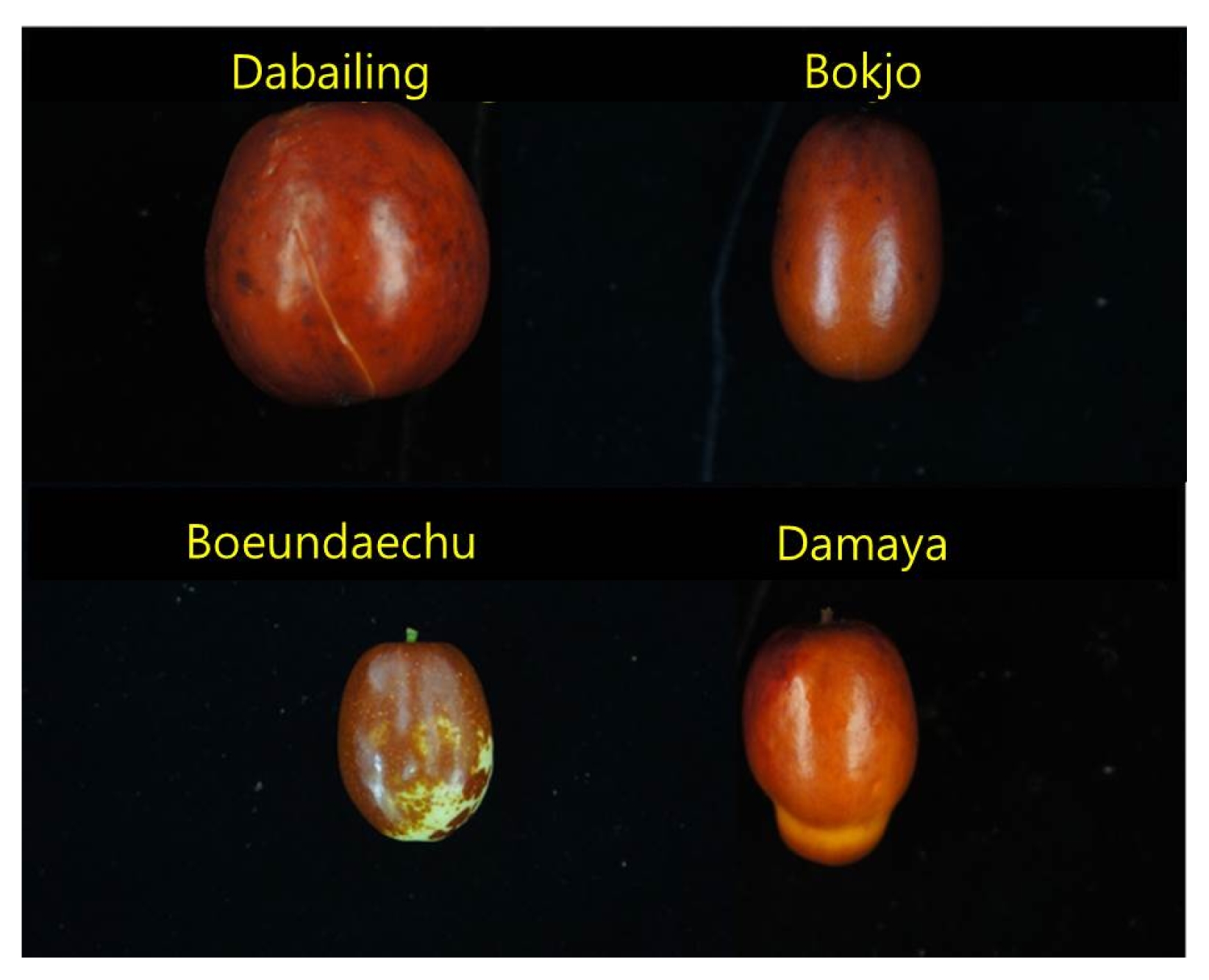
Table 4). While oblong shape was general, Daguazao, Dabailing, and Yuanling No. 2 had large elliptical shapes and Damaya showed a unique shape with protrusion at the bottom (
Fig. 1). The 4 traits related with leaves were mostly found to have either single traits or severe variations within individuals, so that they were considered inappropriate for using as markers to identify cultivars (
Table 4).
Fifteen quantitative traits were subjected to variance analysis, followed by comparison for each category using Duncan’s test. As a result, sizes of leaves, fruits, and stones were identified and useful information for identification between jujube cultivars and Sour jujube and between Korean cultivars and two Chinese apple jujube cultivars (Daguazao and Dabailing) were obtained (
Table 5 and
6).
Twenty-two jujube cultivars averaged 57.87 mm in leaf length, 28.89 mm in leaf width, 42.91 mm in terminal leaf length, and 20.24 mm in terminal leaf width, whereas Sour jujube averaged 37.06 mm in leaf length, 18.88 mm in leaf width, 26.51 mm in terminal leaf length and 12.48 mm in terminal leaf width, showing that Sour jujube could be distinguished by leaf size. In addition, jujube cultivars averaged 34.93 mm in fruit length, 27.09 mm in fruit width, and 12.50 g in fruit weight, whereas Sour jujube averaged 13.37 mm in fruit length, 11.83 mm in fruit width, and 1.07 g in fruit weight, showing that they were clearly distinct.
Korean cultivars and Chinese apple jujube cultivars were compared to find differences. Geumseong, Mudeung, and Wolchul averaged 65.62 mm in leaf length, 34.79 mm in leaf width, 52.36 mm in terminal leaf length, and 25.96 mm in terminal leaf width. In contrast, Daguazao and Dabailing averaged 58.44 mm in leaf length, 28.47 mm in leaf length, 38.51 mm in terminal leaf length, and 17.52 mm in terminal leaf width, indicating that two Chinese cultivars were smaller than Korean cultivars. The difference was more obvious in fruit characteristics. Fruits of Korean cultivars were oblong with 36.95 mm mean fruit length, 26.53 mm mean fruit width, and 11.20 g mean fruit weight, whereas Daguazao and Dabailing had round fruits with 39.66 mm, 37.16 mm, and 25.54 g, respectively, being more than 2 times heavier.
Principal component analysis (PCA)
To investigate relationships among jujube cultivars, contribution of principal component to eigenvalues and total variations were calculated using 15 quantitative traits as variables. Traits that had at least 1.0 eigenvalue were extracted for calculation. Regarding characteristics obtained by PCA, the eigenvalue for the first principal component (PC1) was 5.76, which contributed 38.4% to the total variance, while those of the second principal component (PC2) and the third principal component (PC3) were 3.94 (26.2%) and 1.28 (8.6%), respectively, so that the 3 principal components contributed 73.2% to the total variance (
Table 7).
In the correlation analyses between principal components and morphological characteristics, PC1 showed high positive correlations with fruit–related characteristics such as fruit weight (0.940), flesh index of fruit (0.933), and fruit width (0.903), and PC2 formed a cluster with leaf-related characteristics such as terminal leaf width (0.898), terminal leaf area (0.845), terminal leaf length (0.816), leaf width (0.786), and leaf area (0.759). For PC3, petiole length (0.865), leaf length (0.627), and terminal petiole length (0.621) were identified as major traits (
Table 8).
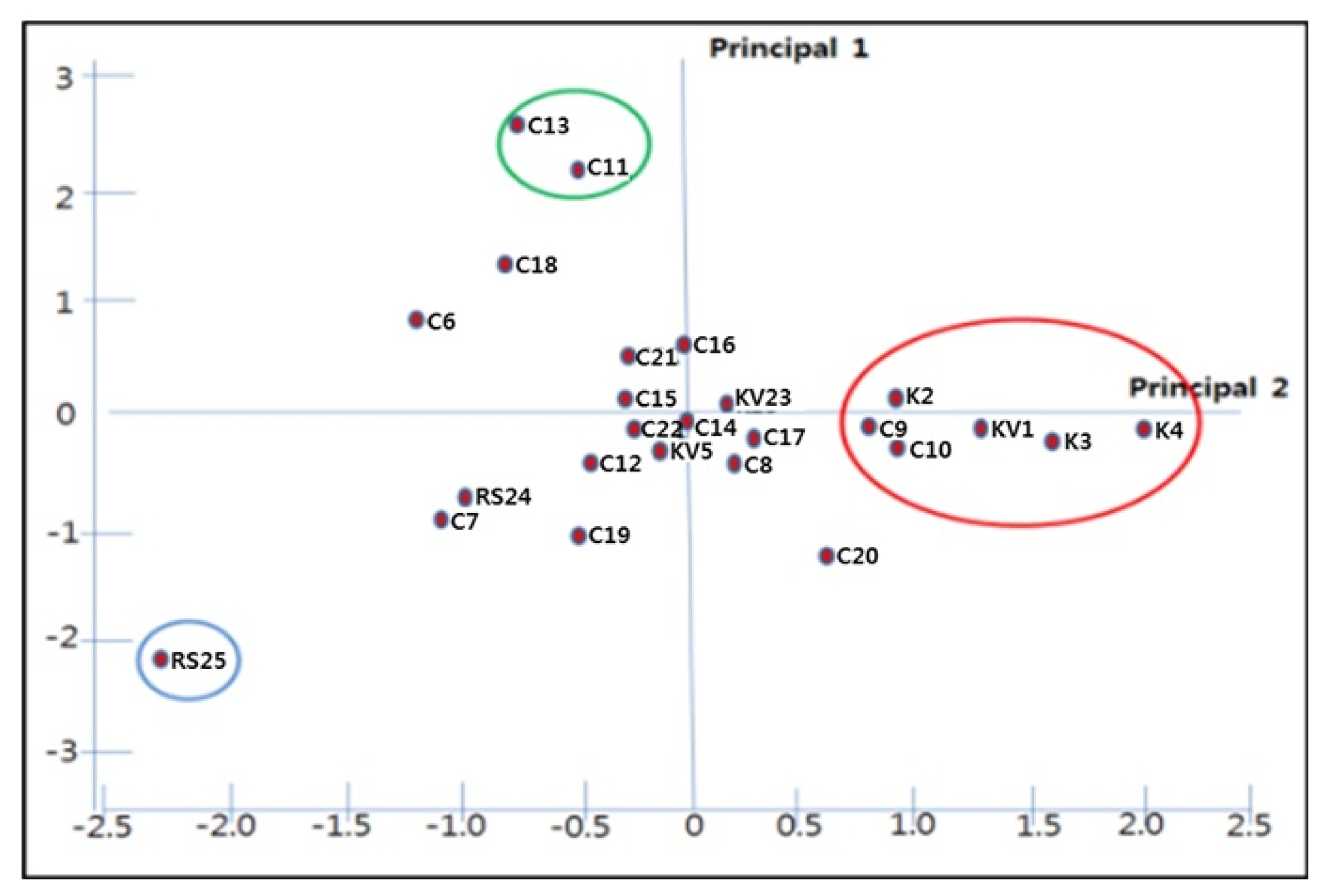
Cultivars were plotted in a 2-dimensional space using PC1 and PC2 as axes. Korean cultivars, including Mudeung (K2), Wolchul (K3), and Geumseong (K4), were localized on the right side of the first axis along with Bokjo (KV1), Panzao (C9), and Zanhuangdazao (C10). In contrast, Chinese cultivars such as Dabailing (C11) and Daguazao (C13) were on the upper left part of the biplot, whereas Sour jujube 2 (RS25) was independently located at the lower left side of the biplot (
Fig. 2).
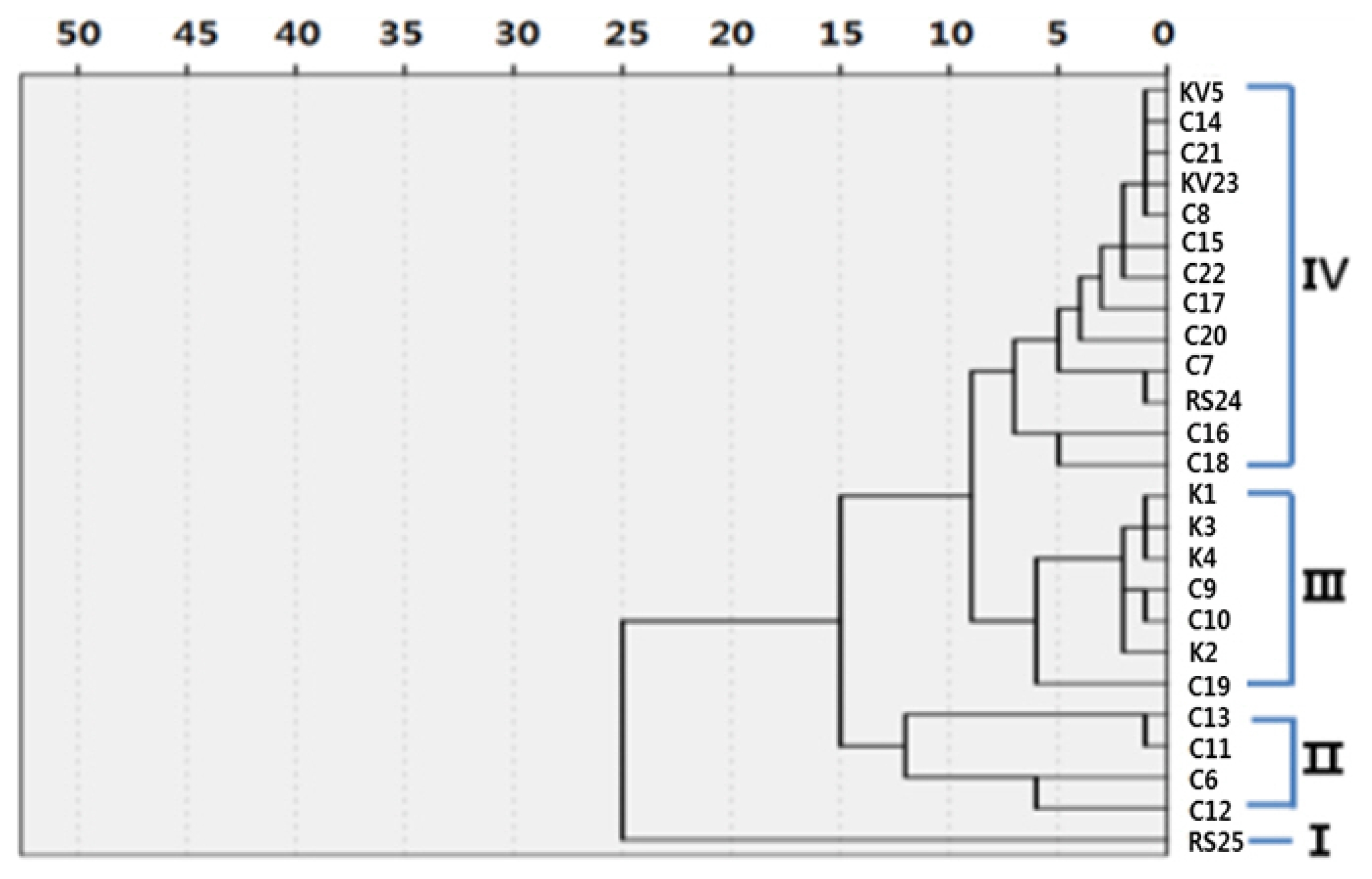
Scores calculated from PCA were standardized as new variables, followed by cluster analysis of 25 jujube cultivars, which were largely divided into 4 clusters. Sour jujube 2 (RS25) that had smaller fruits and leaves was separated first. Cluster II included Chinese cultivars with large fruit sizes, including Dalizao (C6), Dabiling (C11), Damaya (C12), and Daguazao (C13), and Cluster III had Bokjo (KV1), Mudeung (K2), Wolchul (K3), Geumseong (K4), as well as Panzao (C9), Zanhuangdazao (C10), and Jinsi No. 3 (C19). The remaining 13 cultivars and individuals formed a cluster, which included 10 Chinese cultivars and various individual cultivars such as Boeundaechu (KV5), Chuncheon 7 (KV23), and Sour jujube 1 (RS24) (
Fig. 3).
DISCUSSION
Some morphological characteristics showed significant differences among cultivars under the same conditions, making them useful characteristics for cultivar identification. Among qualitative traits, jujube cultivars could be identified using presence or absence of spikes and fruit shape.
Plants defend themselves from herbivores using morphological mechanisms to change densities of spikes, stellate hairs, and branches and chemical mechanisms that increase secondary metabolites (
Karban and Myers 1989;
Haukioja 1990;
Herms and Mattson 1992;
Hartley and Jones 1997). Such mechanisms have been reported to be different between individual plants and variable depending on time and environmental stresses (
Massei and Hartley 2000). Energy allocation to defensive mechanisms leads to growth retardation (
Bazzaz et al. 1987) and an artificial intervention during cultivation can reduce energy allocation to defense mechanism resulting in increased selection for plants with high growth rates and yields (
Small 1996;
Rosenthal and Dirzo 1997;
Jones 1998). In a study with olive tree wild types and cultivars,
Massei and Hartley (2000) discovered that more herbivore browsing was associated with more investment on defensive mechanisms (i.e., spikes) and slower growth. In this study, spikes observed on annual branches were also a defensive mechanism. Considering that most plants in the genus
Ziziphus, including Sour jujube, develop spikes, it seemed that spineless common jujube (
Z. jujuba Mill. var.
inermis) lines that consume less energy for defense during cultivation were generalized through artificial selection.
Bal (1992) reported that Indian jujube cultivars showed differences in the shape of fruit tips. Hence, it is thought that fruit shapes of jujubes could be used as main characteristics for identification of cultivars. Contrastingly, although nuclei transformed from the endocarp were related with fruit shape, they showed only little differences, making them difficult to measure in order to identify cultivars.
Cluster analysis found that the 15 quantitative traits were appropriate for identification of jujube cultivars. The three Korean cultivars together with Bokjo formed a cluster, while Boeundaechu belonged to another cluster. Hence, it is speculated that Mudeung, Wolchul, and Geumseong have a close relationship with Bokjo, while Bokjo and Boeundaechu have derived from different lines. As for Panzao, which was closely clustered with Korean cultivars, it was difficult to distinguish it using quantitative traits, but it showed differences in some qualitative traits. Therefore, it could be identified using comprehensive application of various characteristics. It would be possible to identify Korean cultivars and some Chinese cultivars using the investigated 25 morphological characteristics. However, differences in leaf-related characteristics were too small to apply to various cultivars, and it was considered difficult to apply fruit-related characteristics to seedlings. Furthermore, as metric traits are significantly affected by the plant’s growth environment and seasonal factors, a combination of molecular markers and phenotypic data is the best choice for genetic variability analysis.
Fig. 1Morphological variability of fruits in various jujube cultivars.
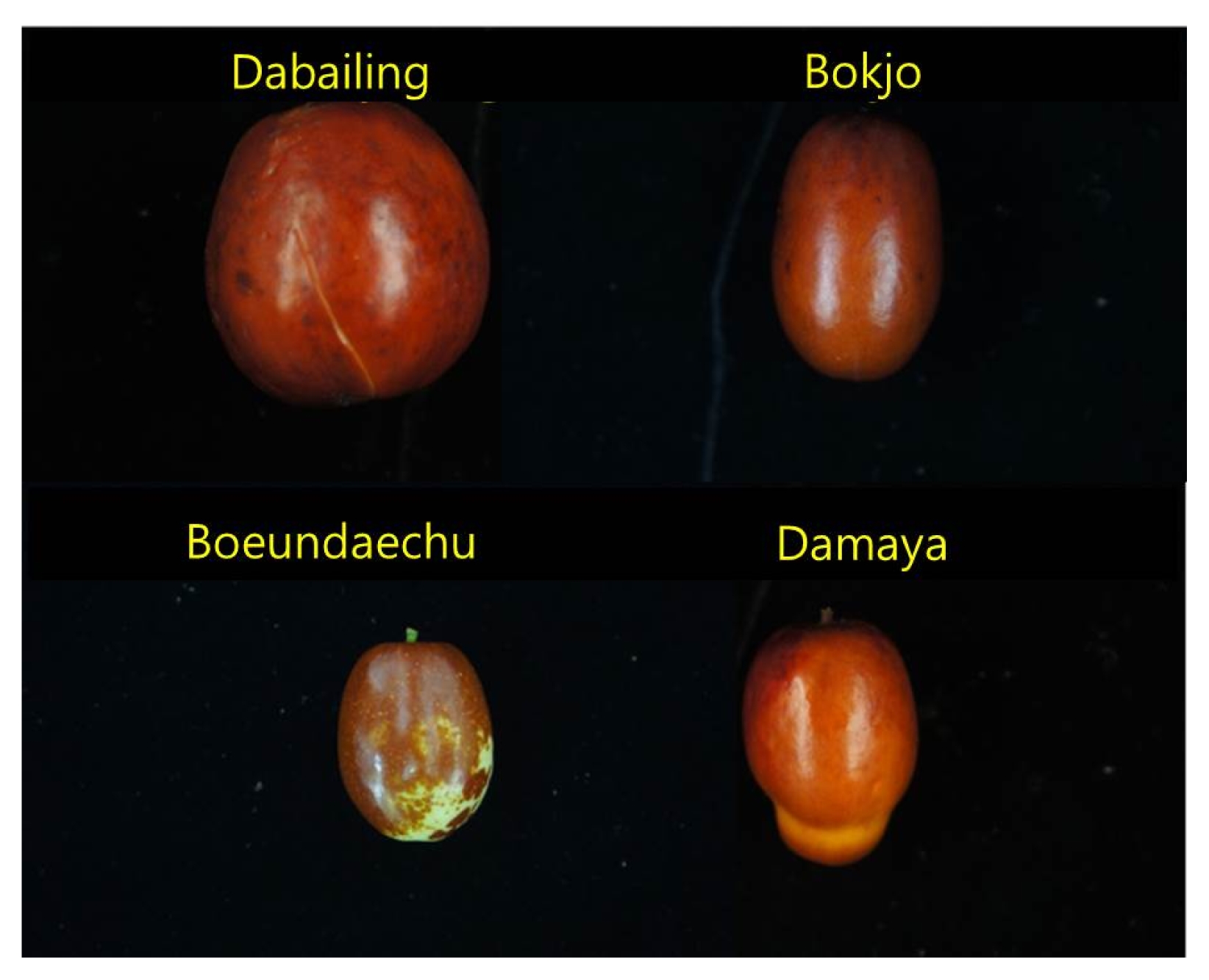
Fig. 2Scattered diagram of 25 jujube cultivars based on the principal component 1 and 2 variables for 15 morphological characteristics. Major cultivated jujube cultivars in Korea were grouped with two Chinese cultivars in the red circle. 2 Chinese jujube cultivars in the green circle were commonly known as apple jujube. The blue circle, related species Sour jujube was completely separated from cultivated jujube cultivars.
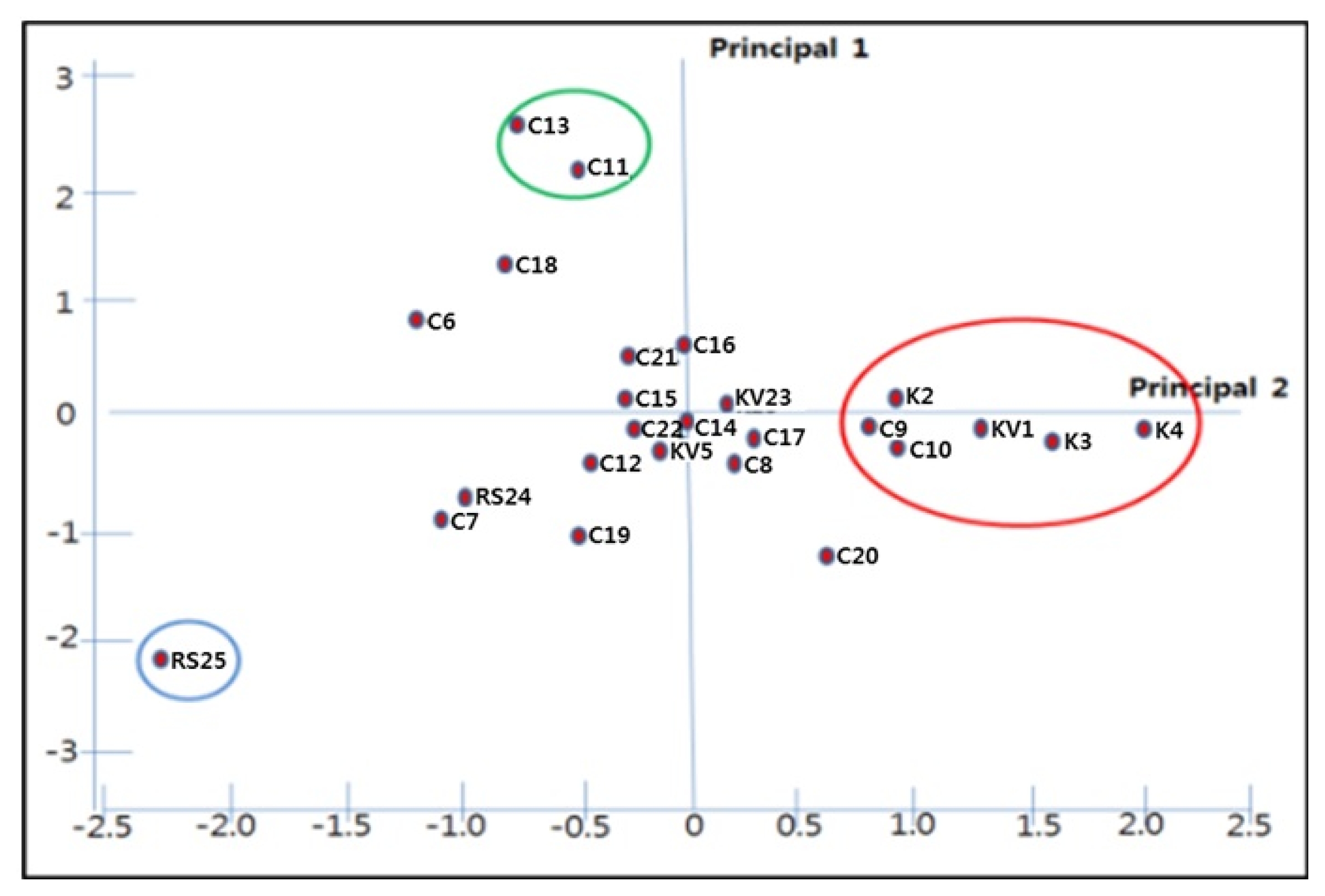
Fig. 3Dendrogram for cluster analysis of 25 jujube cultivars based on quantitative morphological data.
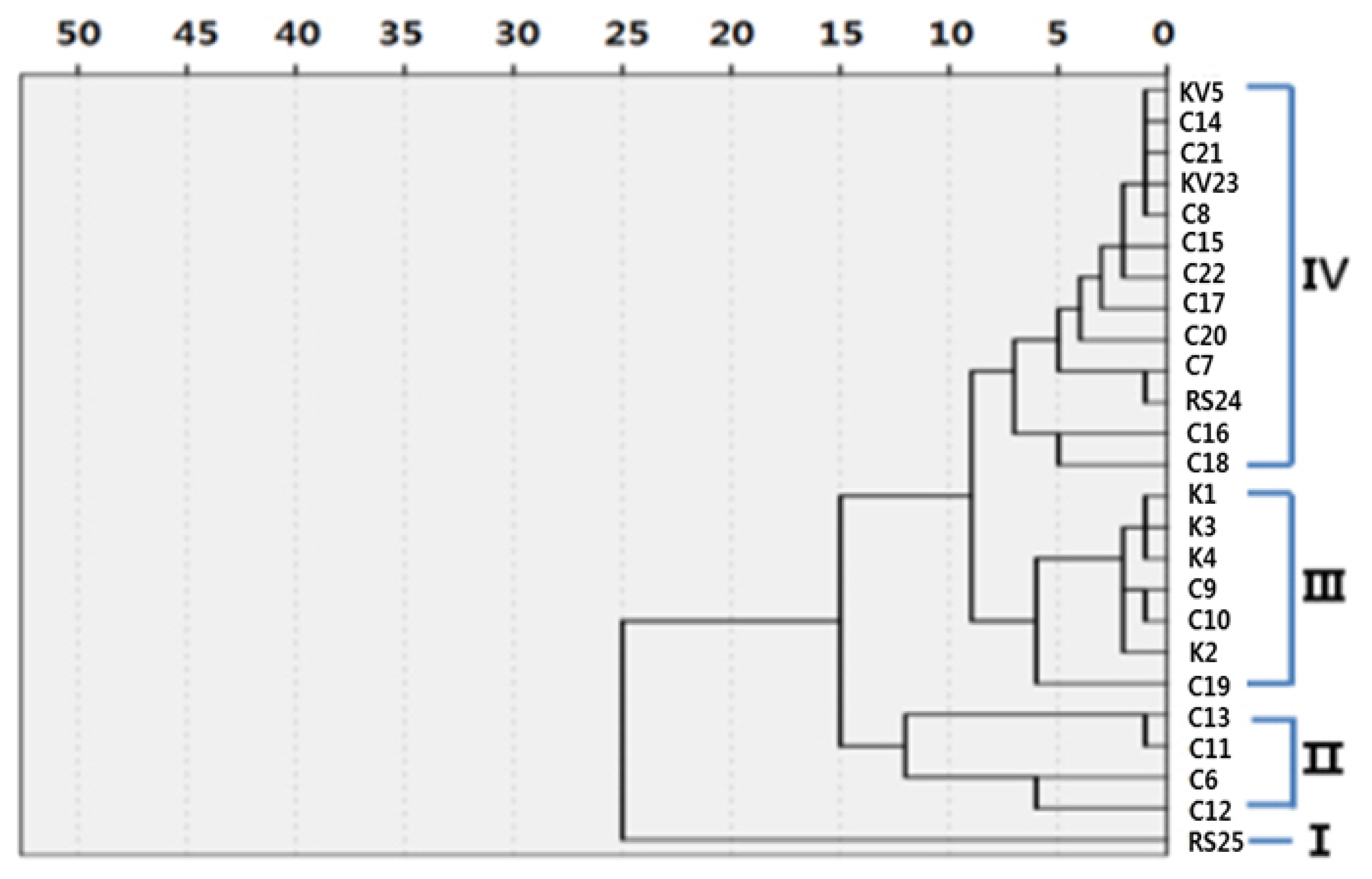
Table 1Cultivars name and their source used in this study.
Table 1
|
No. |
Common name |
Source |
Codez)
|
No. |
Common name |
Source |
Code |
|
1 |
Bokjo |
Korea |
KV1 |
14 |
Jinsixiaozao |
China |
C14 |
|
2 |
Mudeung |
Korea |
K2 |
15 |
Zhongyangmuzao |
China |
C15 |
|
3 |
Wolchul |
Korea |
K3 |
16 |
Sandonglizao |
China |
C16 |
|
4 |
Geumseong |
Korea |
K4 |
17 |
Xiaolizao |
China |
C17 |
|
5 |
Boeundaechu |
Korea |
KV5 |
18 |
Dongzao |
China |
C18 |
|
6 |
Dalizao |
China |
C6 |
19 |
Jinsi No. 3 |
China |
C19 |
|
7 |
Huizao |
China |
C7 |
20 |
Jinsi No. 4 |
China |
C20 |
|
8 |
Pozao |
China |
C8 |
21 |
Yuanling No. 1 |
China |
C21 |
|
9 |
Panzao |
China |
C9 |
22 |
Yuanling No. 2 |
China |
C22 |
|
10 |
Zanhuangdazao |
China |
C10 |
23 |
Chuncheon 7 |
Korea |
KV23 |
|
11 |
Dabailing |
China |
C11 |
24 |
Sour jujube 1 |
China |
RS24 |
|
12 |
Damaya |
China |
C12 |
25 |
Sour jujube 2 |
China |
RS25 |
|
13 |
Daguazao |
China |
C13 |
|
|
|
|
Table 2List of 10 qualitative characteristics of jujube cultivars for phenetic analysis in this study.
Table 2
|
No. |
|
Trait |
Abbreviation |
Unit |
|
1 |
Growth |
Bud burst time |
BBT |
Code (3-early; 5-mid; 7-late) |
|
2 |
|
Flowering time |
FLT |
Code (3-early; 5-mid; 7-late) |
|
3 |
|
Fructification time |
FRT |
Code (3-early; 5-mid; 7-late) |
|
4 |
|
Spikes form |
SF |
Code (1-present; 2-absent) |
|
5 |
Leaf |
Leaf color (upper side) |
LCU |
RHS Color Chart group and codez)
|
|
6 |
|
Leaf color (lower side) |
LCL |
RHS Color Chart group and code |
|
7 |
|
Leaf shape |
LS |
Code (3-elliptical; 5-ovalness; 7-oblong) |
|
8 |
|
Serra shape |
SS |
Code (1-entire; 3-serrate; 5-biserrate) |
|
9 |
Fruit |
Fruit shape |
FS |
Code (1-round; 2-round oblate; 3-ovalness; 4-oblong; 5-elliptical) |
|
10 |
Stone |
Stone shape |
STS |
Code (3-round; 5-ovate; 7-fusiform) |
Table 3List of 15 quantitative characteristics of jujube cultivars for phenetic analysis in this study.
Table 3
|
No. |
|
Trait |
Abbreviation |
Unit |
|
1 |
Leaf |
Leaf length |
LL |
mm |
|
2 |
|
Leaf width |
LW |
mm |
|
3 |
|
Petiole length |
PL |
mm |
|
4 |
|
Leaf area |
LA |
cm2
|
|
5 |
|
Terminal leaf length |
TLL |
mm |
|
6 |
|
Terminal leaf width |
TLW |
mm |
|
7 |
|
Terminal petiole length |
TPL |
mm |
|
8 |
|
Terminal leaf area |
TLA |
cm2
|
|
9 |
Fruit |
Fruit length |
FL |
mm |
|
10 |
|
Fruit width |
FWI |
mm |
|
11 |
|
Flesh index of fruitz)
|
FIF |
g |
|
12 |
|
Fruit weight |
FWE |
g |
|
13 |
Seed |
Stone length |
SL |
mm |
|
14 |
|
Stone width |
SWI |
mm |
|
15 |
|
Stone weight |
SWE |
g |
Table 4Representative characteristics of 25 jujube cultivars in the related qualitative traits.
Table 4
Cultivar
code |
Traitz)
|
|
|
BBT |
FLT |
FRT |
SF |
LCU |
LCL |
LS |
SS |
FS |
STS |
|
KV1 |
5 |
5 |
7 |
0 |
Green 137Ay)
|
Green 138A |
3 |
2 |
4 |
7 |
|
K2 |
5 |
5 |
7 |
0 |
Green 139A |
Green 147B |
5 |
2 |
4 |
7 |
|
K3 |
5 |
5 |
7 |
0 |
Green 137A |
Green 147B |
5 |
2 |
4 |
7 |
|
K4 |
5 |
5 |
7 |
0 |
Green 137B |
Green 147B |
5 |
2 |
4 |
7 |
|
KV5 |
5 |
5 |
5 |
0 |
Green 137A |
Green 147B |
5 |
2 |
3 |
5 |
|
C6 |
7 |
7 |
7 |
0 |
Green 137A |
Green 147B |
7 |
2 |
3 |
5 |
|
C7 |
5 |
5 |
5 |
1 |
Green 139B |
Green 137C |
7 |
2 |
4 |
7 |
|
C8 |
5 |
5 |
3 |
0 |
Green 137A |
Green 147B |
3 |
2 |
3 |
7 |
|
C9 |
5 |
5 |
5 |
1 |
Green 137A |
Green 138A |
3 |
2 |
4 |
7 |
|
C10 |
3 |
3 |
5 |
0 |
Green 137A |
Green 147B |
5 |
2 |
4 |
5 |
|
C11 |
3 |
5 |
5 |
0 |
Green 139B |
Green 138A |
5 |
2 |
5 |
5 |
|
C12 |
5 |
5 |
5 |
0 |
Green 137A |
Green 147B |
5 |
2 |
2 |
7 |
|
C13 |
5 |
5 |
3 |
0 |
Green 137A |
Green 147B |
3 |
2 |
5 |
5 |
|
C14 |
5 |
5 |
5 |
1 |
Green 137A |
Green 147B |
3 |
2 |
3 |
7 |
|
C15 |
3 |
3 |
5 |
0 |
Green 137A |
Green 138A |
3 |
2 |
3 |
7 |
|
C16 |
7 |
7 |
7 |
1 |
Green 137A |
Green 147B |
3 |
2 |
3 |
7 |
|
C17 |
5 |
7 |
7 |
1 |
Green 137A |
Green 147B |
3 |
2 |
4 |
7 |
|
C18 |
5 |
7 |
7 |
0 |
Green 137A |
Green 147B |
3 |
2 |
5 |
7 |
|
C19 |
5 |
5 |
5 |
0 |
Green 137B |
Green 147B |
3 |
2 |
3 |
7 |
|
C20 |
5 |
3 |
5 |
1 |
Green 137A |
Green 138A |
3 |
2 |
3 |
7 |
|
C21 |
5 |
5 |
5 |
0 |
Green 137A |
Green 137C |
3 |
2 |
4 |
7 |
|
C22 |
7 |
5 |
5 |
0 |
Green 139B |
Green 137C |
3 |
2 |
5 |
7 |
|
KV23 |
5 |
3 |
5 |
0 |
Green 137A |
Green 137C |
3 |
2 |
4 |
7 |
|
RS24 |
3 |
3 |
3 |
1 |
Green 137B |
Green 147B |
3 |
2 |
4 |
7 |
|
RS25 |
3 |
3 |
3 |
1 |
Green 137B |
Green 147B |
7 |
2 |
3 |
5 |
Table 5Mean values of leaf related quantitative characteristics in 25 jujube cultivars.
Table 5
Cultivar
code |
Traitz)
|
|
|
LL |
LW |
PL |
LA |
TLL |
TLW |
TPL |
TLA |
|
KV1 |
66.03bcy)
|
35.18b |
7.16b |
16.84c |
50.40bc |
24.72b |
4.49cd |
10.41b |
|
±6.58 |
±5.63 |
±1.37 |
±2.56 |
±5.63 |
±3.08 |
±0.71 |
±2.16 |
|
K2 |
62.16de |
30.51d |
6.11cde |
16.76c |
50.57bc |
22.79c |
5.28a |
9.10c |
|
±5.02 |
±4.29 |
±0.96 |
±2.84 |
±5.70 |
±4.13 |
±0.87 |
±1.37 |
|
K3 |
66.08bc |
35.60b |
6.37bcd |
18.38b |
52.57ab |
27.31a |
4.52cd |
10.87b |
|
±5.89 |
±3.52 |
±0.48 |
±3.25 |
±5.44 |
±2.63 |
±0.48 |
±2.14 |
|
K4 |
68.62ab |
38.28a |
6.88bc |
22.42a |
53.95a |
27.77a |
5.01a |
12.11a |
|
±7.53 |
±3.64 |
±1.05 |
±3.94 |
±5.51 |
±3.52 |
±1.04 |
±1.68 |
|
KV5 |
54.68gh |
29.61d |
5.38ef |
12.97fg |
38.61hi |
20.18fgh |
3.52hijk |
7.00fgh |
|
±4.85 |
±3.06 |
±1.72 |
±1.83 |
±5.30 |
±2.52 |
±1.24 |
±1.41 |
|
C6 |
56.98fgh |
23.68jk |
8.57a |
10.33jk |
33.77l |
14.20k |
3.19kl |
5.12jkl |
|
±6.88 |
±2.96 |
±1.39 |
±1.71 |
±6.13 |
±1.95 |
±0.71 |
±0.33 |
|
C7 |
50.63ij |
22.25k |
5.72def |
9.12l |
33.96kl |
14.01k |
4.23def |
4.69l |
|
±4.95 |
±1.13 |
±0.54 |
±1.02 |
±2.52 |
±2.26 |
±0.35 |
±0.62 |
|
C8 |
57.52fg |
28.70def |
5.44def |
11.93ghi |
44.93de |
21.14def |
4.26de |
6.65ghi |
|
±2.16 |
±2.16 |
±0.65 |
±0.95 |
±4.13 |
±0.87 |
±0.66 |
±0.55 |
|
C9 |
63.79cd |
33.22c |
5.74def |
15.56d |
49.69c |
22.32cd |
3.77ghij |
7.69e |
|
±4.08 |
±3.04 |
±1.87 |
±1.66 |
±3.87 |
±2.98 |
±0.62 |
±1.32 |
|
C10 |
65.19c |
34.28bc |
4.98f |
16.61c |
42.75efg |
25.75b |
3.42jkl |
8.27d |
|
±5.45 |
±3.02 |
±1.15 |
±3.07 |
±4.10 |
±2.08 |
±0.52 |
±0.92 |
|
C11 |
59.68ef |
30.14d |
6.69bc |
12.29gh |
41.63fg |
19.04h |
4.40cde |
6.17i |
|
±5.24 |
±1.79 |
±0.70 |
±1.48 |
±1.79 |
±1.09 |
±0.31 |
±0.41 |
|
C12 |
70.29a |
25.90ghj |
8.26a |
14.65de |
46.30d |
15.60j |
4.71bc |
5.00jkl |
|
±3.23 |
±2.78 |
±1.12 |
±1.48 |
±3.40 |
±0.70 |
±0.77 |
±0.54 |
|
C13 |
57.20fgh |
26.82gh |
6.77bc |
14.08e |
35.40jkl |
15.99ij |
3.53hijk |
5.29jkl |
|
±2.93 |
±1.43 |
±1.08 |
±1.63 |
±3.73 |
±1.56 |
±0.34 |
±0.60 |
|
C14 |
53.96h |
29.25d |
5.30ef |
11.29hij |
40.45gh |
21.61cde |
4.07efg |
4.82kl |
|
±7.11 |
±3.17 |
±1.39 |
±1.86 |
±4.15 |
±3.16 |
±0.86 |
±0.82 |
|
C15 |
56.04gh |
24.52ij |
6.09cde |
11.40hij |
42.62efg |
17.023i |
3.73ghij |
6.22i |
|
±5.86 |
±1.44 |
±1.19 |
±1.40 |
±5.15 |
±1.653 |
±0.71 |
±0.45 |
|
C16 |
47.95ijk |
24.48ij |
3.05i |
12.41gh |
42.03fg |
20.18fgh |
2.19m |
7.05fgh |
|
±7.18 |
±4.10 |
±0.52 |
±2.93 |
±3.35 |
±3.51 |
±0.30 |
±1.52 |
|
C17 |
54.14h |
28.97de |
3.85hi |
10.72j |
43.67ef |
22.55c |
3.22kl |
7.20efg |
|
±7.86 |
±4.41 |
±0.75 |
±1.43 |
±5.86 |
±3.43 |
±0.41 |
±1.25 |
|
C18 |
46.49k |
22.78jk |
3.84hi |
12.77g |
36.48ijk |
15.72ij |
3.13l |
6.57hi |
|
±9.00 |
±5.22 |
±0.70 |
±1.87 |
±5.90 |
±2.91 |
±0.65 |
±0.83 |
|
C19 |
69.30a |
32.73c |
6.84bc |
19.02b |
52.13abc |
20.62efg |
4.60cd |
8.35d |
|
±4.51 |
±1.65 |
±0.73 |
±1.30 |
±4.24 |
±1.48 |
±0.63 |
±1.07 |
|
C20 |
47.75jk |
23.81jk |
3.98gh |
8.52l |
38.18hi |
16.84ij |
3.12l |
5.45jk |
|
±4.66 |
±2.12 |
±0.23 |
±0.79 |
±2.80 |
±1.82 |
±0.20 |
±0.30 |
|
C21 |
49.82ij |
29.20d |
4.81fg |
10.73j |
36.19jkl |
19.65gh |
3.84ghi |
5.32jkl |
|
±4.81 |
±2.14 |
±0.67 |
±1.23 |
±1.52 |
±1.31 |
±0.61 |
±0.75 |
|
C22 |
51.01i |
27.44efg |
4.92f |
11.13hij |
40.35gh |
20.21fgh |
3.48ijk |
5.52j |
|
±3.46 |
±1.73 |
±0.27 |
±1.11 |
±4.77 |
±1.01 |
±0.62 |
±0.76 |
|
KV23 |
55.69gh |
27.10fgh |
4.94f |
13.88ef |
40.40gh |
20.32efgh |
3.88fgh |
7.48ef |
|
±7.87 |
±4.84 |
±1.31 |
±2.88 |
±9.28 |
±1.73 |
±0.97 |
±1.46 |
|
RS24 |
56.38gh |
25.59hi |
4.90f |
9.54kl |
37.28ij |
16.48ij |
3.82ghi |
4.95jkl |
|
±2.62 |
±1.58 |
±0.82 |
±0.99 |
±4.40 |
±1.74 |
±0.42 |
±0.77 |
|
RS25 |
37.06l |
18.88l |
3.96gh |
5.70m |
26.51m |
12.48l |
2.24m |
2.97m |
|
±3.77 |
±2.21 |
±1.09 |
±1.20 |
±3.74 |
±0.79 |
±0.50 |
±0.69 |
|
Meanx)
|
57.87 |
28.89 |
5.73 |
13.64 |
42.91 |
20.24 |
3.89 |
7.06 |
|
±9.18 |
±5.40 |
±2.13 |
±3.95 |
±7.70 |
±4.51 |
±0.97 |
±2.29 |
Table 6Mean values of fruit and seed related quantitative characteristics in 25 jujube cultivars.
Table 6
Cultivar
code |
Traitz)
|
|
|
FL |
FWI |
FIF |
FWE |
SL |
SWI |
SWE |
|
KV1 |
37.28cdey)
|
27.11de |
12.11ef |
12.59fg |
21.66cde |
7.49ghij |
0.48k |
|
±2.41 |
±2.27 |
±2.79 |
±2.81 |
±1.46 |
±0.76 |
±0.09 |
|
K2 |
37.71bcd |
26.68de |
11.22fg |
11.84gh |
23.86a |
8.59de |
0.62efg |
|
±2.46 |
±2.44 |
±2.15 |
±2.15 |
±2.39 |
±0.59 |
±0.06 |
|
K3 |
35.31gh |
26.35ef |
10.56fghi |
11.11ghi |
22.13bcde |
7.63ghijk |
0.56ghij |
|
±4.04 |
±2.17 |
±2.50 |
±2.49 |
±2.17 |
±0.79 |
±0.10 |
|
K4 |
37.84bc |
26.58de |
11.82ef |
12.37fg |
22.66bc |
7.61ghijk |
0.55hij |
|
±3.61 |
±2.42 |
±3.05 |
±3.02 |
±2.16 |
±0.69 |
±0.11 |
|
KV5 |
31.00j |
25.34fg |
9.95ghi |
10.52hij |
19.17hi |
8.58de |
0.57fghi |
|
±2.95 |
±2.55 |
±3.42 |
±3.42 |
±1.43 |
±0.59 |
±0.12 |
|
C6 |
35.63fgh |
30.77c |
14.56d |
15.28d |
22.07bcde |
9.30c |
0.71d |
|
±4.21 |
±2.22 |
±2.89 |
±2.87 |
±2.89 |
±0.77 |
±0.12 |
|
C7 |
29.77jk |
20.78j |
5.82k |
6.28k |
19.46hi |
7.25k |
0.46k |
|
±2.87 |
±1.59 |
±1.66 |
±1.66 |
±1.45 |
±0.34 |
±0.02 |
|
C8 |
35.12gh |
26.32ef |
9.41hij |
9.88ij |
19.01i |
7.17k |
0.46k |
|
±2.62 |
±1.62 |
±1.75 |
±1.82 |
±2.15 |
±0.705 |
±0.07 |
|
C9 |
36.27efg |
27.21de |
11.09fg |
11.64gh |
21.23ef |
7.85ghij |
0.55hij |
|
±2.53 |
±3.83 |
±3.03 |
±3.07 |
±2.01 |
±0.94 |
±0.13 |
|
C10 |
33.43i |
27.82d |
10.99fgh |
11.53gh |
19.83ghi |
7.88ghi |
0.55hij |
|
±1.65 |
±1.57 |
±1.78 |
±1.77 |
±0.85 |
±0.59 |
±0.07 |
|
C11 |
38.80b |
37.17a |
22.02b |
23.21b |
22.46bcd |
11.06b |
1.19a |
|
±3.90 |
±3.66 |
±6.79 |
±6.85 |
±1.94 |
±1.57 |
±0.28 |
|
C12 |
34.45hi |
25.00g |
8.32j |
8.94j |
22.54bcd |
8.32ef |
0.62efg |
|
±2.19 |
±1.38 |
±1.45 |
±1.49 |
±1.14 |
±0.38 |
±0.05 |
|
C13 |
40.52a |
37.16a |
26.85a |
27.87a |
21.61de |
10.70b |
1.02c |
|
±2.73 |
±3.86 |
±6.83 |
±6.84 |
±1.85 |
±1.41 |
±0.23 |
|
C14 |
35.22gh |
27.06de |
11.91ef |
12.41fg |
19.97ghi |
7.51hijk |
0.50jk |
|
±1.94 |
±1.74 |
±1.92 |
±1.93 |
±0.95 |
±0.41 |
±0.05 |
|
C15 |
35.34gh |
23.61h |
10.69fghi |
11.30ghi |
22.70bcde |
8.58de |
0.63ef |
|
±2.08 |
±2.26 |
±0.54 |
±0.49 |
±0.99 |
±0.81 |
±0.15 |
|
C16 |
36.16efg |
27.48de |
13.08de |
13.75ef |
20.61fg |
9.03cd |
0.67de |
|
±2.29 |
±2.51 |
±3.23 |
±3.35 |
±3.00 |
±1.28 |
±0.21 |
|
C17 |
33.52i |
24.79g |
9.98ghi |
10.49hij |
20.09gh |
7.51hijk |
0.51ijk |
|
±2.25 |
±2.14 |
±2.22 |
±2.24 |
±1.24 |
±0.62 |
±0.07 |
|
C18 |
35.86efgh |
32.91b |
16.41c |
17.50c |
22.18bcde |
13.08a |
1.09b |
|
±2.95 |
±2.52 |
±3.12 |
±3.13 |
±1.12 |
±0.39 |
±0.14 |
|
C19 |
28.134 |
21.95i |
6.60k |
7.10k |
16.50j |
7.40jk |
0.50jk |
|
±2.60 |
±1.96 |
±1.74 |
±1.74 |
±2.09 |
±0.23 |
±0.07 |
|
C20 |
28.54kl |
21.98i |
6.83k |
7.12k |
16.87j |
6.368 |
0.290 |
|
±1.59 |
±1.24 |
±0.87 |
±0.87 |
±0.79 |
±0.16 |
±0.02 |
|
C21 |
36.16efg |
24.21gh |
9.16ij |
9.72ij |
21.23ef |
7.92fgh |
0.56ghij |
|
±1.99 |
±0.55 |
±1.32 |
±1.30 |
±1.99 |
±0.32 |
±0.08 |
|
C22 |
34.55hi |
31.17c |
14.09d |
14.71de |
20.09gh |
8.68de |
0.62efg |
|
±2.35 |
±1.10 |
±2.11 |
±2.08 |
±1.52 |
±0.24 |
±0.10 |
|
KV23 |
37.09cdef |
25.31fg |
11.28fg |
11.83gh |
24.58a |
7.43ijk |
0.55ghij |
|
±2.67 |
±0.48 |
±1.26 |
±1.26 |
±1.31 |
±0.64 |
±0.06 |
|
RS24 |
26.33m |
20.36j |
4.239 |
4.826 |
19.45hi |
8.67de |
0.59fgh |
|
±1.35 |
±0.23 |
±0.41 |
±0.43 |
±1.14 |
±0.66 |
±0.04 |
|
RS25 |
13.37n |
11.83k |
0.63m |
1.07m |
9.39k |
8.01fg |
0.44k |
|
±0.78 |
±0.82 |
±0.16 |
±0.19 |
±1.06 |
±1.28 |
±0.10 |
|
Meanx)
|
34.93 |
27.09 |
11.89 |
12.50 |
20.96 |
8.33 |
0.61 |
|
±4.05 |
±4.68 |
±5.43 |
±5.59 |
±2.63 |
±1.55 |
±0.23 |
Table 7Principal component analysis based on 15 quantitative characteristics for 25 jujube cultivars.
Table 7
|
Principal |
Total |
Eigenvalue Variance % |
Accumulate % |
|
PC1 |
5.755 |
38.367 |
38.367 |
|
PC2 |
3.936 |
26.238 |
64.605 |
|
PC3 |
1.284 |
8.558 |
73.163 |
Table 8Eigenvectors associated with the eigenvalues obtained from principal component analysis for 15 quantitative characteristics on 25 jujube cultivars.
Table 8
|
Characteristics |
PC1 |
PC2 |
PC3 |
|
Leaf length |
0.079 |
0.612
|
0.627
|
|
Leaf width |
0.054 |
0.786
|
0.267 |
|
Petiole length |
0.127 |
0.041 |
0.865
|
|
Leaf area |
0.161 |
0.759
|
0.282 |
|
Terminal leaf length |
−0.006 |
0.816
|
0.266 |
|
Terminal leaf width |
0.007 |
0.898
|
−0.091 |
|
Terminal leaf petiole length |
0.023 |
0.464
|
0.621
|
|
Terminal leaf area |
0.053 |
0.845
|
0.038 |
|
Fruit length |
0.732z)
|
0.460
|
0.018 |
|
Fruit width |
0.903
|
0.189 |
0.038 |
|
Flesh index of fruit |
0.933
|
0.087 |
−0.023 |
|
Fruit weight |
0.940
|
0.077 |
−0.017 |
|
Stone length |
0.572
|
0.357 |
0.183 |
|
Stone width |
0.716
|
−0.334 |
0.120 |
|
Stone weight |
0.794
|
−0.206 |
0.149 |
References
- Adams R, Adams M, Willens A, Willerns G. 1978. Dry lands, man and plants. Architectural Press. London, U.K: pp. 152.
- Bal JS. 1992. Identification of ber (Ziziphus mauritiana L.) cultivars through vegetative and fruit characters. Acta Hortic. 317: 245-253.
- Bazzaz FA, Chiarielli NR, Coley PD, Pitelka LF. 1987. Allocation resources to reproduction and defense. Bio-Science. 37: 58-67.
- Dagar JC, Singh G, Singh NT. 2001. Evaluating forest and fruit trees for rehabilitation of semiarid alkali-sodic soils in India. Arid Land Res Manag. 15: 115-133.
- Hartley SE, Jones CG. 1997. Plant chemistry and herbivory, or why the world is green. pp. 284-324. Crawley MJ, editor. Plant ecology. Blackwell. Oxford.
- Haukioja E. 1990. Induction of defenses in trees. Annu Rev Entomol. 36: 25-42.
- Hebbara M, Manjunatha MV, Patil SG, Patil DR. 2002. Performance of fruit species in saline-waterlogged soils. Karnataka Journal of Agricultural Sciences. 15: 94-98.
- Hedren M. 2002. Patterns of allozyme and morphological differentiation in the Carex flava complex (Cyperaceae) in Fennoscandia. Nor J Bot. 22: 257-301.
- Herms DA, Mattson WJ. 1992. The dilemma of plants: to grow or defend. Quart Rev Biol. 67: 283-325.
- Jones DA. 1998. Why are so many food plants cyanogenic? Phytochemistry. 47: 155-162.
- Karban R, Myers JK. 1989. Induced plant responses to herbivory. Annu Rev Ecol Evol Syst. 20: 331-348.
- Liu MJ, Cheng CY. 1995. A taxonomic study of the genusZiziphus. Acta Hortic. 390: 161-165.
- Massei G, Hartley SE. 2000. Disarmed by domestication? Induced responses to browsing in wild and cultivated olive. Oecologia. 122: 225-231.
- Pratt DB, Clark LG. 2004. Amaranthus rudis and A. tuberculatus, one species or two? J Torrey Bot Soc. 128: 282-296.
- Qu ZZ, Wang YH. 1993. Chinese fruit trees record Chinese jujube. The Forestry Publishing House of China. Beijing, China: pp. 33-37.
- Rosenthal JP, Dirzo R. 1997. Effects life history, domestication and agronomic selection on plant defence against insects: evidence for maize and wild relative. Evol Ecol. 11: 337-355.
- Small E. 1996. Adaption to herbivory in alfalfa (Medicago sativa). Can J Bot. 74: 807-822.
- Smith JSC, Smith OS. 1992. Fingerprinting crop varieties. Adv Agron. 47: 85-140.
- Sneath PHA, Sokal RR. 1973. Numerical taxonomy. W.H. Freeman and Company. San Francisco, California, USA: pp. 230-234.
- Sneath PHA. 1995. Thirty years of numerical taxonomy. Syst Biol. 44: 281-298.
- Von Maydell HJ. 1986. Trees and shrubs of the sahel: Their characteristics and uses. GT2. Eschborn, Germany: pp. 525.