Abstract
Synthetic B. napus was produced through interspecific hybridization between nine varieties of B. rapa and only one exotic variety of B. oleracea var. alboglabra along with exogenous application of gibberellic acid (GA3) before pollination. A total of eighteen crosses including their reciprocals were made between the two species. Crossability in both way directions between the two species of Brassica was not equally success. The degree of success was significantly influenced by maternal genotypes. On average, the cross success was 8.42% when the varieties of B. rapa used as female parents in contrast to 2.88% when B. rapa used a pollen parents. Among the four concentrations (25, 50, 75 and 100 ppm) of GA3, 75 ppm gave highest response for different crossability characters in both way cross directions. The hybrids contained 19 somatic chromosomes which were the sum of the gametic chromosome number of B. rapa and B. oleracea. Of the two methods, followed to induce chromosome doubling in the adult plants, the Modified Injection Method was found more effective than the Cotton Plug Method. Among different concentration of colchinine 0.20% gave the highest success (66.67%) of chromosome doubling in the hybrids. All the colchiploid (C1) plants contained 38 chromosomes in their somatic cells which were the sum of the somatic chromosomes of both species. The genomes of resynthesized lines were also identified through Brassica genome specific SSR markers. The presence of markers for both A and C genome was detected in resynthesized lines suggesting that their genomic constitution was AACC.
-
Key words: Interspecific hybrids, Crossability, Chromosome doubling, Molecular marker
INTRODUCTION
Rapeseed
B. napus is a member of the
Brassicaceae family grown for the production of vegetable oil for human consumption, animal feed and biodiesel. Rapeseed and mustard play an important role of edible vegetable oil supply of the world after soybean and palm. About 15% of the world’s edible oil comes from rapeseeds (FAOSTAT,
http://www.fao.org/faostat/en/#home).
Brassica napus (AACC, 2n = 38) evolved in nature through hybridization between
B. rapa (AA, 2n = 20) and
B. oleracea (CC, 2n = 18) (U 1935). It is believed that the southwest European Mediterranean region, where the wild forms of the two parental species still exists was one of the places, where this hybridization event occurred (
Prakash and Hinata 1980). Cytogenetic studies in 1960s have provided evidence that the three
Brassica genomes, A of
B. rapa, B of
B. nigra and C of
B. oleracea, gave the emergence of secondary polyploids, originating from a genome with a lower number of chromosomes (
Röbbelen 1960). Recent studies using DNA based molecular markers provided further insight into these three genomes. It is well established today that the two diploid genomes of
B. napus, the A of
B. rapa and C of
B. oleracea, evolved from a common progenitor through genome duplication, chromosome fission, fusion and rearrangements (
Lagercrantz and Lydiate 1996;
Lagercrantz 1998;
Chatterjee et al. 2016). Traditional as well as molecular cytogenetic analysis demonstrated that a high level of chromosome homoeology exists between the A and C genomes, while the B genome is more distinct from these two genomes (
Attia and Röbbelen 1986;
Attia et al. 1987;
Mason et al. 2010;
Chatterjee et al. 2016). Therefore, these two diploid species can be used as genetic resources for the resynthesis of
B. napus.
Resynthesized
B. napus provides various gene sources from
B. rapa and
B. oleracea but also potential germplasm for utilization in rapeseed breeding (
Kraling 1987). Artificial polyploidization of an interspecific hybrid offers chromosome doubling and evolves new crop plants in short time which might be a novel avenue for restore fertility to
Brassica breeding (
Leitch and Bennet 1997; Wright
et al. 1998). In the various breeding programmes, resynthesized
B. napus with characteristics of earliness (Akbar 1989;
Malek et al. 2012;
Schranz and Osborn 2000), yellow seed color (
Rahman 2001), low linolenic acid (
Heath and Elizabeth 1997), attrazine resistance and male sterility (Jourdan
et al. 1989) and self-incompatibility (Rahman 2004a), were reported for broadening the genetic base in
B. napus (
Becker et al. 1995; Jesske et al, 2011), as well as to fix the heterotic effect arising from interaction between alleles from the two genomes (
Abel et al. 2005) were also suggested.
Resynthesized
B. napus lines with 2-4.6 times and F
1 hybrids crossed with cultivated
B. napus, also produced 1.6-3.7 higher yields as compared to short duration
B. napus cultivars (
Karim et al. 2014). Different parental combinations for synthesis of
B. napus L. will enhance new variability in germplasm which could be exploited for improvement of the crop. Before going to the resynthesis of
B. napus L, it is necessary to study the cross ability between the species
B. rapa and
B. oleracea as influenced by their cytoplasm and nuclear genome. Depending on the cross direction, synthetic
B. napus L. may carry the cytoplasm of
B. oleracea or
B. rapa L. In addition, the presence of either the
B. oleracea or the
B. rapa cytoplasm in
B. napus L. has been reported to affect agronomical important traits of crop (
Nour et al. 2013). However, to date a little is known about the cytoplasmic effects and genetic diversity of synthetic
B. napus L. So, considering the above facts, the present study were carried out to check the crossability of different varieties of
B. rapa those are well adapted in Bangladesh and exotic genotype of
B. oleracea var.
alboglabra, and also produce synthetic interspecific hybrids using chromo-some doubling techniques and finally confirm the hybrids through morphological, cytological and molecular studies for the germplasm enhancement and yield improvement of rapeseed mustard.
MATERIALS AND METHODS
Plant materials
There were a total of nine varieties of
B. rapa of which six were from yellow sarson group, two from brown sarson and one from toria ecotype. On other hand, one exotic variety from
B. oleracea var.
alboglabra was used in crossing programme. The seeds of the different varieties of
B. rapa were collected from Bangladesh Institute of Nuclear Agriculture (BINA), Bangladesh Agricultural Research Institute (BARI) and Bangladesh Agricultural University (BAU), Bangladesh and the seeds of
B. oleracea var. Alboglabra-1 were collected from the Institute of Agronomy and Plant Breeding (IAPB), Gottingen Unive-rsity, Germany. A set of crosses were made between the varieties of
B. rapa and
B. oleracea var.
alboglabra using the varieties of
B. rapa as female parent. Again another set were made using
B. oleracea var.
alboglabra as a female parent and the varieties of
B. rapa as pollen parents. List of the varieties with some characteristics are shown in the
Table 1.
A total of 18 (eighteen) interspecific cross and reciprocal cross-combinations were made. List of the cross-com-binations are shown in the
Table 2. To overcome the interspecific pre-fertilization barrier, gibberellic acid was sprayed during anthesis period @ 0, 25, 50, 75 and 100 ppm concentration on flower buds one day before emasculation in the afternoon by using a hand sprayer. Emasculation and pollination was followed by bagging with the thin brown paper bags and labelled with tags. Achieving the proper maturation of siliqua F
1 hybrids were harvested and after proper drying the seeds were stored in the refrigerator for the use of next winter season. Interspecific
B. hybrids were confirmed through cytological and pollen fertility charac-teristics.
Seeds of true hybrid (AC) after confirmation were grown in the field and treated with colchicine in the field condition on growing shoots and buds of young adult plants and also on sprouting seeds in the laboratory condition. Two different methods; a) Modified Injection Method (MIM) b) Cotton plug Method (CPM) were followed to induce chromosome doubling of the hybrids plants. The three concentrations of colchicine such as 0.10%, 0.15% and 0.2% were used both in MIM and CPM. Germinating seeds of five crosses were also treated with colchicine using 0.125%, 0.25% and 0.50% aqueous solutions over moist filter paper. Finally MS medium was used as a basal medium for regeneration of plants using root as explants and IBA for acceleration of roots. Number of somatic chromosome was confirmed using cytological studies. The presence of A and C genome in resynthesized lines were confirmed using Brassica genome specific SSR markers (
Yan et al. 2014) shown in
Table 3. Genomic DNA was extracted from young fresh leaves of 15 days old seedling of both parent and resynthesized lines using CTAB method (
Saghai-Maroof et al. 1984;
Rahman et al. 2007) with some modifications. After quantification PCR was performed in an oil-free thermal cycler (Master Cycler Gradient, Eppendorf). PCR amplification procedure was as follows: denaturation at 94℃ for 3 minutes; 32 cycles of denaturation at 94℃ for 45 seconds, annealing for 45 seconds and extension at 72℃ for 35 seconds; and extension at 72℃ for 6 minutes at last. The amplified products were separated electrophoretically on 2% agarose gel and DNA bands were observed under UV light on a UV transilluminator using gel documentation system to observe DNA and photographed by gel documentation system for documen-tation. The bands representing particular alleles at the microsatellite loci were scored manually and designated the bands as A or C from the top to the bottom of the gel. The genotypes of different strains were scored as AA or CC. A single genotypic data matrix was constructed for all loci. The software DNA FRAG version 3.03 [5] was used to estimate marker length and allelic length.
Data were recorded on number of flower buds crossed, siliqua formed, developed siliquae with seeds, total pollen grains, viable pollen grains, sterile pollen grains and percentage of pollen fertility.
Statistical analysis
The data on the above parameters were taken in percent. In order to normalize the distributions, all the data were transformed by arcsin transformation and analysis of variance was done for all the different parameters under study using the mean values (Singh and Choudhury 1985). Duncan’s Multiple Range Test (DMRT) was performed for all the characters to test the significant differences among the means of the genotypes and also the treatments following
Steel and Torrie (1960).
RESULTS
Crossability between the Species of B. rapa and B. oleracea
Crosses were made between the nine varieties of
B. rapa and an exotic genotype of
B. oleracea var.
alboglabra. The crossing programme includes both crosses and their reciprocals using the varieties of
B. rapa as female parents in one set and also as male parents in another set. As crosses were attempted at interspecific level sometimes pre- or post- or both pre and post fertilization barriers become operative bringing the poor success in crosses. Gibberellic acid (GA
3) in different concentrations were used for breaking the fertilization barrier to get a good success in the crossing programme. Analysis of variance showed that there were significant variations among the crosses for siliquae setting (%), cross success (%), seeds per pollinated flower (%) and seeds per siliqua (%) (
Supplementary Table S1, S2). Application of GA
3 in different concentrations (0, 25, 50, 75 and 100 ppm) influenced significantly all characters. The interaction between the genotypes and concentrations of GA
3 also had significant effects on these characters (
Supplementary Table S1, S2). The mean performances of the crosses using the
B. rapa varieties as female parents are presented in the
Table 4 as there was a single male parent
B. oleracea var. Alboglabra-1. The female parents Safal, Binasarisha-6 and Sampad belonging to the
B. rapa set significantly higher number of siliquae per cross. The varieties Agrani, Safal, Binasarisha-6, Sampad, BARI Sarisha-14 and BARI Sarisha-6 showed significantly higher cross success over the all other varieties. The higher percentage of seeds were produced per pollinated flowers from the varieties Agrani, Safal, Binasarisha-6, Sampad, BARI Sarisha-14 and BARI Sarisha-6. Significantly higher percentage of seeds per siliqua were obtained from the female parents Agrani, Safal, Binasarisha-6, Sampad, and BARI Sarisha-14. Considering all these characters together, the female parents Binasarisha-6, Safal and Sampad ranked top among the other varieties for successful crosses. The mean performance of the crosses using the
B. rapa varieties as pollen parents are presented in the
Table 5. In these crosses, a single genotype
B. oleracea var. Alboglabra-1 was used as female parent. Significantly higher percentage of siliquae setting in the crosses involving varieties Binasarisha-6 and Sampad as pollen parent was noticed. For cross success (%), all the varieties of
B. rapa showed significantly higher success except BARI Sarisha-9. The varieties Binasarisha-6 and Sampad produced significantly higher number of seeds per pollinated flower and siliqua. Considering all these characters together, the pollen parents Binasarisha-6, and Sampad ranked top among the other varieties studied. Comparison of the
Tables 4 and
5 it appears that there was significant variation between the crosses and their reciprocals for the characters studied. In general, when the varieties of
B. rapa used as female parents produced higher number of siliquae per cross, cross success (%), seeds per pollinated flower (%) and seeds per siliquae (%). On average, the success of cross was 8.42% when the
B. rapa were used as female parents in contrast to 2.88% in their reciprocals.
Effects of application of GA
3 in different concentrations on different crossability characters showed significant variation among the treatments. The mean value for different characters increased with the increasing level of GA
3 from control (T
0) up to 100 ppm (T
4). The performance of the treatments range from 54.63 to 71.79% for siliquae setting 6.18 to 13.27% for cross success, 9.85 to 34.57% for seeds per pollinated flower and 17.69 to 44.88% for seeds per siliqua when
B. rapa varieties were used as female parents. Among the concentrations, 75 ppm conc. of GA
3 showed significantly higher values for all the crossability parameters over all other treatments. The effects of GA
3 on crossability of
B. oleracea and
B. rapa, when varieties of
B. rapa were used as pollen parents are shown in the
Supplementary Table S3. Mean values of different conc. of GA
3 on different crossability characters varied significantly. Siliqua setting, cross success, seeds per pollinated flower and seeds per siliqua of 9 crosses of
B. oleracea ×
B. rapa with pre-pollination hormonal treatments ranged from 27.75 to 40.62%, 2.20 to 4.10%, 2.66 to 15.69% and 9.16 to 30.92%, respectively. Again 75 ppm of GA
3 showed significantly higher response to all the crossability parameters over the other treatments (
Supplementary Table S3, S4)
The seeds obtained from nine interspecific crosses between the different genotypes of
B. rapa (2n = AA = 20) and
B. oleracea var.
alboglabra (2n = CC = 18) were examined to confirm their hybridity through counting of somatic chromosome number. Ten seeds from each cross combination were taken as a sample from the population. Somatic chromosomes counting from this hybrid root tips showed that chromosomes contained the seeds from the crosses contained the chromosome of both
B. rapa and
B. oleracea.
B. rapa contributed 10 gametic chromosome and
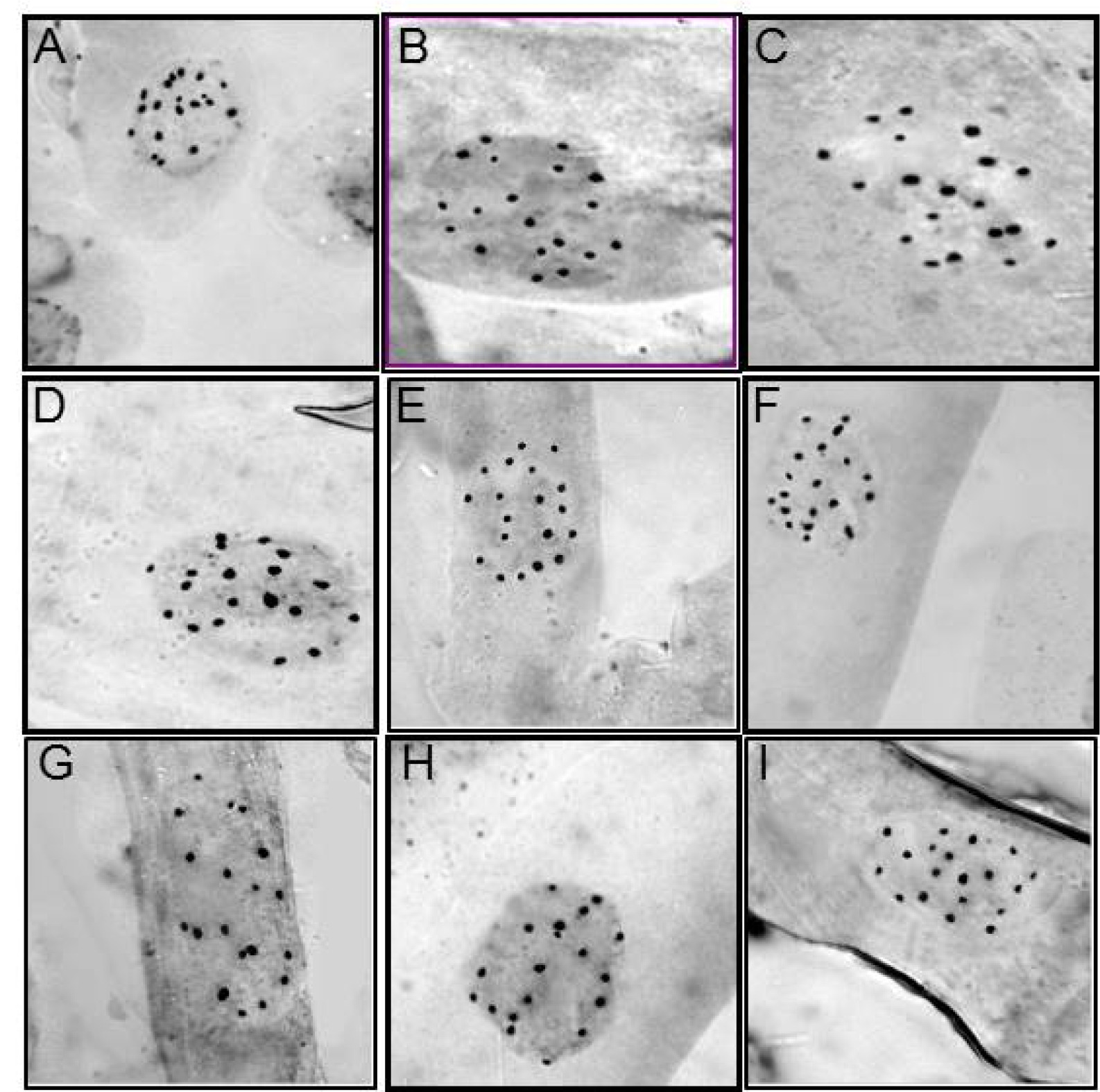
B. oleracea gave 9 gametic chromosomes making a total 19 in the all hybrids (
Fig. 1).
Colchicine in different concentrations was applied to the F
1 hybrid plants in two different methods for chromosome doubling. Analysis of variance for the crosses, concen-trations of colchicine, methods of application and their interactions have been shown in the
Supplementary Table S5. From the table it is observed that there were significant variations among the concentrations of colchicine, methods of application and interaction between concentrations and methods of application. In response to colchicine, the treated plants showed numerous variations. Generally, growth and development were strongly inhibited in the colchicine treated plants. In cotton plug method, growth and development was started after two or three weeks of treatment but in some cases, it was very slow or even no shoots emerged from the colchicine treated leaf axils. Among the treated leaf axils, some of the leaf axils were found to be injured and wounded and no shoots were emerged further. Effectiveness of colchicine treatments to induce chromosome doubling in the F
1 hybrids using cotton plug method are presented in the
Table 6. In total 256 F
1 plants were treated with different concentrations of colchicine and 110 plant survived. The number of plants those produced new shoots from treated leaf axils and viable seeds at maturity after colchicine treatments were considered as survived plants. The range of survival of the treated plants was from 25.00 to 70.00% with an average 42.97%. Production of colchiploid plants influenced by different cross combinations varied and ranged from 39.92 to 54.15%. Highest (54.15%) colchiploid plants were produced from the BARI Sarisha-6 × Alboglabra-1. Effectiveness of colchicine treatments to induce chromo-some doubling in the F
1 hybrids of different cross combinations using Modified Injection Method are presented in the
Table 7. In total 227 F
1 plants were treated with different concentrations of colchicine and 120 plant survived. The range of survival of the treated plants was from 33.33 to 80.00% with an average 52.86%. Production of colchiploid plants influenced by different cross combinations varied and ranged from 48.48 to 61.53%. The highest (61.53%) colchiploid plants were produced from the cross BARI Sarisha-12 × Alboglabra-1 (
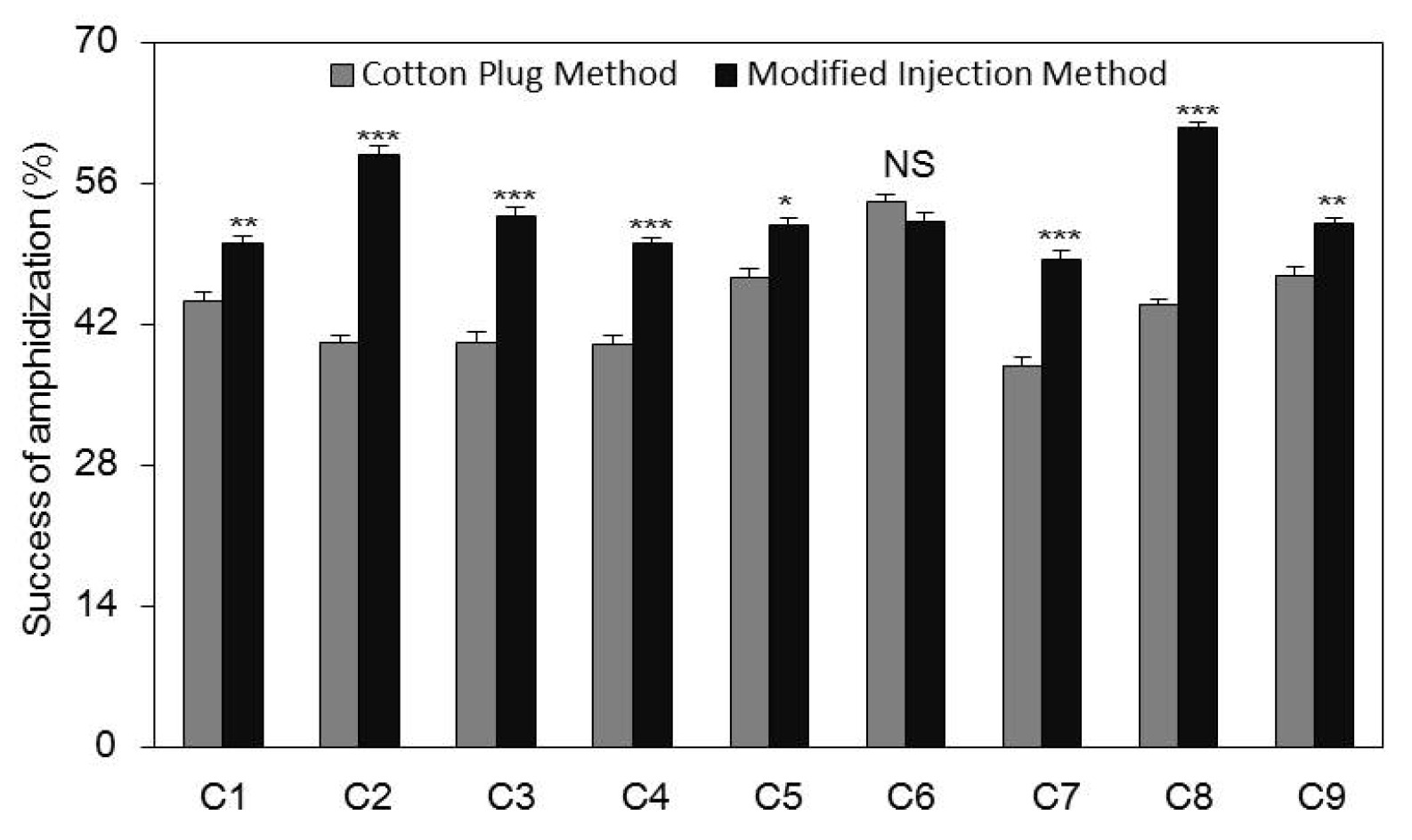
Table 7). The success of amphidization (%) was significantly high for modified injection method in compared to cotton plug method for all crosses except BARI Sarisha-6 × Alboglabra-1 (
Fig. 2) combination.
The seeds of colchiploid plants (C
1) from different cross combinations were examined to confirm their amphidi-ploidy through counting of somatic chromosome number from root tips cells. Ten seeds from each cross combination were taken as a sample from the C
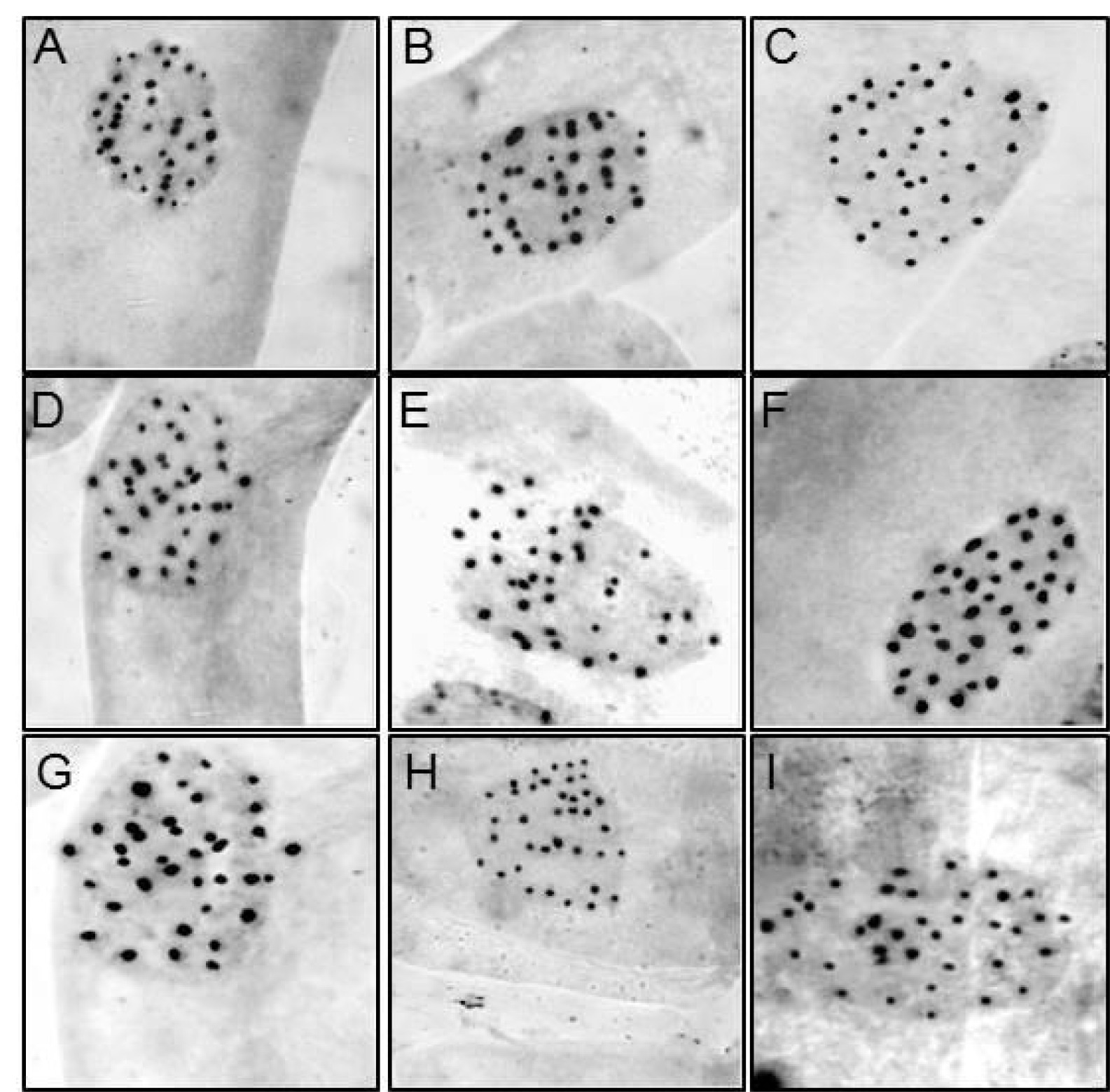
1 plants. The colchiploid plants were found to contain 38 somatic chromosomes in their somatic cells, which was the sum of the somatic chromosome number of
B. rapa and
B. oleracea (
Fig. 3)
Two primer of
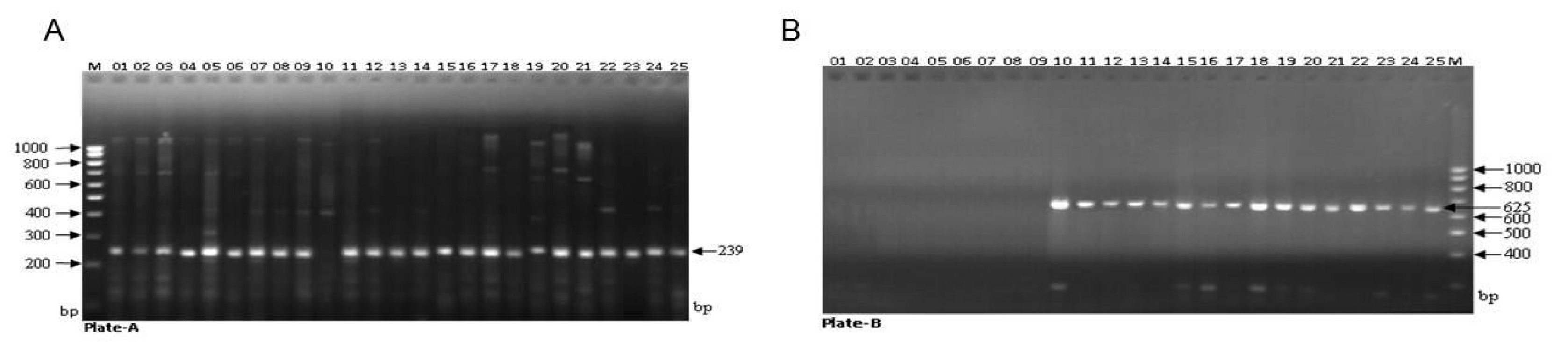
Brassica genome specific SSR markers were used to identify the genomes of 15 RS lines and 10 parental lines. The primer pair DA produced the expected target band only from the species with the genome A i.e., for
B. rapa species. The primer pair DC produced the expected target band only from the species with the genome C. Varieties from
B. rapa (1-9) did not produce any band but the variety
B. oleracea var.
alboglabra and all the RS lines produced band (
Fig. 4). Finally, it was concluded that all the produced
B. napus RS lines in the present study were true
B. napus bearing AACC genome.
DISCUSSION
Crossability between the varieties of B. rapa and B. oleracea var. alboglabra
The degree of success on interspecific crosses among the
Brassica species depends on the genomic relationship between the species crossed (Osipova and Zimina 1988). A high level of chromosome homoeology exists between the
B. rapa (A) and
B. oleracea (C) genomes, while the B genome of
B. nigra is more distinct from these two genomes (
Mason et al. 2010). This feature explains comparatively higher crossability success between
B. rapa and
B. oleracea. The success of interspecific crossing also depends on the choice of female parent in the cross. Often, the use of species with higher chromosome number as female increases the chance of success of the cross (
Downey et al. 1980). The effect of cytoplasm on crossability between the species
B. rapa and
B. oleracea also reported (
Lu et al. 2001).
Rahman (1981) reviewed the crossability among different species of
Brassica and reported that there are a number of species, where both way crosses were not equally successful. In the present experiment, interspecific crosses were attempted between the cultivated varieties of
B. rapa and an exotic variety of
B. oleracea var.
alboglabra for resynthesis of
B. napus. Therefore, it is important to consider the cross direction in interspecific hybridization. Nine crosses and their reciprocals were made to produce hybrid seeds from
B. rapa and
B. oleracea. All the crosses were successful, but the rate of interspecific hybrid seed production was not equal and varied with the combinations from 4.49% to 11.18%, with a mean 8.42% for the crosses with the varieties of
B. rapa used as the female parents. When the variety Alboglabra-1 of
B. oleracea was used as female parent in crosses with nine varieties of
B. rapa as pollen parents, the hybrid seed production rate decreased distinctly as compared to the crosses having
B. rapa varieties as female parents.
Lu et al. (2001) reported that the interspecific hybrid production rate (HPR) varied with the combinations from 0 to 76.9%, with a mean of 24.7% for the crosses with
B. rapa as the female parent and 6.9% for the crosses with
B. oleracea as female parent. So, it is clear that the degree of success in the interspecific crosses was significantly influenced by maternal genotype. Significant maternal influence on the interspecific crossability in
Brassica species was also noticed by other researchers. Zaman and Biswas (1987) reported the cross compatibility among the
Brassica species varied with species, direction of cross and also genotypes within the same species.
Takeda and Takahata (1988) reported that species containing A genome could be hybridized more easily with species of other genomes in
Brassica. Sarashima and Matsuzawa (1989) made crosses among diploid species of the U-triangle and found relatively higher cross-compatibility between
B. campestris and
B. oleracea and their reciprocals than crossability with other
Brassica species.
Diederichsen and Sacristan (1994) obtained 0.75 hybrids per pollination using
B. oleracea as the female parent and 0.89 hybrids per pollination using
B. rapa as the female parent.
Heath and Earle (1996) obtained 0.28 hybrids per pollination using
B. oleracea as the female parent.
Lu et al. (2001) obtained 0.07 hybrids per pollination using
B. oleracea as the female parent and 0.25 hybrids per pollination using
B. rapa as the female parent.
Malek et al. (2012) synthesized
B. napus by hybridization between its diploid progenitor species
B. rapa and
B. oleracea followed by chromosome doubling. Yingze
et al. (2003) observed that large difference in rate of hybrid formation among the different crosses and their reciprocals when crossed with
B. chinensis and
B. oleracea var.
alboglabra. The rate of hybrid formation was always higher when the varieties of
B. chinensis was used as maternal parents, but
Karim et al. (2014) found crossability in the crosses between the varieties of
B. rapa and
B. oleracea was 0% and its reciprocals was 0.3% through ovary culture.
Gibberellic acid had a distinct role for siliquae setting, cross success, seeds per pollinated flower and seeds per siliqua in both way of cross directions (
Wilson et al. 2008). This might be due to better germination of pollen, growing its tube and which consequently promoted fertilization activity of the pollen grains. In
B. rapa cytoplasm based interspecific crosses, siliqua setting increased up to 18.16%, crossability success up to 7.09%, seeds per pollinated flower up to 11.4% and seeds per siliqua increased up to 27.19% over the control. On the contrary, in
B. oleracea cytoplasm based interspecific crosses, siliquae setting increased up to 12.87%, cross ability success up to 1.9%, seeds per pollinated flower up to 13.03% and seeds per siliqua increased up to 21.76% over the control. And finally, there was poor germination of seeds of these crosses suggesting very poor crossability when
B. oleracea was used as female parents. Yingze
et al. (2003) found better seed set in the siliquae setting between the crosses of the species
B. chinensis and
B. oleracea var.
alboglabra as maternal parents treated with 50-60 ppm gibberellic acid.
Wilson et al. (2008) crossed among the species of
Lupinus with the application of hormonal mix at pre and post pollination treatments and found increased pod retention but did not increase seed set. But in the present study, pre-pollination hormonal treatments with GA
3 in the crosses and reciprocal crosses were increased in different crossability characters including seed set. Crossability with exogenous application of GA
3 between the species
B. rapa and
B. oleracea in both way cross directions were not equally success. Crossability success with exogenous application of GA
3 higher in
B. rapa cytoplasm-based crosses than
B. oleracea cytoplasm based crosses which might be due to the maternal genotypes used in the present hybridization programme.
The present cytological study revealed that chromosome association at metaphase-1 showed a homeology between the A and C genome. On other hand, presence of 19 chromosomes from two ancestors of
Brassica (A and C) suggests that recovery of
B. napus type plants are possible through the doubling of somatic chromosome. Half of the gametic chromosome number were also found in interspecific
Brassica F
1 hybrids crossed from
B. rapa and
B. oleracea reported by Inomata 1978.
Malek et al. (2012) made interspecific crosses between
B. rapa (n = 10) and
B. oleracea var.
alboglabra (n = 9) and studied in root tip cells of the F
1 hybrids and found chromosome number 19, which was half of the sum total of the somatic chromosome number of the two parental species. Malek (2007) made interspecific crosses between
B. rapa (n = 10) and
B. nigra (n = 8) and observed that chromosome number in root tip cells of the F
1 hybrids was 18, which was half of the sum total of the somatic chromosome number of their parents.
Zhang et al. (2004) using three varieties of
B. rapa, cv. Hauarad (accession 708), cv. Maoshan-3 (714) and cv. Youbai (715), as the maternal plants and one variety of
B. oleracea cv. Jingfeng-1 (6012) as the paternal plant. Crosses were made to produce interspecific hybrids through ovary culture techniques. Cytological studies showed that the chromosome number of all plants tested was 19 (the sum of both parents), indicating that these regenerated plants were all true hybrids of
B. rapa (n = 10) ×
B. oleracea (n = 9).
Chandra et al. (2004) produced interspecific hybrids between wild species,
B. fruticulosa (2n = 16, FF) and
B. rapa (2n = 20, AA) using sequential ovary culture and observed that the chromosomes F
1 hybrids was 2n = 18.
Sacristan and Gerdemann (1986) confirmed the hybridity in the F
1 hybrids of
B. napus and
B. juncea and
B. napus and
B. carinata through counting chromosome number taking sample from the hybrid population.
The present results showed the effects on chromosome doubling of interspecific
B. hybrids between
B. rapa and
B. oleracea with view to production of synthetic
B. napus by treating adult F
1 plants with colchicine. In response to the colchicine, the treated plants exhibited numerous variations. First of all, growth and development of colchicine treated plants were inhibited for a certain period in
Brassica interspecific hybrids which also reported by
Aslam et al. (1990). However, greater effect of colchicine was noticed over all concentrations in modified injection method than cotton plug method. Hoftman
et al. (1982) developed amphidiploid of
B. napus by applying colchicine solution in the hybrids with injection method and achieved a higher percentage of success rate of amphidiploid production than applying colchicine to leaf axils with cotton wool method.
Malek et al. (2013) synthesized
Brassica hexaploids from triploid hybrids of
B. rapa,
B. oleracea and
B. nigra by chromosome doubling with the use of colchicine and observed modified injection method was more effective than cotton plug method (
Fig. 2). On an average, the use of 0.10, 0.15 and 0.20% colchicine gave 36.4, 56.0 and 71.8% success in chromosome doubling by modified injection method compared to 27.4, 38.0 and 39.1% success by cotton plug method. Different methods of colchicine application having different rates of success to induce chromosomes doubling are also reported earlier and showed similarity with the present results (
Aslam et al. 1990;
Shi et al. 2002). In the present study the results also indicated that rates of chromosome doubling varied with the concentration of colchicine which was resembled with the results of other researchers (Swason
et al. 1989; Vyadilova
et al. 1993; Mohammadi
et al. 2011;
Malek et al. 2012). Among three colchicine treatments (0.10, 0.15 and 0.20%), 0.15% gave the highest success (86%) of chromosome doubling in the hybrids (AC; n = 19). Haploid embryos in the cotyledonary stage were treated with four colchicine concentrations 125, 250, 500 and 1000 mgL
−1 by Mohammadi
et al. (2011). He reported high doubling efficiency, 64.29 and 66.66% of regenerated plants which was obtained from 250 mg/L and 500 mg/L colchicine treatments respectively.
Genome or chromosome-specific markers are useful for monitoring genome introgression and for identification of genome components in
Brassica. According to the triangle of U (1935),
B. napus (AACC, 2n = 38) originated from
B. rapa (AA, 2n = 20) and
B. oleracea (CC, 2n = 18). Among the three genomes (A, B and C) of
Brassica species, a relatively close genetic relationship exists between the genomes A and C, while a relatively distant one between the genomes A and B and between the genomes B and C (
Aono et al. 2011). For this reason, the A- and C-genome components in
B. napus could not be clearly distinguished from one another using genomic
in situ hybridization (
Snowdon et al. 1997). But identification of A- and C-genome through genome-specific probes are more appropriate (
Xiong and Pires 2011). In such condition, single-locus SSR makers could be a good option to successfully identification of the genome A and C. In the present study, fifteen better performing RS lines those somatic chromosomes were counted earlier were used to identify their genome through genome specific SSR markers. For this purpose, two primers were used, one (Forward and reverse) for A genome and another for C genome detection. In the previous time,
Yan et al. (2014) used two specific primers for identification of A and C genomes of
Brassica. Results revealed that all the
B. napus RS lines were true
B. napus bearing both A and C genomes.
Hosaka et al. (1990) developed ten genome-specific probes from
Brassica napus and
B. oleracea genomic DNA libraries and used to confirm the parental diploid species originating the three amphidiploids,
B. napus,
B. carinata and
B. juncea. They suggested that genome-specific markers could separate these three genomes. Therefore, these RS lines were confirmedly
B. napus having AACC genomic composition. These fifteen resynthesized lines can be further evaluated in subsequent generations through selection of desirable genotypes having desirable traits for high yield potential, early maturity, and stress tolerance.
SUPPLEMENTARY MATERIALS
ACKNOWLEDGEMENTS
Bangladesh Agricultural Research Institute (BARI) and Bangladesh Institute of Nuclear Agriculture (BINA) for providing necessary research facilities. Department of Agricultural Extension, Ministry of Agriculture for awarding scholarship to Gour Gobindo das and research grants.
Fig. 1Somatic chromosome number (19) of F1 hybrids (AC) of B. rapa × B. oleracea crosses (A) Agrani × Alboglabra-1, (B) Binasarisha-6 × Alboglabra-1, (C) Safal × Alboglabra-1, (D) Sampad × Alboglabra-1, (E) BARI Sarisha-14 × Alboglabra-1, (F) BARI Sarisha-06 × Alboglabra-1 (G) BARI Sarisha-09 × Alboglabra-1, (H) BARI Sarisha-12 × Alboglabra-1, (I) Tori-7 × Alboglabra-1.
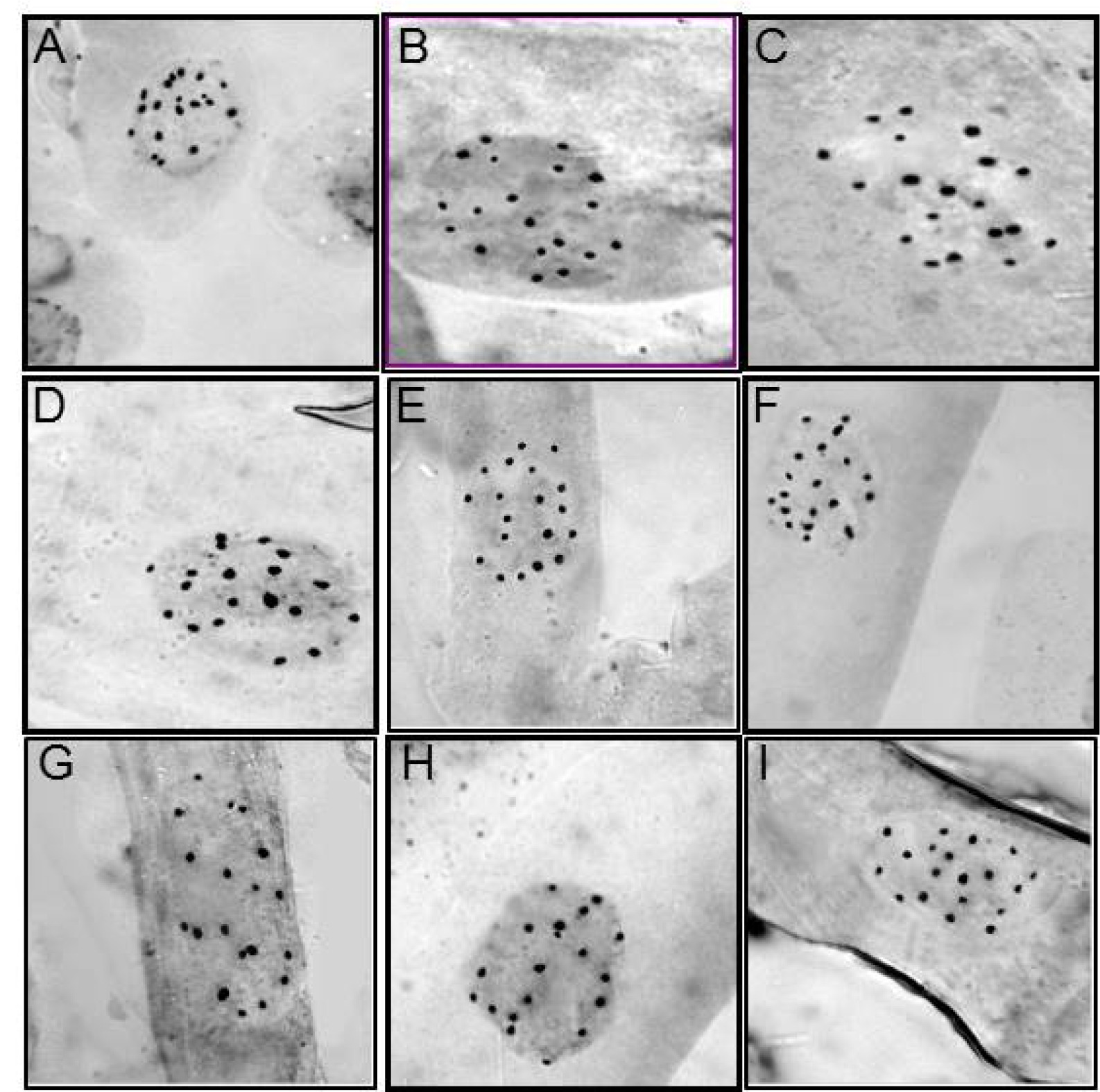
Fig. 2Comparison of efficiency between cotton plug and modified injection method to induce chromosome doubling in the F1’s of B. rapa and B. oleracea var. alboglabra crosses .The values indicate means ± SE. Asterisk indicates significant difference between cotton plug and modified injection method. *P < 0.05, **P < 0.01 and ***P < 0.001. C1: Agrani × Alboglabra-1, C2: Binasarisha-06 × Alboglabra-1, C3: Safal × Alboglabra-1, C4: Sampad × Alboglabra-1, C5: BARI Sarisha-14 × Alboglabra-1, C6: BARI Sarisha-6 × Alboglabra-1, C7: BARI Sarisha-09 × Alboglabra-1, C8: BARI Sarisha-12 × Alboglabra-1, C9: Tori-7 × Alboglabra-1.
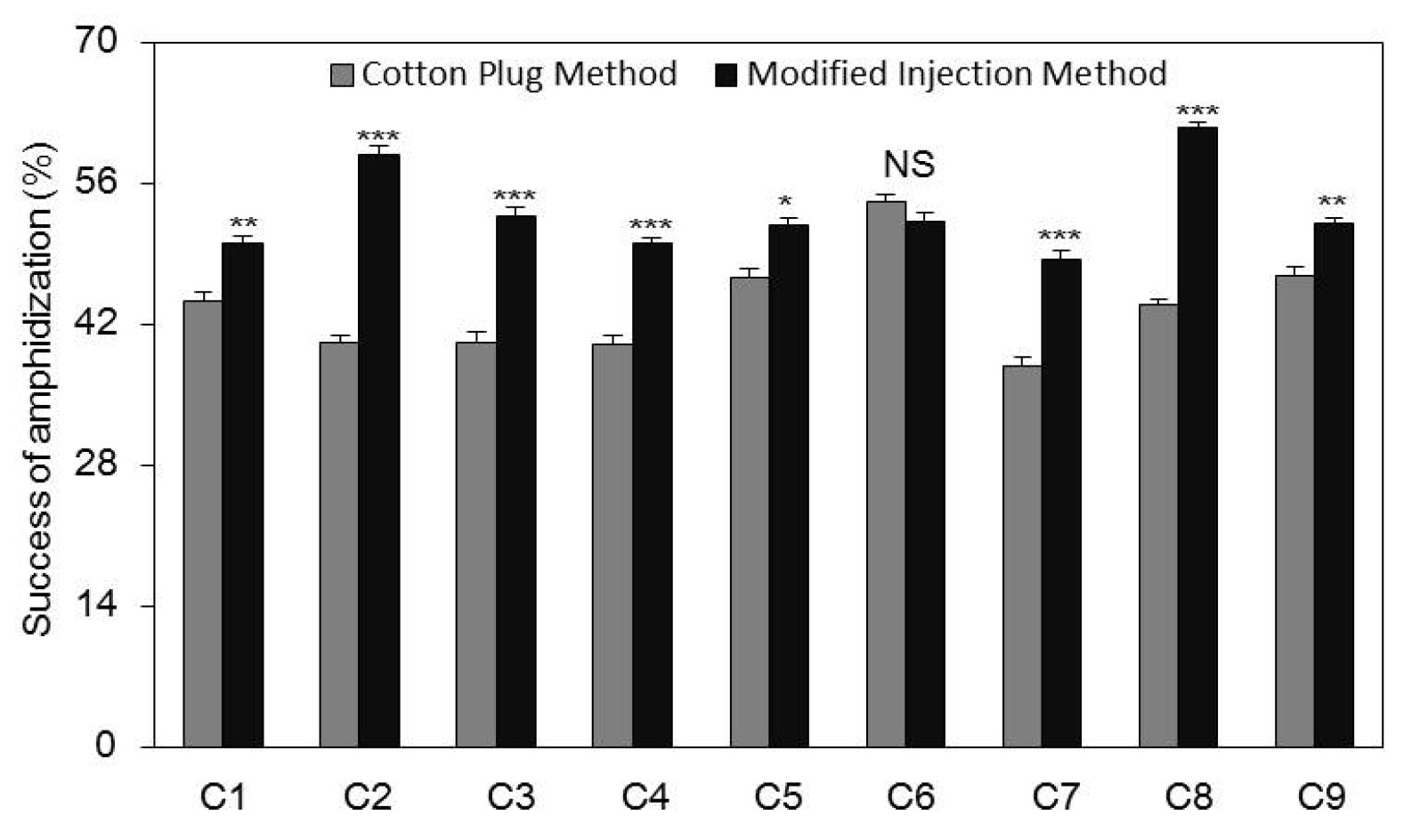
Fig. 3Somatic chromosome number of resynthesized B. napus (2n = 4× = 38) (A) Agrani × Alboglabra-1, (B) Binasarisha-6 × Alboglabra-1, (C) Safal × Alboglabra-1, (D) Sampad × Alboglabra-1, (E) BARI Sarisha-14 × Alboglabra-1, (F) BARI Sarisha-106 × Alboglabra-1 (G) Sampad × Alboglabra-1, (H) BARI Sarisha-09 × Alboglabra-1, (I) BARI Srisha-6 × Alboglabra-1.
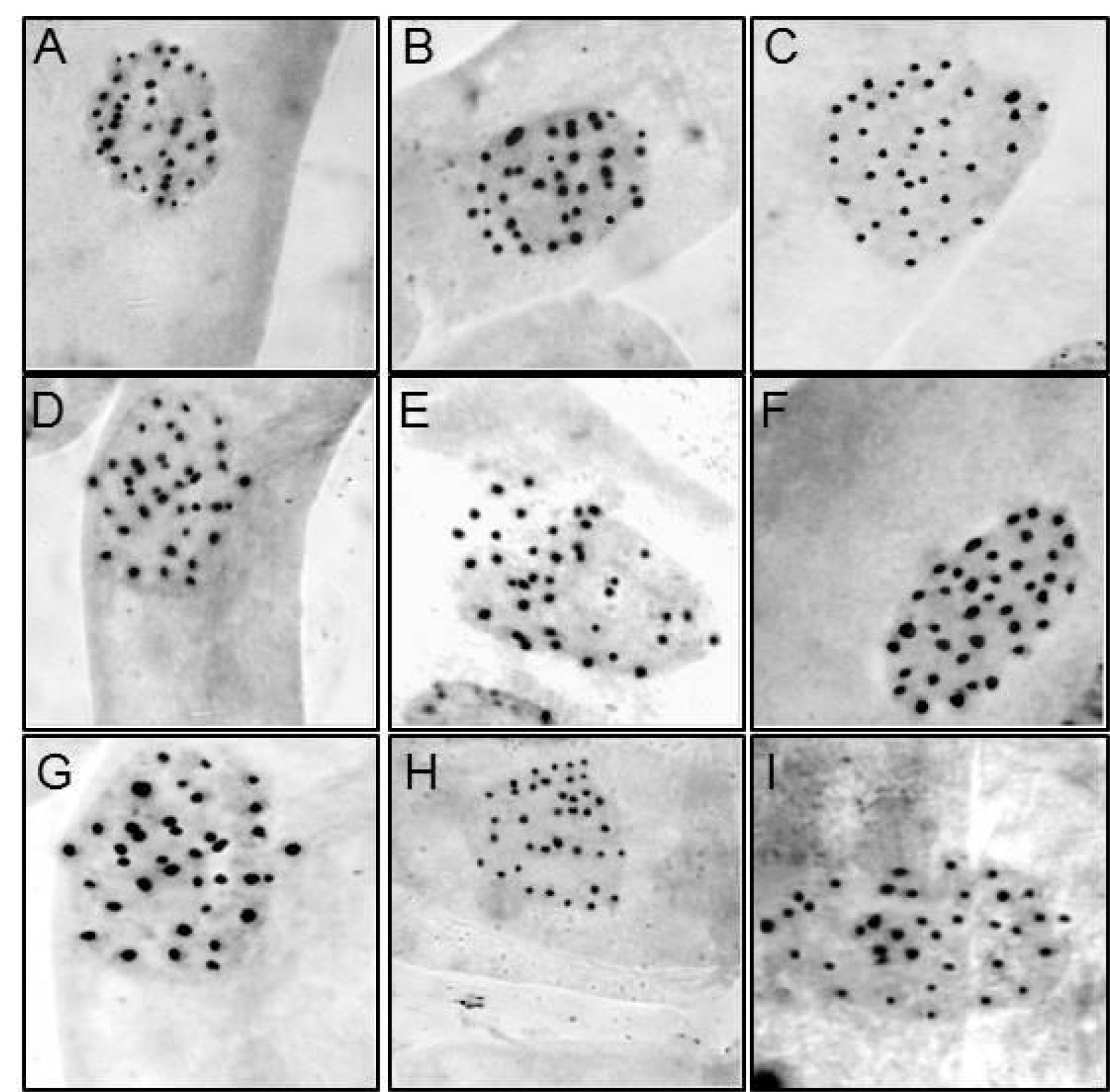
Fig. 4Genome specific amplifications using DA and DC marker. Lane 1-9 were for varieties of B. rapa (2n = AA), lane 10 for variety of B. oleracea var. alboglabra (2n = CC) and lane 11-25 for RS lines of B. napus (AACC) using DA (A) and DC (B) marker.
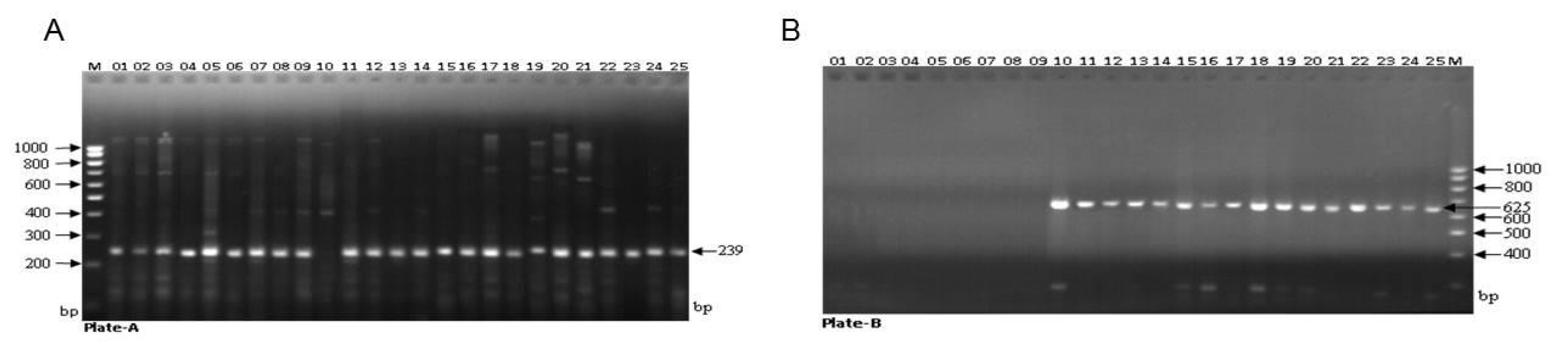
Table 1Varieties of Brassica species used in the crossing programme.
Table 1
|
Sl |
Brassica species |
Varieties |
Life cycle (Days) |
Sources |
|
1 |
B. rapa var. yellow sarson |
Agrani |
85-90 |
BINA, Bangladesh |
|
2 |
B. rapa var. yellow sarson |
Binasarisha-6 |
90-95 |
BINA, Bangladesh |
|
3 |
B. rapa var. yellow sarson |
Safal |
90-95 |
BINA, Bangladesh |
|
4 |
B. rapa var. yellow sarson |
Sampad |
80-85 |
BAU, Bangladesh |
|
9 |
B. rapa var. toria |
Tori-7 |
70-80 |
Local variety |
|
10 |
B. oleracea var. alboglabra Bailey |
Alboglabra-1 |
115-120 |
IAPB, Gottingen University, Germany |
Table 2Cross combinations between the varieties B. rapa and B. oleracea.
Table 2
|
Sl. No. |
Crosses |
Sl. No. |
Reciprocal crosses |
|
1 |
Agrani × Alboglabra-1 |
2 |
Alboglabra-1 × Agrani |
|
3 |
Binasarisha-6 × Alboglabra-1 |
4 |
Alboglabra-1 × Binasarisha-6 |
|
5 |
Safal × Alboglabra-1 |
6 |
Alboglabra-1 × Safal |
|
7 |
Sampad × Alboglabra-1 |
8 |
Alboglabra-1 × Sampad |
|
9 |
BARI Sarisha-14 × Alboglabra-1 |
10 |
Alboglabra-1 × BARI Sarisha-14 |
|
11 |
BARI Sarisha-6 × Alboglabra-1 |
12 |
Alboglabra-1 × BARI Sarisha-6 |
|
13 |
BARI Sarissha-9 × Alboglabra-1 |
14 |
Alboglabra-1 × BARI Sarissha-9 |
|
15 |
BARI Sarissha-12 × Alboglabra-1 |
16 |
Alboglabra-1 × BARI Sarissha-12 |
|
17 |
Tori-7 × Alboglabra-1 |
18 |
Alboglabra-1 × Tori-7 |
Table 3List of SSR primers used for molecular study.
Table 3
|
Primer |
Sequence (5’-3’) |
Genome detection |
Fragment size (bp) |
|
DA |
F: gggttttcgcctcggtctcc |
A |
239 |
|
R: actcccctggtgccgctgc |
|
DC |
F: actccgactccatgtccctca |
C |
625 |
|
R: acactcccctggtgcctttca |
Table 4Effect of B. rapa varieties on crossability characters in B. rapa × B. oleracea crosses when the varieties of B. rapa used as female parents.
Table 4
|
Name of the crosses |
Siliqua setting (%) |
Cross success (%) |
Seeds per pollinated flower (%) |
Seeds per siliqua (%) |
|
Agrani × Alboglabra |
68.21c
|
9.66ab
|
18.93abc
|
27.43abc
|
|
Binasarisha-6 × Alboglabra |
75.17ab
|
11.72a
|
31.23a
|
39.01a
|
|
Safal × Alboglabra |
76.21ab
|
10.23a
|
22.13ab
|
28.52abc
|
|
Sampad × Alboglabra |
78.22a
|
11.00a
|
29.04a
|
35.80ab
|
|
BARI Sarisha-14 × Alboglabra |
69.43c
|
9.34ab
|
20.50abc
|
28.8abc
|
|
BARI Sarisha-6 × Alboglabra |
71.49bc
|
9.71ab
|
18.10abc
|
24.76bc
|
|
BARI Sarisha-9 × Alboglabra |
45.57d
|
6.90bc
|
10.95bc
|
22.74bc
|
|
BARI Sarisha-12 × Alboglabra |
40.19e
|
6.07c
|
10.04bc
|
23.91bc
|
|
Tori-7 × Alboglabra |
37.50e
|
4.49c
|
7.73c
|
20.02c
|
|
Mean |
62.44 |
8.42 |
18.73 |
27.88 |
Table 5Effect of B. rapa genotypes on cross ability for different characters in B. oleracea × B. rapa crosses when the varieties of B. rapa used as pollen parents.
Table 5
|
Name of the crosses |
Siliqua setting (%) |
Cross success (%) |
Seeds per pollinated flower (%) |
Seeds per siliqua (%) |
|
Alboglabra-1 × Agrani |
28.33d
|
2.14ab
|
4.73d
|
15.93f
|
|
Alboglabra-1 × Binasarisha-6 |
38.33ab
|
3.80a
|
10.71ab
|
26.30ab
|
|
Alboglabra-1 × Safal |
36.10bc
|
3.72ab
|
8.91bc
|
23.74bc
|
|
Alboglabra-1 × Sampad |
40.56a
|
2.93ab
|
12.56a
|
28.93a
|
|
Alboglabra-1 × BARI Sarisha-14 |
29.80d
|
2.81ab
|
6.01cd
|
19.03def
|
|
Alboglabra-1 × BARI Sarisha-6 |
32.15cd
|
2.57ab
|
7.02cd
|
21.20cde
|
|
Alboglabra-1 × BARI Sarisha-9 |
31.61d
|
2.08b
|
5.63d
|
16.38f
|
|
Alboglabra-1 × BARI Sarisha-12 |
31.48d
|
3.68ab
|
7.38cd
|
22.15cd
|
|
Alboglabra-1 × Tori-7 |
32.65cd
|
2.17ab
|
6.13cd
|
17.65ef
|
|
Mean |
33.44 |
2.88 |
7.67 |
21.25 |
Table 6Efficiency of different colchicine concentration to induce chromosome doubling in the F1’s of B. rapa and B. oleracea var. alboglabra crosses using Cotton Plug Method.
Table 6
|
Plants of F1
crosses |
Success of amphidization (%) |
|
Colchicine concentrations |
|
Colchicine concentrations |
|
0.1% |
0.15% |
0.2% |
Total |
0.1% |
0.15% |
0.2% |
Total |
|
Agrani × Alboglabra-1 |
10 (4) |
9 (5) |
8 (3) |
27 (12) |
|
40.00 |
55.56 |
37.50 |
44.35 |
|
Binasarisha-06 × Alboglabra-1 |
8 (3) |
11 (5) |
8 (3) |
27 (11) |
|
37.50 |
45.45 |
37.50 |
40.15 |
|
Safal × Alboglabra-1 |
12 (3) |
9 (5) |
10 (4) |
31 (12) |
|
25.00 |
55.56 |
40.00 |
40.18 |
|
Sampad × Alboglabra-1 |
11 (3) |
8 (5) |
10 (3) |
29 (11) |
|
27.27 |
62.5 |
30.00 |
39.92 |
|
BARI Sarisha-14 × Alboglabra-1 |
9 (3) |
10 (7) |
11 (4) |
30 (14) |
|
33.33 |
70.00 |
36.36 |
46.56 |
|
BARI Sarisha-6 × Alboglabra-1 |
12 (5) |
11 (7) |
7 (4) |
30 (16) |
|
41.67 |
63.64 |
57.14 |
54.15 |
|
BARI Sarisha-09 × Alboglabra-1 |
13 (4) |
9 (5) |
11 (3) |
33 (12) |
|
30.76 |
55.56 |
27.27 |
37.86 |
|
BARI Sarisha-12 × Alboglabra-1 |
11 (3) |
10 (6) |
9 (4) |
30 (13) |
|
27.27 |
60.00 |
44.44 |
43.90 |
|
Tori-7 × Alboglabra-1 |
6 (2) |
7 (4) |
6 (3) |
19 (9) |
|
33.33 |
57.14 |
50.00 |
46.82 |
|
Total |
92 (30) |
84 (49) |
80 (31) |
256 (110) |
|
32.60 |
58.33 |
38.75 |
42.97 |
Table 7Efficiency of different colchicine concentration to induce chromosome doubling in the F1’s of B. rapa and B. oleracea var. alboglabra crosses using Modified Injection Method.
Table 7
|
Plants of F1 crosses |
Success of colchiploid induction (%) |
|
Colchicine concentrations |
|
Colchicine concentrations |
|
0.1% |
0.15% |
0.2% |
Total |
0.1% |
0.15% |
0.2% |
Total |
|
Agrani × Alboglabra-1 |
6 (2) |
5 (3) |
5 (3) |
16 (8) |
|
33.33 |
60.00 |
60.00 |
50.00 |
|
Binasarisha-06 × Alboglabra-1 |
7 (3) |
5 (3) |
5 (4) |
17 (10) |
|
42.85 |
60.00 |
80.00 |
58.82 |
|
Safal × Alboglabra-1 |
12 (5) |
11 (6) |
13 (8) |
36 (19) |
|
41.67 |
54.54 |
53.85 |
52.77 |
|
Sampad × Alboglabra-1 |
8 (3) |
9 (5) |
7 (4) |
24 (12) |
|
37.5 |
55.55 |
57.14 |
50.00 |
|
BARI Sarisha-14 × Alboglabra-1 |
10 (4) |
8 (4) |
9 (6) |
27 (14) |
|
40.00 |
50.00 |
66.67 |
51.85 |
|
BARI Sarisha-6 × Alboglabra-1 |
8 (4) |
8 (3) |
7 (5) |
23 (12) |
|
50.00 |
37.50 |
71.43 |
52.17 |
|
BARI Sarisha-09 × Alboglabra-1 |
10 (4) |
12 (5) |
11 (7) |
33 (16) |
|
40.00 |
41.67 |
63.63 |
48.48 |
|
BARI Sarisha-12 × Alboglabra-1 |
9 (4) |
8 (5) |
9 (7) |
26 (16) |
|
33.33 |
50.00 |
77.78 |
61.53 |
|
Tori-7 × Alboglabra-1 |
8 (3) |
8 (4) |
9 (6) |
25 (13) |
|
37.50 |
50.00 |
66.67 |
52.00 |
|
Total |
78 (32) |
74 (38) |
75 (50) |
227 (120) |
|
41.02 |
51.35 |
66.67 |
52.86 |
References
- Abel S, Möllers C, Hecker HC. 2005. Development of synthetic Brassica napus lines for the analysis of "fixed heterosis" in allopolyploid plants. Euphytica. 146: 157-163.
- Akbar MA. 1987. Resynthesis of B. napus for earliness and day length insensitivity. PhD Thesis Department of Plant Breeding, Swedish University of Agricultural Science. Uppsala, Sweden.
- Akbar MA. 1990. Resynthesis of Brassica napus aiming for improved earliness and carried out by different approaches. Hereditas. 111: 239-246.
- Aono M, Wakiyama S, Nagatsu M, Kaneko Y, Nishizawa T, Nakajima N, et al. 2011. Seeds of a possible natural hybrid between herbicide-resistant Brassica napus and Brassica rapa detected on a riverbank in Japan. GM Crops. 2: pp. 201-210.
- Aslam FN, Macdonald MV, Loudon P, Ingram DS. 1990. Rapid-cycling Brassica Species: inbreeding and selection of B. campestris for anther culture ability. Ann. Bot.. 65(5): 557-566.
- Attia T, Busso C, Röbbelen G. 1987. Digenomic triploids for an assessment of chromosome relationships in the cultivat-ed diploid Brassica species. Genome. 29: 326-330.
- Attia T, Röbbelen G. 1986. Cytogenetic relationship within cultivated Brassica analyzed in amphihaploids from the three diploid ancestors. Cana. J. Genet. Cytol.. 28: 323-329.
- Becker HC, Engqvist GM, Karlsson B. 1995. Comparison of rapeseed cultivars and resynthesized lines based on allozyme and RFLP markers. Theor. Appl. Genet.. 91: 62-67.
- Chandra A, Gupta ML, Banga SS, Banga SK. 2004. Pro-duction of an interspecific hybrid between wild species, B. fruticulosa and B. rapa. Plant Breed.. 23(5): 497-498.
- Chatterjee D, Banga S, Gupta M, Bharti S, Salisbury PA, Banga SS. 2016. Resynthesis of Brassica napus through hybridization between B. juncea and B. carnata. Theor. Appl. Genet.. 129(5): 977-990.
- Diederichsen E, Sacristan MD. 1994. The Use of Ovule Culture in Reciprocal Hybridisation between B. campestris L. and B. oleracea L. Plant Breed.. 113: 79-82.
- Downey RK, Klassen AJ, Stringam GR. Fehr W. R., Hadley H., 1980. Rapeseed and Mustard. editors. Hybridization of crop plants. ASA, CSA. Madison, WI: pp. 495-509.
- Heath DW, Earle ED. 1996. Resynthesis of rape seed (Brassica napus L.): a comparison of sexual versus somatic hybridization. Plant Breed.. 115: 395-401.
- Heath DW, Elizabeth DE. 1997. Synthesis of low linolenic acid rapeseed (Brassica napus L.) through protoplast fusion. Euphytica. 93: 339-343.
- Hoffman F, Thomas E, Wenzel G. 1982. Anther culture as a breeding tool in rape. II. Progeny analysis of androgenetic lines and induced mutants from haploid cultures. Theor. Appl. Genet. 61: 225-232.
- Hosaka K, Kianian SF, McGrath JM, Quiros CF. 1990. Development and chromosomal localization of genome-specific DNA markers of Brassica and the evolution of amphidiploids and n9 diploid species. Genome. 33(1): 131-142.
- Hossain MM, Inden H, Asahira T. 1989. Interspecific hybrids between Brassica campestris L. and B. oleracea L. through embryo and overy culture. Memoirs of the College of Agriculture-Kyoto University. 135: 21-30.
- Hossain MM, Inden H, Asahira T. 1990. Pollen morphology of interspecific hybrids of B. oleracea and B. campestris. HortScience.. 25(1): 109-111.
- Karim M, Siddika A, Tonu N, Hossain DM, Meah B. 2014. Production of high yield short duration Brassica napus by interspecific hybridization between B. oleracea and B. rapa. Breed. Sci.. 63: 495-502.
- Kräling K. 1987. Utilization of genetic variability of resynthesized rapeseed. Plant Breed.. 99: 209-217.
- Lagercrantz U. 1998. Comparative mapping between Arabidopsis thaliana and Brassica nigra indicates that Brassica genomes have evolved through extensive genome replication accompanied by chromosome fusions and frequent rearrangements. Genetics. 150: 1217-1228.
- Lagercrantz U, Lydiate DJ. 1996. Comparative genome mapping in Brassica. Genetics.. 144: 1903-1910.
- Leitch L, Bennett M. 1997. Polyploidy in angiosperms. Trends Plant Sci.. 2(12): 470-476.
- Lu CM, Zhang B, Kakihara F, Kato M. 2001. Introgression of genes into cultivated Brassica napus through resynthesis of B. napus via ovule culture and the accompanying change in fatty acid composition. Plant Breed.. 120(5): 405-410.
- Malik MA. 2007. Study of crossability and F1 of interspecific hybridization between Brassica rapa (B. campestris) and B. nigra. Bangladesh J. Agr. Res.. 32(3): 445-449.
- Malek MA, Ismail MR, Rafii MY, Rahman M. 2012. Synthetic Brassica napus L. Development and Studies on Morphological Characters, Yield Attributes, and Yield. The Scientific World Journal. 2012: 1-6.
- Malek MA, Rahman L, Das ML, Hassan L, Rafii MY, Ismail MR. 2013. Development of hexaploid Brassica (AA BBCC) from hybrids (ABC) of B. carinata (BBCC) × B. rapa (AA). Aust. J. Crop Sci.. 7(9): 1375-1382.
- Mason AS, Huteau V, Eber F, Coriton O, Yan G, Nelson MN, et al. 2010. Genome structure affects the rate of autosyndesis and allosyndesis in AABC, BBAC and CCAB Brassica interspecific hybrids. Chromosome Res.. 18: 655-666.
- Mohammadi PP, Moieni A, Ebrahimi A, Javidfar F. 2012. Doubled haploid plants following colchicine treatment of microspore-derived embryos of oilseed rape (Brassica napus L.). Plant Cell Tissue Organ Cult.. 108: 251-256.
- Murashige T, Skoog F. 1962. A revised medium for rapid growth and bioassays with tobacco tissue culture. Physiol. Plant. 15: 473-497.
- Nour SZ, Clemens R, Mollers C. 2013. Cytoplasmic diversity of Brassica napus, Brassica oleracea L. and Brassica rapa L. as determined by chloroplast microsatellite markers. Genet. Resour. Crop Evol.. 60: 953-965.
- Osipova GM, Zamina NS. 1988. Interspecies hybridization in Brassica and its use in breeding spring Swede rape. Nauchno-TekhinicheskU Bulletin. SibirshU-Nauchno-lssledovalel, SkU Institute Kormov. 1: 10-19.
- Prakash S, Hinata K. 1980. Taxonomy, cytogenetics and origin of crop Brassicas, a review. Nord. J. Bot.. 55: 1-57.
- Rahman L. Khaleque M.A., Abul Khair A.B.M, Akbar M.A., Haque M.M., 1981. Oil seed Research and Development activities at the BAU. editors. Proc. of the workshop on oil crop improvement, BARI Oilseed Research Project. pp. 25.
- Rahman L, Molla MR, Sultana S, Islam MN, Ahmed NU, Rahman MS, et al. 2007. Plant Varieties of Bangladesh: Morphological and Molecular Characterization. Published by Seed Wing, Ministry of Agriculture, Government of the Peoples' Republic of Bangladesh. Vol. 1: pp. 486.
- Rahman MH. 2001. Production of yellow seeded Brassica napus through interspecific crosses. Plant Breed.. 120: 463-472.
- Rahman MH. 2005. Resynthesis of Brassica napus for self-incompatibility: Self-incompatibility reaction, inheritance and breeding potential. Plant Breed.. 124: 13-19.
- Röbbelen G. 1960. Beiträge zur analyse des Brassica-genoms. Chromosoma. 11: 205-228.
- Sacristan MD, Gerdemann M. 1986. DiVerent behaviour of B. Juncea and B. carinata as source of Phoma lingam resistance in experiment of interspecific transfer to Brassica napus. Plant Breed.. 97: 304-314.
- Saghai-Maroof MA, Soliman KM, Jonsensan RA, Allard RW. 1984. Ribosomal RNA spacer length polymorphism in barley: Mendelian inheritance, chromosomal location and population dynamics. Proc. Natl. Acad. Sci. U.S.A.. 81: 8014-8019.
- Schelfhout CJ, Snowdon R, Cowling WA, Wroth JM. 2004. A PCR based B-genome-specific marker in Brassica species. Theor. Appl. Genet.. 109(5): 917-921.
- Schranz ME, Osborn TC. 2000. Novel Flowering Time Variation in the Resynthesized Polyploid Brassica napus. J. Hered.. 91(3): 242-246.
- Shi W S, JiangSheng W, YongMing Z, HouLi L. 2002. Diploidization techniques for microspore-derived hap-loid plants of rapeseed (Brassica napus L.). Chinese J. of Oil Crop Sci.. 24(1): 1-5.
- Singh PK, Chaudhury BD. 1977. Biometrical Methods in Quantitative Genetic Analysis. Kalyani Publishers. New Delhi, India: pp. 318.
- Snowdon RJ, Köhler W, Friedt W, Köhler A. 1997. Genomic in situ hybridization in Brassica amphidiploids and interspecific hybrids. Theor. Appl. Genet.. 95: 1320-1324.
- Stebbins GL. 1996. Chromosomal variation and evolution. Science. 152(3728): 1463-1469.
- Steel RGD, Torrie JH. 1960. Principles and Procedures of Statistics. Mc.Graw Hill Book Company, Inc. New York, Toronto, London: pp. 481.
- Swanson EB, Herrgesell MJ, Arnoldo M, Sippel DW, Wong RSC. 1989. Microspore mutagenesis and selection: Canola plants with field tolerance to the imidazolinones. Theor. Appl. Genet.. 78: 525-530.
- Takeda T, Takahata Y. 1988. Further study on the hybrid-ization between synthesized trigenomic hexaploid and cultivated species in genus Brassica. Cruciferae Newsletter. 13: 16-17.
- Nagaharu U, Nagaharu N. 1935. Genome analysis in Brassica with special reference to the experimental formation of B. napus and peculiar mode of fertilization. J. Jap. Bot.. 7: 389-452.
- Wilson JG, Clements JC, Quealy J, Yang H. 2008. Develop-ment of an Interspecific hybridization protocol for Lupinus. Develop-ment of an Interspecific hybridization protocol for Lupinus In: Proceedings of the 12th International Lupin Conference; Australia. pp 14-18.
- Xiong Z, Pires C. 2011. Karyotype and Identification of All Homeologous Chromosomes of Allopolyploid Brassica napus and Its Diploid Progenitors. Genetics. 187(1): 37-49.
- Yan M, Liu X, Guan C, Liu L, Xiang J, Lu Y, et al. 2014. Cloning of TTG1 gene and PCR identification of genomes A, B and C in Brassica species. Genetica. 142(2): 169-176.
- Yingze N, Liangzhong W, Yuzhen L. 1999. Creation of new germplasm in B. napus using landraces of B. chinensis and B. oleracea var. alboglabra from SW China. In: Proceeding of the 10th International Rapeseed Congress, Australian Agronomy Conference; Australia. pp 25-30.
- Zhang GQ, Tang GX, Song WJ, Zhou WJ. 2004. Resyn-thesizing Brassica napus from interspecific hybridization between B. rapa and B. oleracea through ovary culture. Euphytica. 140(3): 181-187.