Abstract
Amplified fragment length polymorphism (AFLP) is a molecular marker technique based on DNA and is extremely useful in detection of high polymorphism between closely related genotypes like Korean wheat cultivars. Six sequence characterized amplified regions (SCARs) have been developed from inter simple sequence repeat (ISSR) analysis which enabled the identification and differentiation of 13 Korean wheat cultivars from the other cultivars. We used six combinations of primer sets in our AFLP analysis for developing additional cultivar-specific markers in Korean wheat. Fifty-eight of the AFLP bands were isolated from EA-ACG/MA-CAC, EA-AGC/MA-CTG and EA-AGG/MA-CTA primer combinations. Of which 40 bands were selected to design SCAR primer pairs for Korean wheat cultivar identification. Three of 58 amplified primer pairs, KWSM006, KWSM007 and JkSP, enabled wheat cultivar identification. Consequently, 23 of 32 Korean wheat cultivars were classified by eight SCAR marker sets.
-
Key words: AFLP, Molecular marker, SCARs, Wheat
INTRODUCTION
Various molecular marker techniques have been introduced and are constantly being modified and developed to enhance their utility in the process of genome analysis (
Swati et al. 1999). DNA-based molecular marker techniques are very useful in various fields like genetic engineering, plant molecular biology, physiology as well as plant breeding. In plant breeding program like wheat breeding, various molecular markers have been used for marker-assisted selection (MAS). MAS has been widely practiced in many crop breeding programs across the globe. This technique reduces the effort and time, while improving the efficiency of the selection in the plant breeding process.
AFLP is a PCR-based technique which is useful in the analysis of relationship between closely related genotypes. It is a complex technique that is coupled with convenience of random amplification polymorphic DNA (RAPD) based on PCR and random fragment length polymorphisms (RFLP) having high reproducibility (
Vos et al. 1995). AFLP comprises two different two steps. The first step is restriction of DNA using combination of restriction enzyme such as
MseI and
EcoRI. The second step is ligation of oligonucleotide adapters that are defined sequences including the respective restriction enzyme sites. AFLP has been used for DNA fingerprinting, cloning and also mapping of species-specific DNA sequences (Yong
et al. 1996;
Paglia et al. 1998). In addition, AFLP technique was used for mutation analysis caused by transposition, insertion and deletion of some nucleotide in genome as well as it has been used for the analysis of genetic map (
Mackill et al. 1996;
Voorrips et al. 1997), evolution (
Heun et al. 1997) and research of bio-diversity (
Barrett and Kidwell 1998). Similar to RAPDs or inter simple sequence repeats (ISSRs), bands of the species-specific obtained by AFLP can be converted into SCARs (
Son et al. 2013). Thus, AFLP technique is an important tool with variety of applications.
Genetic diversity among landraces of bread wheat between different geographic regions and phylogenetic relationships of durum wheat cultivars were analyzed by using AFLPs (
Stodart et al. 2005;
Martos et al. 2005). This technique is a useful tool for Korean wheat research. In this study, we developed specific DNA markers for Korean wheat cultivar identification using AFLP technique. We selected this technique among various molecular marker techniques because AFLP has been shown to generate many polymorphic DNA bands.
MATERIALS AND METHODS
Plant materials and DNA extraction
Genomic DNAs were extracted from young leaves of 32 Korean wheat cultivars using HiGene
TM Genomic DNA Prep Kit (SolGent, Korea). They were chosen as major cultivars in Korea and representative species in the classification of wheat cultivars (
Table 1).
Information of adaptor and primer sets for AFLP analysis is indicated in
Table 2. Genomic DNA was digested with
MseI and
EcoRI restriction enzymes. Adapter ligation step was performed according to AFLP analysis system I manual (Invitrogen, USA). A total of 25 ul pre-amplification mixture containing 40 ng of adapter ligased DNA, 0.5 uM pre-amp primer mix, 1X PCR buffer plus Mg and 5U Platinum High Fidelity Taq polymerase (Invitrogen, USA) were amplified through PCR which was performed in 20 cycles at 94°C for 30 s, 56°C for 60 s and 72°C for 60 s. This protocol was described in AFLP Starter Primer Kit (Invitrogen, USA). Selective amplification reactions were performed with 20 ng diluted pre-amplified products, 5 uM primer sets, 0.2 mM dNTPs and 0.5 U Platinum High Fidelity Taq polymerase (Invitrogen, USA) in a total volume of 25 ul. Selective amplification was carried out for one cycle at 94°C for 30 s, 65°C for 30 s, 68°C for 60 s, and the annealing temperature was then repeatedly lowered by 0.7 °C for each cycle during 12 cycles, followed by 23 cycles at 94°C for 30 s, 56°C for 30 s, 68°C for 60 s and the final extension of 68°C for 5 min. The amplified DNA fragments were loaded on 6% polyacrylamide gel and detected by silver stain method.
Specific bands (300 – 1,000 bp) were eluted from the 6% polyacrylamide gel. The eluted DNA fragments were ligated into pGEM-T vector (Promega, USA), and the clones were transferred into DH5α competent E. coli cells. Nucleotide sequencing was processed at genome analysis company Xenotech Inc., Korea. The sequences were determined by primer pairs M13 and SP6 using a PRISM3700 automatic DNA sequencer (ABI Inc., USA).
Sequence analysis and re-amplification
The sequence analyzed DNA fragment length was determined from minimum 300 to maximum 1,000 bp. These fragments were included in wheat species. The sequence information was confirmed in GenBank (NCBI,
http://www.ncbi.nlm.nih.gov). Using the sequences, we designed the SCAR primers using primer3 (version 0.4.0,
http://frodo.wi.mit.edu/). Designed primers were tested for classification of Korean wheat cultivars. PCR reaction was performed with 40 ng of genomic DNA, 200 uM of each dNTP, 1X reaction buffer and 0.5 U Platinum High Fidelity Taq polymerase (Invitrogen, USA) in a total volume of 25 ul. PCR condition was the same with selective amplification reaction. The amplified DNA fragments were confirmed on 1.2% agarose gel electrophoresis. Using SCAR primers, the PCR reaction was performed in 35 cycles at 94°C for 30 s, 55–58°C for 30 s, 72°C for 1 min and the final extension at 72°C for 5 min. Using Jokyoung specific primer (JkSP), PCR reaction was performed by touch-down phase system. In the first seven cycles the annealing temperature was lowered at 1°C interval from 62°C to 55°C, while the second step was performed in 35 cycles at 94°C for 30 s, 58°C for 30 s, 72°C for 1 min and the final extension at 72°C for 5min. The amplified DNA fragments were confirmed by loading on 1.2% agarose gel.
RESULTS
AFLP finger printing of Korean wheat cultivars
We used six combinations of primer sets for AFLP analysis (
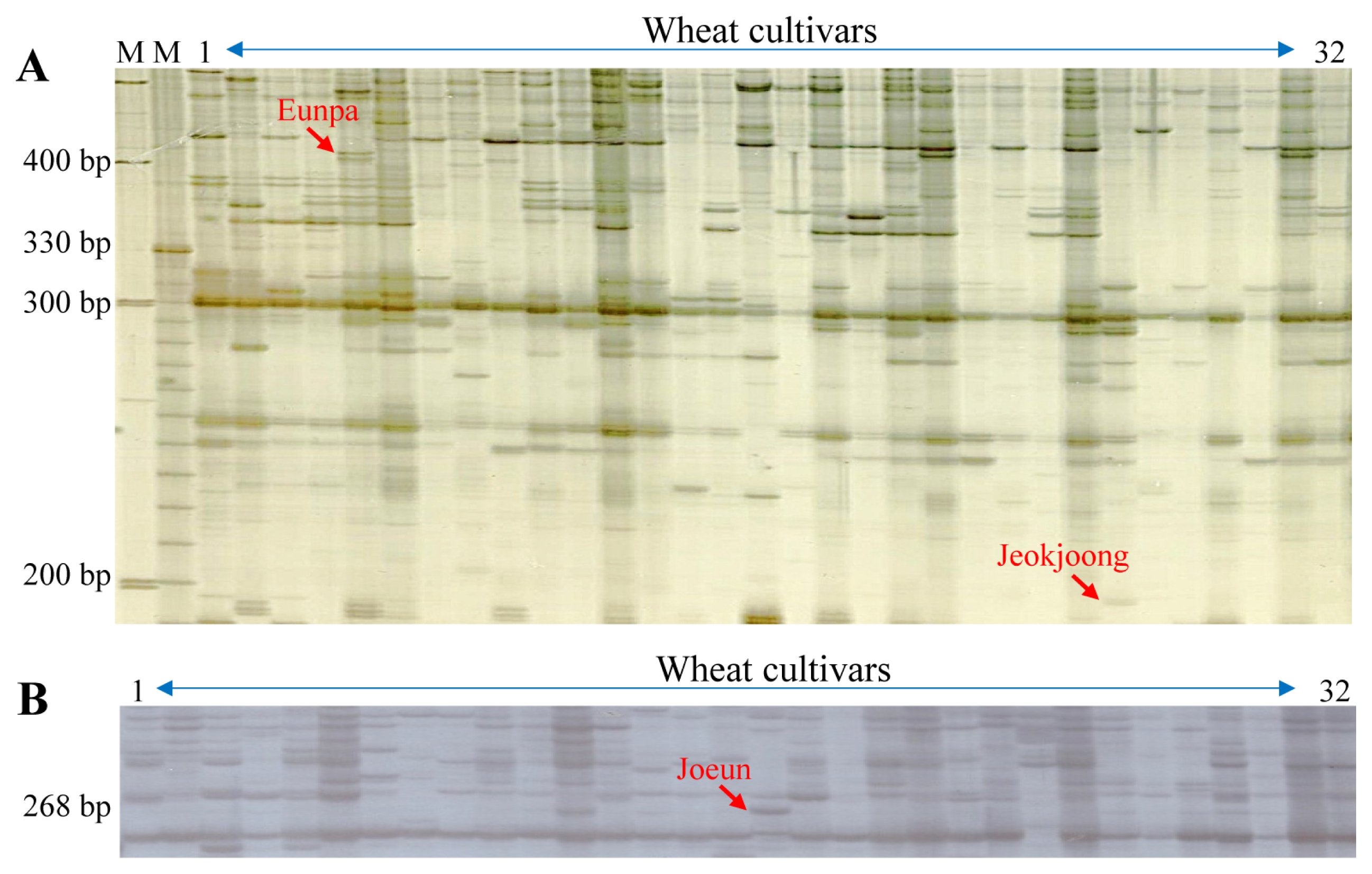
Table 2) to develop cultivar-specific markers in Korean wheat. Each primer set produced 70 to 100 detectable amplified bands with size ranging from 200 to 500 bp, depending on the primers and Korean wheat cultivars. Fifty-eight of the total amplified bands that are potential useful markers were selected from the three primer sets (
Fig. 1). Twenty-one of the AFLP bands were isolated from EA-ACG/MA-CAC primer combination, 19 bands were isolated from AGC/CTG primer combination and 18 bands were isolated from EA-AGG/MA-CTA. These bands were unique to a specific or few cultivars. We eluted the cultivar-specific bands from the silver stained acrylamide gel and performed cloning and sequencing.
We analyzed the sequences of 58 amplified DNA fragments and designed SCAR primer pairs for Korean wheat cultivar identification. Three of 58 amplified primer pairs KWSM007, KWSM008 and JkSP were able to differentiate the set of wheat cultivars used in the test. KWSM007 and JkSP primers were designed from each amplified DNA sequences (C2 and C17) of EA-ACG/MA-CAC primer set and KWSM008 primer was designed from amplified DNA sequence (AGG10) of EA-AGG/MA-CTA primer sets (
Fig. 1). C2 and AGG10 DNA fragments were 368 bp and 268 bp, respectively, but they did not match any gene. Result of BLAST search using a part of C2 DNA sequence revealed that AGG10 sequence was not annotated but the search identified matches to some region of
Triticum aestivum chromosome 3B-specific BAC library (contig ctg0954b) sequences. Also, C17 DNA sequence was not annotated in wheat but it has a characteristic of retrotransposon that was
Ty3-gypsy subclass in rice (LOC_ OS11g28870).
A total of 13 Korean cultivars were classified using the six SCAR markers sets developed in
Son et al. (2013). Using this study as reference two SCAR markers KWSM007 and KWSM008 were added to the set of markers we developed.
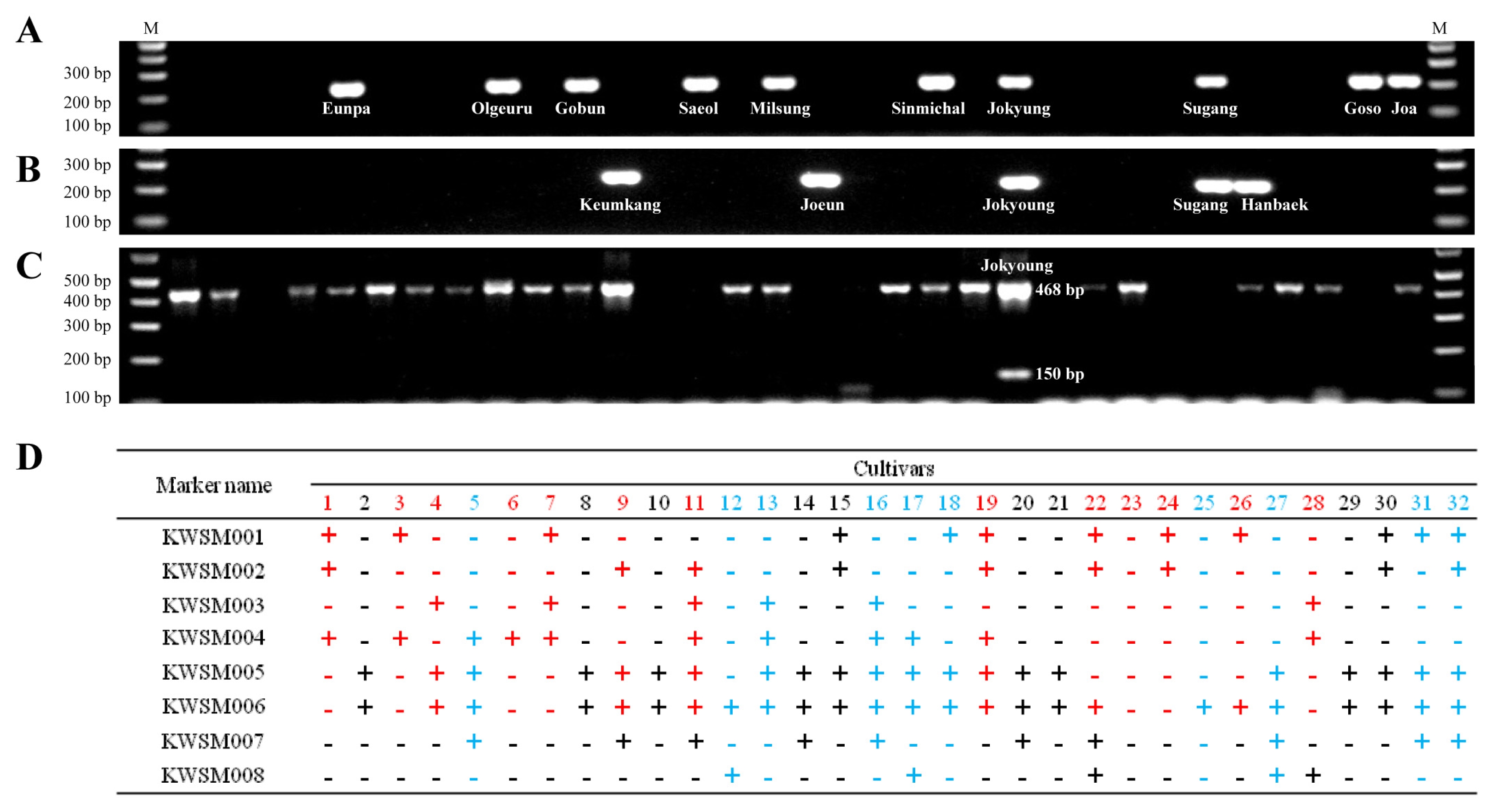
The DNA band of 215 bp length was amplified by KWSM007 primer pairs in ten cultivars including Eunpa, Olgeuru, Gobun, Saeol, Milsung, Sinmichal, Jokyung, Sugang, Goso, and Joah. Then KWSM007 primer was applied to the six ISSR-derived SCAR primer sets (
Son et al. 2013) as newly SCAR marker which enabled the identification of seven other cultivars (
Table 1;
Fig 2). In other words, 20 out of 32 Korean wheat cultivars were classified by combination of seven SCAR primer sets containing KWSM007 primer. These seven cultivars were Eunpa, Seodun, Milsung, Joeun, Anbaek, Goso, and Joah (
Table 1).
The KWSM008 primer pairs amplified the DNA band of 212 bp length in five cultivars, Keumkang, Joeun, Jokyoung, Sugang and Hanbaek (
Fig. 2). Hence, three more additional cultivars Keumkang, Baekjung and Sugang were distinguished from 32 cultivars.
However, the Jokyoung-specific/derived primer, amplified two distinct bands but only in Jokyoung, while the rest only showed single band (
Fig. 2).
Consequently, 23 of 32 Korean wheat cultivars were classified by six ISSR-derived and two AFLP-derived SCAR markers combination (
Fig 2). This molecular screening technique uses only few number of SCAR marker combination yet it efficiently distinguished some cultivars from numerous cultivars evaluated.
DISCUSSION
Various molecular marker techniques have been successfully demonstrated in plant research or genomics (containing genetics and cytology) and breeding for cultivar DNA fingerprinting, marker-assisted selection (MAS), and quantitative trait loci (QTLs) analysis (
Lee et al. 2012). AFLP is a powerful molecular-marker technique because it produces multiple amplified fragments in each PCR reaction (
Vos et al. 1995). The multiple steps in the AFLP process, however, make it worthwhile to convert the AFLP markers to SCAR markers that are easily produced by a single PCR reaction. AFLP analysis detects restriction-site polymorphisms by PCR analysis and it was difficult to detect a single cultivar-specific polymorphic fragment (
De Jong et al. 1997;
Negi et al. 2000). There are useful RAPD or SSR-derived SCAR markers for drought tolerance or other abiotic stresses in wheat (
Deshmukh et al. 2012). AFLP markers have been used for genetic, species relationship, and simple DNA fingerprinting such as genetic erosion in durum wheat cultivars and between common wheat cultivars (
Martos et al. 2005).
Through sequences analysis, we expected that C17 is related to wheat retrotransposon. Retrotransposons were derived from RNA intermediate (Class I transposon). They can amplify themselves through the replication in a genome and particularly abundant in plants. Many retrotransposons consisted of repeated DNA and they have been found in the plants having enormous genome like maize (49–78%) and wheat (~ 90%). Their genome size was increased by retrotransposons (
San Miguel et al. 1998;
Li et al. 2004).
Six Korean wheat cultivar-specific marker sets have been developed from previous ISSR analysis (
Son et al. 2013). These markers can identify specifically the 13 Korean wheat cultivars from other cultivars (
Son et al. 2013). But using KWSM007 and KWSM008 in addition to six ISSR-derived SCAR primer sets, we were able to distinguish 23 out of 32 Korean wheat cultivars (
Table 1). Likewise, we were able to develop a single cultivar-specific marker, called JkSP that was derived from Jokyoung.
ACKNOWLEDGMENTS
This study was supported by 2014 Postdoctoral Fellowship Program (PJ00875601) of National Institute of Crop Science, Rural Development Administration, Republic of Korea.
Fig. 1AFLP analysis of 32 Korean wheat cultivars. Sizes of the amplified products range from 200 to 500 bp. The red arrows indicate the eluted cultivar-specific DNA fragments. A; EA-ACG/MA-CAC selective-primer combination, B; EA-AGG/MA-CTA selective-primer combination. M; 1kb plus ladder and 10 bp size marker.
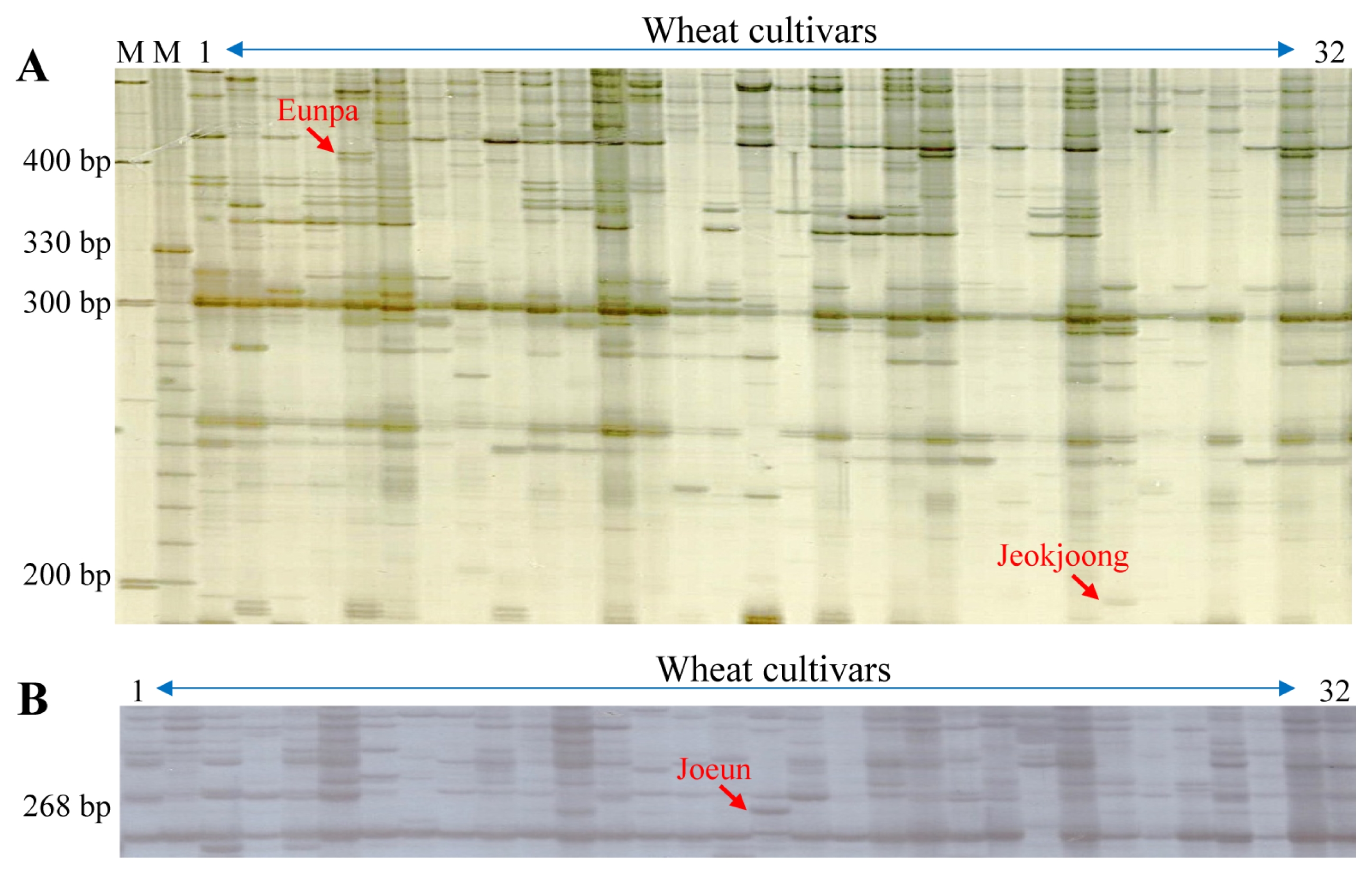
Fig. 2The profiles of PCR amplified DNA fragments using developed SCAR markers in 32 Korean wheat cultivars and amplification patterns of SCAR markers. KWSM001 to KWSM006 indicate ISSR derived SCARs, KWSM007 and KWSM008 indicate AFLP-derived SCARs. A; KWSM006, B; KWSM007, C; JkSP, M; 1kb plus ladder, D; The + indicates amplified bands and − is absence. The red and blue letters indicate wheat cultivars that were identified by ISSR-derived SCARs and AFLP-derived SCARs, respectively.
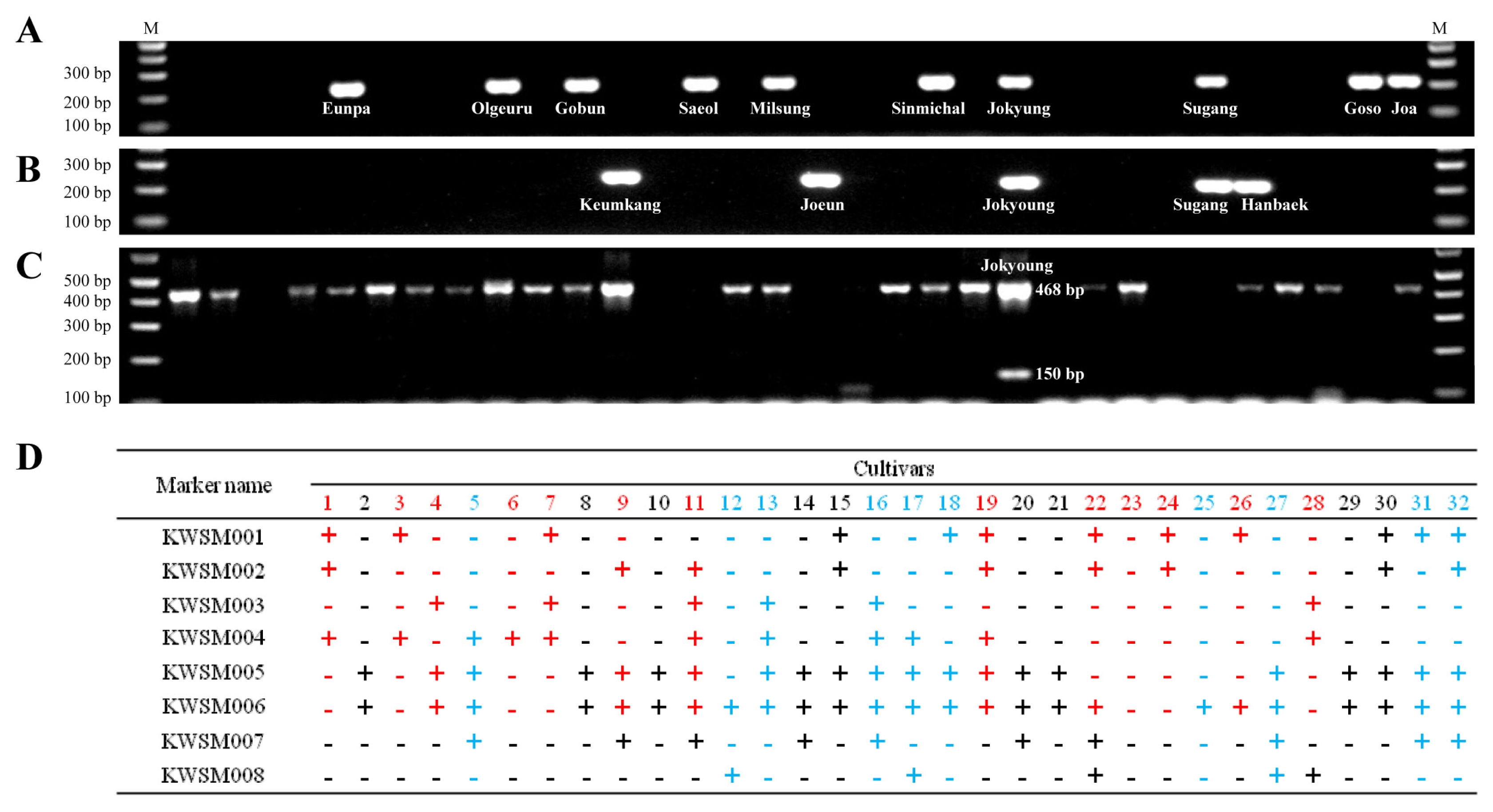
Table 132 Korean wheat cultivars used in this study and their expression patterns for novel markers.
Table 1
|
No. |
Cultivar |
Amplified pattern |
|
1 |
Ol |
N |
|
2 |
Geuru |
N |
|
3 |
Dahong |
N |
|
4 |
Chungkye |
N |
|
5 |
Eunpa
|
KWSM006 |
|
6 |
Tapdong |
N |
|
7 |
Namhae |
N |
|
8 |
Uri |
N |
|
9 |
Olgeuru |
KWSM006 |
|
10 |
Alchan |
N |
|
11 |
Gobun |
KWSM006 |
|
12 |
Keumkang
|
KWSM007 |
|
13 |
Seodun
|
N |
|
14 |
Saeol |
KWSM006 |
|
15 |
Jinpoom |
N |
|
16 |
Milsung
|
KWSM006 |
|
17 |
Joeun
|
KWSM007 |
|
18 |
Anbaek
|
N |
|
19 |
Jopoom |
N |
|
20 |
Sinmichal |
KWSM006 |
|
21 |
Jonong |
N |
|
22 |
Jokyoung |
KWSM006/KWSM007/JkSP |
|
23 |
Younbaek |
N |
|
24 |
Shinmichal1 |
N |
|
25 |
Baekjung
|
N |
|
26 |
Jeokjoong |
N |
|
27 |
Sugang
|
KWSM006/KWSM007 |
|
28 |
Hanbaek |
KWSM007 |
|
29 |
Suan |
N |
|
30 |
Dajoong |
N |
|
31 |
Goso
|
KWSM006 |
|
32 |
Joah
|
KWSM006 |
Table 2Nucleotide sequences of the AFLP primers.
Table 2
|
Primer name |
Sequences (5′->3′) |
|
EcoRI-adaptor |
EA1: GACTGCGTACC |
|
EA2: AATTGGTACGCAGTC |
|
MseI-adaptor |
MA1: TACTCAGGACTCATC |
|
MA2: GATGAGTCCTGAG |
|
Anchored EcoRI-adaptor primers |
CTGCGTACCAATTCA |
|
Anchored MseI-adaptor primers |
GATGAGTCCTGAGTAAC |
|
EcoRI- selective primers |
|
EA-ACG |
CTGCGTACCAATTCACG |
|
EA-AGC |
CTGCGTACCAATTCAGC |
|
MseI- selective primers |
|
MA-CAC |
GATGAGTCCTGAGTAACAC |
|
MA-CTG |
GATGAGTCCTGAGTAACTG |
|
MA-CTC |
GATGAGTCCTGAGTAACTC |
Table 3The information of three SCAR markers for 32 Korean wheat cultivars identification.
Table 3
|
Marker name |
Forward sequences |
Reverse sequences |
Annealing temperature (°C) |
Product size (bp) |
Type of polymorphism |
|
KWSM007 |
TAAGGTGGACTCTTCTGGTTGT |
ACGACATTGTCATATCGTAAAG |
56 |
215 |
Presence/absence |
|
KWSM008 |
GAATTCAGGCTTCAGTTGATGG |
AAGGATACAATTGAAGGAACAG |
58 |
212 |
Presence/absence |
|
JkSP |
CAGAGTATACGAACGAGAACTAAC |
TGACACGCGATCTCTGATCCTG |
58*
|
468/150 |
Single or double |
References
- Barrett BA, Kidwell KK. 1998. AFLP-based genetic diversity assessment among wheat cultivars from the Pacific Northwest. Crop Sci. 38: 1261-1271.
- De Jong W, Forsyth A, Leister D, Gebhardt C, Baulcombe DC. 1997. A potato hypersensitive resistance gene against potato virus X maps to a resistance gene cluster on chromosome 5. Theor Appl Genet. 95: 246-252.
- Deshmukh R, Tomar NS, Tripathi N, Riwari S. 2012. Identification of RAPD and ISSR markers for drought tolerance in wheat (Triticum aestivum L.). Physiol Mol Biol Plants. 18: 101-104.
- Heun M, Schäfer-Pregl R, Klawan D, Castagna R, Accerbi M, Borghi B, Salamini F. 1997. Site of einkorn wheat domestication identified by DNA fingerprinting. Science. 278: 1312-1314.
- Lee SI, Park KC, Ha MW, Kim KS, Jang YS, Kim NS. 2012. CACTA transposon-derived Ti-SCARs for cultivar fingerprinting in rapeseed. Genes Genom. 34: 575-579.
- Li W, Zhang P, Fellers JP, Friebe B, Gill BS. 2004. Sequence composition, organization, and evolution of the core Triticeae genome. Plant J. 40: 500-511.
- Mackill DJ, Zhang Z, Redona ED, Colowit PM. 1996. Level of polymorphism and genetic mapping of AFLP markers in rice. Genome. 39: 969-977.
- Martos V, Royo C, Rharrabti Y, Garcia del Moral LF. 2005. Using AFLPs to determine phylogenetic relationships and genetic erosion in durum wheat cultivars released in Italy and Spain throughout the 20th century. Field Crop Res. 91: 107-116.
- Negi MS, Devic M, Delseny M, Lakshimikumaran M. 2000. Identification of AFLP fragments liked to seed coat colour in Brassica juncea and conversion to a SCAR marker for rapid selction. Theor Appl Genet. 101: 146-152.
- Paglia GP, Olivieri AM, Morgante M. 1998. Towards second-generation STS (sequence-tagged sites) linkage maps in conifers: a genetic map of Norway spruce (Picea abies K). Mol Gen Genet. 258: 466-478.
- San Miguel P, Bennetzen JL. 1998. Evidence that a recent increase in maize genome size was caused by the massive amplification of intergene retrotranposons. Ann Bot. 82: 37-44.
- Son JH, Kim KH, Shin SH, Kim HS, Kim NS, Hyun JN, Shim SI, Lee CK, Park KG, Kang CS. 2013. ISSR-derived molecular markers for Korean wheat cultivar identification. Plant Breed Biotech. 1: 262-269.
- Stodart BJ, Mackay M, Raman H. 2005. AFLP and SSR analysis of genetic diversity among landraces of bread wheat (Triticum aestivum L. em. Thell) from different geographic regions. Aust J Agric Res. 56: 691-697.
- Swati PJ, Ranjekar PK, Gupta VS. 1999. Molecular markers in plant genome analysis. Curr Sci. 77: 230-240.
- Vos P, Hogers R, Reijans M, Van de Lee R, Hornes M, Friters A, Pot J, Peleman J, Kupier M, Zabeau M. 1995. AFLP: a new technique for DNA fingerprinting. Nucleic Acids Res. 23: 4407-4414.
- Voorrips RE, Jongerius MC, Kanne HJ. 1997. Mapping of two genes for resistance to clubroot (Plasmodiophora brassicae) in a population of doubled haploid lines of Brassica oleracea by means of RFLP and AFLP markers. Theor Appl Genet. 94: 75-82.