Skip to main navigation Skip to main content
  • KSBS
  • E-Submission

Plant Breed. Biotech. : Plant Breeding and Biotechnology

OPEN ACCESS
ABOUT
BROWSE ARTICLES
EDITORIAL POLICIES
FOR CONTRIBUTORS

Articles

Research Article

Characterization and Genetic Mapping of White-Spotted Leaf (wspl) Mutant in Rice

Plant Breeding and Biotechnology 2019;7(4):340-349.
Published online: December 1, 2019

1Department of Plant Science, Plant Genomics and Breeding Institute, Research Institute for Agriculture and Life Sciences, Seoul National University, Seoul 08826, Korea JFIFddDuckydqhttp://ns.adobe.com/xap/1.0/ Adobed     ! 1AQa"q 2#w8B36v7XRr$9bCt%u&Ws'(xy4T5fH  !1AQaq"2B Rbr#u67Ѳ3sTt5v8Sc$4ĂCÔ%UӅFV ?_Aנj- H>>,m*>fzp"TrKkr^r.|_&]|*vPuܶvoQ1mwVJUhu-I"=LniAƕ8"۲ k*ҿ[yu:.vUQ+)%F DHyVBk>Hy8jݹ q~9D4KRmzQ)^ʔ.J%k_tVi5NTjg!'ky|5asOȻ)R۸ߩFMԿ3L4j6dڜ#NIwUF]JqB/(FafJRzq3\G՛ ?~\ 6)6W4m[O^L0E&rRMض*C .]Unl-1 1r#Rj/&QɈ׉˩s6Rj=5Tg.y.·Pӡ:JJS:C8-2u]d&vUz;7p9 5VnL֢"y)">iי(IDDd| Yj0; LRfS:ktYK%*N2^m|&dğth":ey)uPQZW)gcC3Pv&MMWd&Ŵ۲mvTRoժM03*F3Yd6\8,\hݻ kߔi<k NTwSԪmljj[>->ptU%'LR>&EBH$MQAUx[$Z6vi&_a.KIQ{hyƒ j"JOC9eFҝfj;˚Ω<[3_m% lQ@4g=5$(J]Yc-OMq<Ǎ wSzڗ)k$7VIP붾ͯnV+卵*t]iЎD31~SA1éC2u)ʼnQn-Uoi3:grI8ؓWm*G zܕ)ZקJ}Y YlGeJ6cB2I NS3Q>k=KTBT]W6+SOXQgGR? telˊ%-Re\hѯ2TF"C/OJΩ6r[N.0{SpljjX1“jOsӥ;ҭhe}xu`Ք&.)yO̒ Fߑ.$Qw;9Iw2o+RVJMSOj[SoҌZ%;`d$blQ{Ro{Imڌ>3egf\O֝Uzx"䢸g+mv%Gʆ:|V[N'&ס-ޝ'kfE|K,G&˳98Juin/\\Qݿ̋v~Ǩ!rtWU d|E߫R4d}.qPw*Ӭv5YEcn~f5c%MTMkb-F>5JT,})QHg%{("ӔȸWMsYyWNRrkkJr0XドnͫT}r-jj,Ŕʍ\Q2Ri>v$5!]"JB2WɅ)]VԜUc8i|.jeRO6^V.¸ Q&#|ܶ-*uOG%JAtRZRr]FFG\۩w+?'zչSѧt jz>KW&ot{7P&2D;&\\>Q2JzܗAKSfeNn[jRrԕf6,q,F1tRfԗ>vֶևj-&R'Zi2=xv~Elbsvm8=ӛ"ū񕜈BȩlWau[]ٷBߨF~J!|Ipr3R̴#Yp)={7:G{+:\W}n|Q#%)7^-h"Ƒq:M*%J&$T軨I333׎g_- ucBwwjp[6i25$̏bU’ٱRv?G\~#Iͪb7<<}Ezt" q_Inw,7-d,G÷%T* Wg1"䥱kq/A.,_KhqŒxwvo u2ۥۧ.bQ}XκA$֣ +K״ZUNmڸII{.v{5z5ѮRme[moyƾd~cRݾK'j.\i&/S6f|b=5: p!6i_ 4j6=.si˧eƾtS^c.Y^RJVS-Vi3,esi08?H$GvZgg?gi䤟2adw릿:"۪lkSN>q-4kI܋ێe̊qۅgDoѨ9; #T.Q;7#~_Ufstb_'w~Xw1Xk,vcOt._}v}8"(4Z\ۘgk?J?bm_c!g{HZV]Fkk%~gEt)b秴vΰB|꽸}mp~E6ݹv;7P٤v+ri*3Ԣ|'O14_~7nP{7ZU\Vű[ +7󖱅o#:ǥŬ\|3r%TJX]V7ez¨Y]lc|O3V! R zbJ'PnGqVJ"19WVeOF埜EaEJωqCN5Z g-9[S<$sUK5b|7sn\7x qmv##FF\ w[=-43$^ooVSiXօv7iB۴yg>]Vf"r$J3""32!Zh[K%7GvNLs+4nB/B{vlsobJaҺJR:0g%&zR\ S3T[&ִor*ⷳc3ʊO[iozW٨%$gn:ܶWwFBԹjHP&z u&F2\f;ipW73 [; '_̽b;vib!oec dC-tS__$Xs]l9&z$2/N>%'[}b{h/{`{Ji׉׏ YJB/X%}.|+{(S:qz]4_Kѵo`^tY_4S#* ^zvݾMr+TrkQ g.8Ͽ^i>ӈǙvix>$o( ^qt*&t1oJVu-ql5U6jCЉmĻ*"?JT=K'O/|=Vo}l0b}}f?X[?/\JSBe,kP8ETJ==?.p5ފgbU9}ǶdNKk—_$8̸͓ۍ8Di\BԿ-1v{FF]|.^ۅ{vl12׏z7-R7wE?\nh\jN/Kձr_oBw"N QMBZqe-m:ӨSn6j4%!hQ;sv'm4kcM=!8\m[M4{SMliۇ%eֽR&N:{2A8)THLK3Zj[jPBx#BگMf:G1\`edcʮ?|w(-̮vXt,bW2;.ιNHRR#YwTM"<;mk\.foIDjmlJ;vxy7o7i\,KQŊ9d^Mmgc L*.T6tLeIuOH3SJQ3=F/ʿ<9\JM6mN6=<{xkP!F1QR[I$6ُimXu2An2yԒMU q f[IB-'䤯jYm52&JG\zд\~vdg QtHGXw&1Lw+nDEdC1w|YJmvP)HZ>i0BPβә?R:QO["]I_Jʏۍ>QKyu^bycBq4lXF~l [\*N>-J6,Gq(Zr5h]CwYӤU~ʶߑ u*SIv%ZfJ7)! FS*s_\|IŸZ)J ]ܜi4"z[+Z,MOZ))}|Ʀ(RUNIII.S'ˍO~˨rn}M)xxӕ0 eyҵ7YMAB]ӣU:/ѭ*6bcwP͵ "+qēVjŹO|GtY4V j[mLV M -m>",B$ GD1~j6O4|LxnNmqATNR3ε|DŽa[fmn-ڭ+FiK7Pcm;r5 l8r{#-]'nrFh2ruycb;pW=njRqRJ(d mnpckNnʹ+6]tz~E=ʕ l ZZ5jSi3#47.Lcfe`9؏v囜.F\-UZ:*0_<Νu9Lӵm&)_3\^ҹ3"1n1v_|uRʞͫr'iȧN_kH׺8xXrj=\МH)V\ˬ.Xʸ oVRC}ySU9/OBY먌5 ٿwޞ)rw8Ӫi5*5ZΗcGƱ !ZۄlmpjJ -l <R̵/JAպZuq\IdUS 48wXJJtcg4cI~aqߓwŷrm-v)G7yS^7H^-\mŌAq|"m9IBnF㏉9[N+mmy/!KKۉ%n +BdddfFF6FQRN-U5;Sv'm4kcM=Mn)\qιqUd9F%",6MGdT%-+~ f%+y֛^3SrF>6lc(֪vۊN;g._0Sѧ]ETWرkQKzGe9ʨsKA"yC y2\[5 rԭ7Gk5Mzw_4sM3hxЊ'oÍ5jsub )ͪ~tR2H]R͍>̋m6=%(˿(Wrr-܅y5(ܔJ޺YunW̹븹NsqK ]/QR#"ZMDfD|43Qw|._ԡSqTZBg??O Ϥ)/E_U|i}2 9Z?¹0:x'3,whǣ?C y-A~=daJј&M?D1_PS+Oi&;a @;Dž7[ zZC"bv:jjMQk$M RԸ3uA\=wI.AwC"^.{?-\NSiˏ"b}T/}q/ o.1M}R%:-ZniʒL$SgrBW*,Mw'N\ɇ{s\j]VryG'8f`}'N<*/`U숻z CwHq18J+vԕKss4R53/&XTt1bZƟo\=%nO)h$rBi-nKĪ^ ջڜlwkYm[̑+/QrZo%TQ;TLs($2C:s.%+eoNttq۰kK7O0m_t_pZ1SsSM7"mevFZ[w -FJ*T*jФQRg BSu|]g:ɵzjqwmltL.e3sRMچkSmjkmWœިm++¦'tILk*բQ D,PB\lI[9{%Gb R6öۍmX-MaʉA931cs..G4CujQտ[9 }G-xwl)IQz j Ó"rqe&=]꾧֎c)<kӳ+0JrRR3'TnXi^xMF Bު*tIL.[h"2"nKzZe'ZV/RrNYz]8죝n]Ķܩ>^Ժ]u-7^\mZjܣ9+Rmn ߑv?oꋘ?&ƪy^N4o=3-ؔ̿*`}V݁ ƒPu8%$ ݗ]wt;\y\>='OjPIp/nJU8{϶FNMsf"ίNqƹ(+ ݮF2Km |jܴZs%zf*eȫ?]4)I۵nR&FX + [jDh(#哑9q9Eծj8noǕZf\J-l&Z˫}`ӎhyrΉn\űn]9pʌӣ"׮Wt?N4_I_~54#/my1Xr*척aS#DT >q ssΛW;3oUaJSRMDgQnt:Ql,/ ܷfRqiM Ȼ>Cob;A>ڦWقM9X~/!'MW.}Vrߔꔵ!5|iB(0-zF=}okڢE$^wW~nokY߮\6՜̌{i-AF*9)\t9IV6۸5ZUF6R$ŨQIq砳YUZ]eyv >hI櫥N )&l JulwE1GDOuFN2| }馥uC1rޫV+^gdb&W[4<^e4YW,d|htͮsUM)۸8:{3d{AѢ)~ \#J=NdƮꮓ90 |1K$v*?мS ]i$J,C,SG?/_՜pMSƯM|mG1V1$~K>CSvkuj=&) -,yLjuFHK{c駗.SOua;BrSqj-ۍZ#'Jys7[g2z/.u4+XV2VQ.ޕ)$"(%)#Z7suZ%j }BǬݕe)Jvz8zJf:hIN|svO1O#IEcۍjݽ:SdὮvu^@:o^5cs>i/VqmVm]ؔܢn6'vޑ̗J4Wn@OlKbX ;n:hgJ9ŻyǑz8f܌q&Y fN0N;[69 rbׅC2/#kE l&2~èMR.*%g=Ft.%؝e8<.e=Uv{~㻏"EˑnvDѭ͜Lu3u0:U֝$[M5<:oi+V4V9 6nXvx&_ q Qqw3W:uϔ2yb/(ɳ|5zQiJ#r|Hw#.W?4aDŲ\ugWG;Cw鐢K|xg)##=O.dF˟jMUvWĻsr.z]kPc9"]R)mkfOd*uYf١RsB Aîh=k]ʳUrrZsq`d#r$/Ը3o^&lRWȍyuW̦Y4QDUMJ65ƒ[+ygk XK_±k#y:8(TJOSQhJt2.DR}"5[) r)6V6u5k:eXZmv𭤔!푊Q[qQ}ҹLE- 8qIZG|UM4j}Mܕ[Vwm{} Naqµ"ԈM zOpKѰ?IAD3Ir0'/q1itoB5{%wkOBn-ۜduqIzYK60{+DʕܞqIt";r1mG/\/ym[6JƫR \L=S=OT@Ix[TMm{>ݾտ֒ݸӉLYIx>+"JVNzx||5rI?C{oz8۹e\R-^\A2F R+N9 vlT]"ۭ d)t֞i #E2jB@׵=#/N+!ĕhx}I!cM`ąZ*ŻɄҒ߮Y.Z}='/oۙ3IpW̮hT7cTSuz9>B}΄&h!>lӵn~j˅IvU.'v'CSZw8QK3G> ,J59ٷ+HSg䧎hJdzvwv-cvxS5[̊n~ؿ%ַX?O0\6ne 6kn9.ϯ} *h 8_QhLݣ7q +=XBҲ5?[[)+F`=4 }B,sNg==u*Nj9k_GJ)+R~GSPBȒZ:(K]heL=vKPӢwq(NrG^ثϣ?#tC?.ͼ[ۅo؞y#%ǛjVyLSw%T*s92JTM%"YkQО.q)gCͲn8cgi6j1MѾ[{9h^vƘǚםidfi.^RHmg&rׇz:}݃}xT$ضk'5s-狶,\vpbPD،=Okf.c#cdz2FK5T!&)|ntD<+OŹU i-G[EE*FDfeaf2QƤM\UG_{ǹm%\yrGy:.\4wjPGUJޕUV7Do\7Vy_13w;[?c]H\$IJ,*L]3b%L{y.JRKG2sq,B6T}(#nW|km+q5] r㪍bJ@y{byz,b踊3ϻJ,'^xd،)JVw#.Vټc''ÝպWtbRؒJz۠8!o9IۄS95E9ؔ-e9JR{dmnッ<[~n${~Њ$W?&ՐY_? #a.ߑv?oꋘ?&ơ|y^N4o=3t=~7!/M3>n8W홎2M`Qx+ z qy8%]7_~540ۦ彷]Wq CѡwkďyF5Dum_}~P(5.(X,K9vᯐ?leB9;Jhm#3{CxGE-S{;@Fz˙]=O'!ɿ]' r`:7'2bЖ>Iy,/eTy/V<.H?UYY{\^#ѣr9^7?xoRȆ7EoS_&??zϾM?(~Q-K&>"~aߨ t7Emsϛ+?;fCr)fY+>z$tIkjn_>vnrֳki-˹l= t;'EyC¥|/BLwBJdgjۛ$s S1|ɍV%JI6KvəhzIlBYɒ|0"Sy0F>eo5W)O+X˻u';v)2vVq۳kۮws?UʑBǴYO漪e2MIjPAک\b1)DDؚKm6ZWΨgȕ۶yjڳ 2ضN[C[|r@9Jfo<_eI7q.|cÊV߷:i.:$ȋ)1%%)ADZCEBxJ0MJۥy(bNsKM9k43IwNt.\%N簤I'.j|ƃ2$grBEٌ\}9:v*!n7M(ɽ]7c@XxƱԨ37īf62cTTfFK]9wntQHͮvٱI/f|j=7}\_V5U^+:uljSȃY(XI.ȱmo1甅jڎIZ2>#\*:gY|4k\8ZwSqtyA!+];бޞKծË¥e)#5ap.QK^8VdU{*ѽL\=qmjnB5>{ Ӟ`v±5 ^k&O~Oshɷ,;6nOW>u6{RqS`)S%jp\ipdEBLfTWy$GIYw~䲭J.1vSY5z.V>^+Ǎvc.I[R{QsNR3ӎfhd>y?UJ*}~[e\i5U^͛E]G_FS(Iɿ]i8:4zj~շsW,ˆsy:%O}iur]iF5~3M:Ӟ#N06)4ߧgdawIotiz:1r5YDZLHBSi;NQc44la=Y kQIT*ըl:tq2(է9VO4뒳܂~2rq'nrVZŦ[t7\oլfb/mlpc.I8콚q^1iE~䰳mi[dۧw֤ICfdFeCsg:i| 6擣׋* 96lust^{%99UNRvaMܽo ammi$em4D6DD\nA%$$#}۷/ݕr99JMն[oT޲E"KTaP+HGkŴj5TM5xƱOS-k`ۛkٝWz;{kS}F;~q|~^_|euwnE'pSupUP)V]vE+t =ZRaVdG6= *.ϼnj9:UɷbېmF_tޫgHjVS'śǕًdkkѻ_]Kv?nT>)^e=Ar1'3ԔILyD?:-^in):{7.؂\.:V }#뺾.3r̸*xbFM aȵz 6SQ:ײj[ 8nn iFMw rR"5M5I旘35f^j='j:nNW.ʭocZvZKV^ɚJ.cM1ZI7E'6rg탸5oZ=[m Z`\hbMUR١Ȗĉ):Jin!_7Dй+f̷eKҷvͨBPR(V`y6tw*MRΝcB.ڭTnc;P$8nFvm4(D(R#R-L -2:FP lxZKQc6I("Km%$E, 78uXIFA$RQI$JbInG]c[ֹ:ZM+n^')JmJMJRu{e)7jQDw~%yQl}BZujSSf۩QZ+Dzhd5o%BIc'GZ?}΍:>Ɵivז-%݌J5MqGWTVʦh݇ܟ~Օ_6 n'{3~mϬj'J11OȻn߃r Qr\3y٘+WӍ'WxEs^O3 o~[|7>]]H9݇ZomT@]?5B:Z߂'`V_+/MSKX߆ޠk3?o7y:4R/7þ] iG߬aBRU&?r&/} cQߥGj2?C5Yśe7hU=?+ x龳f-܈czW^7p%-(\D4h{UK&ӡn^m]Fݢ:`δvj俜F+) y[{{ 7 tu>gvrěOj'5 iRg[ͶFjGe n~qT$ci ۚ0oԹc*jL[sVWqj\ݻ&6"WoK:cnWmrv)o>66(F>=W^bf#c zzʞtپy%mՉPël e}J.\Zk4ttt>oEM=q)hJjI=ͥ(%]脼_88ф;͛gWG;Cw~˘$4=uWdĜTثNDkiQL9U*O"4XP`02,Ge-k5$h>ܼ]3vr6!9RQPIVSnM(ۓ{>;/Qͱv{3&-[rc)ܚI$n{Sv3[j00)-D3z}MRzVQпj,T[uVs0\}Sid;r(ݝJ>æʺL&c[jPK0~d(FKÝW\m]GTcF|Iׁ)I3~#oX%vҦEݑؼ5Żv2qAZTE^..M{ʐfȏ2##.R}*KʛZz^ӞN*lPťLf\G6[WVQquV]XAi)5J!,$iJ6o$tPZc;Kjx_n3`qIelV~vLy{fn匋Ѿn%;zV.n'-ұdd2߽1bZksPe3TI9)$ԩIN9Vơ\=2885N\ p)/a柛w9g_lױo8ݷ iixJV& ғRi{N^_oAŮE6Y7I$Nk$|Q)-*4Z)^¸%4Qm [I%.c-OV+C֧R#%ѨCe3i;w$G+_dy| Fzj$DI(=OA gj%v/]8qԯNIS*֩',Q%\44ZZ%D|Ǧʴ6&vֵI$%8(ԬƾS&#Z. }6z?b/|Jl{ץv&mpx4Z$”ڝ4-H%dGKfM:sKSRWeJAn]>s6应-W9'H]'uȫYvgK^\czp|My\鏩w/ËQ.)]\QiS`8uL뚛̸=J"ܻi\å'-)54Ue]:K\퓡vK xwBqrH\*֕TnzC.mT=t-H]SČ~Nu╏NÅ3f|͡G~B+Xm[Q7U{9"~jgK Zoʰ7"qJ,ekSeNGgϳ] ^.6:s}_,%eRg<5⿨z{ZPun#jRІ.6g T.!]xa c#jN$Zpl̋H WZu8WmMRýsĮ?Mco~sx TU҆Q :KDG4n42.<3/'^?6/ܠڒ^yrrÿr2\D}}B]^E~^T cɛ7϶Y[<֞[7d}2%QPqOLEQR\CIsj1?\}%tJ0e~ *sk"*)&ۓEi#{1J8Hrt|'ܝRr8)=ƔN'RVz:cf]F7bZyZUȘ4x8,#JG̒?.W9XnO]KO]%]ƻ O5Γ/3qÓj؍/r̺rƵ 5\&m6h.xoeX[=<3%< lZ"2h\Z[&jW3ejm?k&[]ųj+{N{66leu_+lj]q* 7g*knأYv= q ەdxЬZ|%GUrQ3jLŒqET]1% qkXYūYc[7Ś]QY\jko\</Lc7+'hMSUc6qXyؙ~6#ѯv.0$BQi5YyIhɍiy=KD!n3Vm[V%W-B%swa97ajۗ m+9~]fKq|Ddaˑ0A]_v޺mM5* F-BYHJ5}q>ʉ.6hyDmpD׬'-_v5;5[8K[viJ.3dR:oYHHh9I7:۽fi+wm^ [)odPѱ52CZUJicSw\&_s0uBȍh32džzQflcd^m|7GѹE!fO5]]H9݇ZomT@]?5B:Z߂'`V_+/MSKX߆ޠk3?o7y:4R/7þ] iG߬aBRU&?r&/} cQߥGj2?C5Yśe7hU=?+ x龳f-܈czW^7p%5|Y:SJE\U-(a_cƣUǽXXKiȞNlmۊڭڄR!**ܤMeȽ$|X5(Ź\rJ~ܮ]>'HB0cp XFr_c?f?7<ukSgov¥iG>>䙗i.+t+bOjIܶ . i^:nm}s}(3>NZ$2Qg([".>i.ƾ)B̋M8+"- >eE6DݥJnJˣt׻ 5.˅nJGwZD~!i۶a,Db3ZQ3O#KO5/֍ozuK'GbRi᝘NV_ҝcvם ZoX}F6z 7e5_e:ۓj=AB+iܔERadMBq*ԯ DwI/Gy*mĥiRKg6skY/#SN4e$-yXM YL?^ĸNNӪ{$r1JJRSLO]Aqm>V/s[~i/j+m>z}eI"Qvp]{ZԼ:{vPAG2=T͡@ڐ#u"E*>C;o$~C#_d/HBq^YRٽzIKbOm\~żjFFGdiQ(*/i*#.FF]©m=BmpQQQSP&Ҫ!T&^>:y)$ˑÐFčI Bӡ-t!bM WҦŶ'UZ=}zvn~oT/\ǒ'nr8 AJIӆz<^uߖ4eFC1i+v!3qNyߕni?4JZlmYFXFۼO0B\m[ tʄU3s"Sr(NJ;SKW72L4̏BVdf^Ҹj\]ȱ۪(ӷm?J-KEmWڽ^4<8qu%9pŹW~877ܾeVгS(յe^C]yX͹! םm4FGȋ\y'Z FX7e)|Gjt߹#gb\ŧq_([R8[qU$Z (ʻezV2V!iQ,i$JE˂٩ a(GK'O{vnBvryRd-RK4=qxZJMl_CuuIz @Rt㮽޳!|68\-l[џ84-2Pu" RJ_^OL>G1~XnBŬw6J0*Uvlږ1N G1q9IUm*'oWu][&UyYZbBZRZNfEJf"+2nF~Eû7n1xv.RUM$6 lAxSQJ&n5ܞwlEói"#>4׿Q.nEq7Oko[1wg8ZQwZYiqtm&~">Bo?w͡ni2峋NCEy Ҕ+%ZJ ʩq*fpˤl,~^Mχk1+:ݕ z&Y`KLӪУDr3[*Z :(SL&ݻ۬Vqsyԭs x|iI߽zZrg.:mp%6ԜvgmpIUt;QbS.Է) ǨKSV,*lڌ|5Jt3#NP.=+OZ~/G سIgbꥹJnl_DUM\iM!֔wVZuԺ,yV.Q>f v:݇WiaŸN5Ҕ[M7SsrvǣrMW= \8ZW-jsnڕ.ZnF2qt ً[ٻޘY۷Zm"Jxr&NAfA-݌to9s359݆mZ+N1-qS$D=17 x׵+%_ ve4ir6Z$FDڗnFtOr'7'{9C˨ꤡaYoace{Refnft RR"4%ʌm:Sj3)OdInTO>X'vxV#jܮw9Fog;5.~Y5\~18YQܹvj4+~t7S ﬕs %^۵ڴDZV69R^Y+rj$ԇoJKR5wB9C>Y:l+EǎS{ʲ{T6Wi* ^^9k/y/Cs\g*qڵgn4T8mERr|Ti+iPe;;.i\EBEJ 丬i9ɧM-ԼsGDrZ>r#R>~X9y4b棇9JwV۔%m(b[Tjvl}۩~nDԺ{Zo-YuK1vx.nWuO+jN [ٮ0%"΢CdTJK-RަH"$I(*ve &҉FzB,_Vpqp9m8werv')E;o&QE׵^d9˦j\_,ڵugZȻ̧8k+jK{wmr@3ӭ2 wFkzFVqs1؛.v'I%$[iT]D5Dl2 nk7qUxԫLS+sا3/ΖeZYK<["%-g/kRs:f3;*E ت wJ%)5&+&rw*霣i|sMҴ|;R+fm䡩.!**dӶ-6s6,]zAXMWjmnz%SJߴm2UXw7MQ%<!tKys#P,W>s;3IYwx<+i_\\\U6 u7P|xbn_k&ӓVOe䦒 VUr,-㘘"-LZeOSҠթrEvq8Kf%5%&K"#%vD/.ZYYŏ+p$nZkvއuW9㓱Z G wYIFyf)?ƎUm5ԉ/'k84{KO:rQI}XRuԪ|*lu)3qZ[mSm5R3".Xcَ5c®ࢫI*۳~wRϿQWޝ(EJrri&ۥ^ʶ齲Im|[yb;mnm֩uiܘq>E+Ikx߄3r33-5𹻖09ϖ9[Tz~mr5NsWl$oPusޛ^{Z;);sڹf\3oٹZmԉ/'k84{NO:rQIBø8Bݱ3n֤DiK4u& ofSȒܩx<˘|N0Fչ]qsp"}! QWw@t4ӭ+cO5%]'*{eM߲DRO1y*q8w++e!c߶ܪlZWّM欼 CQ̼빶lX{vib/V/ ai;x6~]+z]MWB>re-:lgk}պ!#9?%܋V-c[z!W?c7YNm/jRr[HOzԻefճ0q15Zp#rkQQ0tU-AmڵP/cȕ?0cZYj;:0ZM=D6g ?'UN+ձ[K ܖB2'xq9{|۫N0ku 7xaj;n\ 2[VznMlWiKbSk))f..)Km)&bGZ=>OR܍W:j'rM'wYz&/鶧{Sʵb"vջq[I-ՌZH._x*BagC'T(Q:$ͳQcMCKy?3g'ߝqnT);qs #ؤZ}OOI:cfnc8W~qy.;^pVl]Hԓ>^H^@7-AA܃nmL(uWܻS߿ Td95Bdh4t6*dDh!EhI[iŨ\L.&Nc ܮf^;$R)\rip9I|ٺ?#R.ZDZ;/]nݻqs\QE9M&Bd ]N mN*D>tgbK>+ˏ.!23]BȔR1ɝ^j'k2ƮqBQq[$di]icV/e`޵B.FIIJqbi>Ӥ|p; 6${)RU>_e}^dzdfzi %ekRVUS?6'hׂ)5.\+qUgzE2C˷ecŏ^֔ibk shesFWJ#~> Wk~ݨ}ڶ>ơǚ)׽ZƉo~B-ڼrvoE:Ʃ3ۣK7+Y`WirS):{>ڛ}:wԨ(J_";6R%[u&ƫdZ_\'np| RJwNeTW,=rrbnkڄ[M3ܴz)3- R.?:okۼ0TU'w{6&w7j1z3ON'fGoO?)S_bQ_¿R(^ԴԴG.EtMڇ&RUiW uQjU> Kiu1d<ѥIQ'RQ1:O/lŗᏩiʂv&Jc{D5 Tt)1.n[n۶X}RjqnOʽ(~[Ns{ސ⛌uO,kgo֢dRNQȄ .'6W!׌P朼tdZjFGE"]K@'i۪N;sI[{SOzk>`rRR+!σj8&TjlvA̷Q?HyjyLHNտJMjܶT۽lG?SnKN%<‘ nq[N0Sq[Ta(&t(|HGO~gvkݻTR4&Z$#ViOY1r$6YF?e4U/Mvxų:zbU^gQQ+NW_'4jfz^c'#`rvrڡ(IJ/J ݦ6 ]-CW |_{v*_q3^DZ}Ic6Uڌ8p7{crZq5ki`)mU6|-Z5^iEz3P=:Cu7DF'k%}<C-޹ֲ̱#\,(f88%X-N(ck0VLR~} G"-8ӏ/ϰKq?(#nrVTmZ;zióM4 m |UT'C^_1X.gXM{%ʤd 4\ovN":"y-,T)fLQgۢr=/CƹǨJVr[a+!rT|%Y\ٱzsS>jͱ.oOc6f$q% ǒGo;n[];ߎjrk{~\VۓNIGn:iqxo |~t5)Rxעri{Vi&NUOl_ѮMfsޕkЄay.0P{7N((BaIP$ K"U6Gl ݙqJRu+qN$ m#*p<|{:>-Ev=86N*MM긭U*uѾ?/^o7;'u,h4݌xښRM:5.(/ \իU.{F^rmF-Jɷ.>Q"[4xT^OZ~mK}T0ݛ^SAo9u?lX(' qj%=X}"^e4wˠ|rܫ 6I\Ķ;Ӻw!'ڍWg{ i U_9Avhۣƾ+:vs/MK[ɭīe{`Zgb}r[i'GE2J7Nez579wRq+Un ]J.cJ4M:h箽Wxxm^ pc\wcN%'My $$| :$Fqɏ¾^қP9J6Wxvu}ݵP>Z'FFdg"-; [¢cmWkÎT8nG%ݣ7*\խCLRYZͤiD&J#'ehbSyXK|y*ӞpS̍R`[pTr/Eg)K+92{_ n3zwz'oŸۤ+sOj J:`T>Cf*lwd\fYOP"R E֢̔L4ɥ :;.b(B02rJ蠟9>V'9M%)IqnhP<%,r'P/vNSwr#w"ݨaqc(|{kd=^0jTMR2ULNz|.<|^PfY22##!,K~E BEJۜ&jRNsHަޛg\r,v؜.jK3)[EJ2ii{KEiHP^&]Gn8x=K}Wx/KI9-ϵwQ%spܾ[^R}S3$qvq8M[ ozKxcqmJ/ӿ{_}7&ݨ\f6ZSyQz& 7ۉ[8~UNn|nkiTB+4RI8'Nc%tn{!]Ȋo.nEmʱn𵵥J A+wy#+ikǒڂ;՛s85'KmE:Ђu""Iģ5p=БbTY-ͽڔ詻ngL2Q}$de# fs^o{DUUsfwӶ;s1T,ǤtޒQ\෼J=.tKU,7čJ5 N$y3kdSMQU~mO[03 $zAڟsF5^뜞"Կ QHmrR"ӳηer+ҔZ]hE-6Jmt'ޒ=O[sQj)6K}?e4v_KfZheޓ=BV[bY}lݒTTЬ{ȫvO_qpRApVŗ 6ju=*BR)g "O1yhb=tqJ gtm\b3RY+JQ^Ō֍\յ\>+uSi{=x ^w;uӘ#ĸzLn*$anok߷CBӷ}5Yqvdž<( "_OWit5:EZj2 B ρ1̊fi[n!HQF82q1牙nqnEpT(2RMoM4ϳOu ':֧_Xjsg jP^(ڙ{2%E͖j^}ZU[Q$'U) <܂%!s"m R'G5M0<+zM6qYm$ڕ$3ǧH]?o2N<8F1̻r_my[Rf59NjpzBnl7*{.QP 3N&^BLJPjAHCK2Q}$#~YMq8 k(MFMU)8MEqTy+Tʞ-ar5yܕOXw!e;q-Jqܶ䓊Y:LC UE{/t>r"lI9)3KJjϤA 6SEE$d߇3KG*En|P\ԭTn6I-ƍKTj<1H_zwGr19wF N8ݝ+a9ɫM6mhePi%mmD! """"""*1bRKrD"vnrM۫mmĽm]ӡiG~e"˩ lhRTMk^MX["Jݱk7_ޕ*DqĒ&flՒ}`W}~SմZ{ĕ~wm*/{{ѹ_-0ط#P]xlڱ~Tn5wi*lڪ (JxioϏbqKYR|!|KN53 OS222$jzww%i}>N)E+rۥ7c$Ofl/LNث\6H9: FY󡈾I)fB֔JI_ ֣^: 9mY{66㒢7Uj]:.-os[R&gMF3˸#໹kmjq^8W"PΦURjʄWa˧T!͋ lW48JB2ko+ /Nw QwQzQ ے%$ޓ7^YL|r7!v%Trܥ &|M8~ybrn[RV gSn{{*#2#ԽᢏӴHak" ӌcwҜw&RJ07ױ>Ļ =^ BɆ)v32.M1=#6%̠tҤnzqMwԣ~s*%-j|_m*.Yx9Sz=)qE4 3pk+,`=kNRڥ=B=nŔNAx)Q$ԩȧ4z3t#Z2lҮYn$S%y- JzGpu|LBV7ZW#;Wwipܷ%(6jFG5#{$D"uۭ~]֫SrD܃fҎӾ+Tu>-ZTQ& N|$沸ii>eRWݳu'[O̻j8JۻEѩ[]vni= ڒ,[_%kC7I3Nv$4ɎЈeٸoUu:[}Do5|zNq=Tre%ɧ6&~DȍF]ƞG5q m]/w/ \ʲr8=oʔe9U(W"|S]uZd#?Se[W"ֿh][-7Nu:T=)R}.;ml*5Dlf $fF(̏T hiIUU4Szɕ t(%_|2 ~6eM;TƗK[f&]LK^CE2[ȏBOd;Mi|cx,^6;sیGpQ\NuJIFTJ~đArh* B"$H쉩eXPRj?sl"ԥ)su]xpԴY%VESH"ЋJǰ K&5^Ukzׄ8kEgS2h&Se\ Yl]WҶp-ZUvi7QS:4byqOo+[̺腋[6-_Fo.6[7$p&^ _GZԸߍkc.qqoI[9m߸YxOZЦ1uoiSH)P9Uʄjcq= S>֙NeR><;+ڌk%_qT].srNO?s[=vH[]RZHRMtᩗVؾ:/~u)ԍdg%=edVrISb{6vSu=(ܥ)mTv/J}̇8 S3ad:^hBSf؉OɔLhI_1d8,L><_A0y3rXq"'(۱;mFNII.v5_(^q~X>y{3צ I*Vܛv/jW' T'NR'j%ꔩ:mJ3SB}΋!-H-RJBТQoedi9tjENenPpke.%4]#{:>mkEɱdYWl\\\'nRM4&U>?Ќˉk÷!𴪛]]5}UqG~ݏI"O~s6(Ļ)qO~h}uԕd}Q~G,oE!&G&/]_H-O=o{k\̭bkv.Ô܈+;arZx)m?M\3lU$mk-CFXjTv6u' g:Vn_*qk:VC A%'4JV%EY)#BғO4<e׿jQQ]yUr4=wm[K1r׵%Iũ-O}|kC;/VcݩWZ)EHdžTru]8hgĵ-;=>U_ InvTm_jBM+QiF"9*{DI/iuo(=TzϖmPQl_v4z>T*ȴ>YF;ε\t]EH4ꌇ[VrLzef 2T^V>g2~kg5~Nק;{~Z~W}&ŒBӿS2$J?~(Yœ"˲ߩ\O]: J׉ښT{mmIѩn3˧)4LdFZ/zUG>U> n 5& ϴ-KJi2o]uKljvK3$bԔҚV旧iY5.ίfi96v7!v))FJM4{jG~Jt/lUE%pTAFe4qQk\ve۽/u/Im+W')v{\-E|Pms7߮DZRr۞/mu*1ՙaB܆ -xg3#6ۥtRogʌU)׎]ZҞNnŞr}F1Nnޞ;cZ{N}ۿMiuxʉ*3qi'9KHQ$WJxXyرŔe~[v5~/jN9Q4o6rJv FrdxM*iRjMzUinHdн7ᾞS=S'7 } ̽zt7K|_g J=Lq+/Bw_\ۧx\HJUPzQ<hqF[V0x==CsU7q|^ {)Iq38$_A(VgcKu06Ƅ"%i~_ˉk QCܣB8Ku/񋇵u([w}$F|8TՠI.E !;RJ^}MɒD_q2];Ɖ{5}*n7nEInO{Mwv}&q+v [V}Ĝ@%>#dXQ$f;iep.GquixVt x6bj͵mlKقQ[T]zs/&yەnM'W}!Fp_d^Tu N{ɻ'l{խ2.sTu{W^H&;1s)Pӛ6>$mě;Łnj= fLT)>׸+qReɴ[UR\L*P/!$Ӊ3Q 'K=m~6XqW3^W+ųO_[F$rR*u"T%@O +%# ]˽!aܽz{ͷvQh쩎]hGތ5ɇ*DzJDRNLi 4:{~2FmXY-zzĽ^f=]uū{/+&c:Ma{ĝDp2m܍kHș/(--m_vݮK(V{R}.k&yƴ7i^4@3f sK3^Ř˸B=]?gt5KbZB<e;kQLpxuWC}n 5ҴepB##~q= `x]KWF {GfŲ}?G.I9pjWkU]>={7q{kO/^I3==f1ɏ%nnʫ/Zu_yXN<57ۍ'vy/"8넭M2eԷ&Y,в33%IkjMr7xf nmQkX4踼>a-GcIeތw&U=-:qnW)z¥j :WqSZvԒ#j"KrIU)%qrmRoDGQ~SYRsu*V)  ,/x)MFD6O#]z 96[Ui(JRfw'y$GeUީkdMF-ݻ98F2d[o{Rn0n-xsV6Dh|Eb2E:KCOӪv4SJCr"J!!m,hRLD| ZYFm/X~ΧfrN&4Ƒ=Z9Mh.Mܵw/BdrܥniŪ8ɧ|y%œ[M=_tj?F!z5\evM:\ ~F-sg钬OWq“iiȍ<Gi%%n2rqͻllƑ)okw7}\Uk-:&fj솘XerV9yZuʼşdFC=rmo%~ZN78X(N)_7.Εn1MpJ}62jjJdI";R5&iLԸc:jmqiQj$ujp\{;v5B񥍪Xn Ą4qOERjzN(Ga٠䌡)p*v(J7#ZۻZ8O W uONb+^Qipv9GvֽƼϯrYƖKGJQDNPhRJjᡧC"21"9ѓS1;R_O7/WGz)8fE%F2ukmvSov/iZ&/]~KmI[:^~ͤ\kMi稜\ywJt3W7 8Ʒ~ݥeFgѼw"8VVSج\뻆}ݭ/J6Q)d|)zU3>k\L=;ow֯gN3pKѫ|wmkZ$z^2R:E)f>ς нd|#׆?\ǔpV{;\$ƵE%-ͪm0S6[n< kE[}mvE4DDZ^$OZ0*$~XUv҅B@^?]so#%ojw;Y#SxxueBگy v^i-)s)zV jC{7Gt.w3v,ygg8s]aE_,*E tY5k٨h=o"m泏:\6w噓aiL׎n^c\75AGkЯ0Lf46َ`egZ˓p/k;̛]kq!ݸzpԭG"}R9Ve>ˏHUjJ-&7nrnwG*Xv\˱/vN}O)ʼn&CV͍f̵]r\PMB-6Du-#RͰtRN^)mT _}nSȕC*_xBuTkJW[`ɩ`ejvsngP ڻ.-WUtܑqԹQj)t;vN&RNũT+8%IXӃ5fK՛-d9 ]CƑm|nZ-6=Hz,*aEm W3VzRšdY~Xf׀Xx"]s;)5u*ُHB BRGS6bݶؿ 9j[1*jױga7oX CUI%0v#~\-O-Ꙛuɷ쏪&5mY٦M`LJ2qK~HZbr =N'YobI. (^ ׾{_ ?OJ`S`3BN[}5w6:ǵ/iSlt=4F*d&T4y/#. ɵim5Uֲf 眕6Y7 fơ=3dϕq뚩$qTM-%r!$@A? ޾V0c~{[{;򥧅a~ڵ»&ڄv1ek=wb MLkNAԬw-x>~/r=e73VeVN)K%Sښe"+3uXuچrn ֺVzscJ峻m}vb㶓n\YbIUBT%*,0nov=;z꣓S/nSXSpl##k9mXGrZv^Gde!ŷRԠzQyjC]`gToPov{j~KRBMY}i[߶9KL2ԉO0K#m>wB[ٍ+n[[b٦DX ݲpo] [\m5qdT()mo4Oy9Ie b][wղmM~vmi۱~t \}$яimRk(L c Cvk7r9_r1 ;zv|F@KyZ[&jEji/"6$69ml#e]9s\{ScL}Ȣؿ0q/nZ*t,CLoD߉Njǚy=Pgmu6^]l-["çUʖMlʍp-"qmU>۷uFOJ%Ǔkx 'g=睋k[3u,{³WɘݪF]ՍeFX"Oy\,cچ=w/gn Ļ]#2? vqy-gXnR.^}ݺFs{ŝG]}e|#0mjx"ƬWكm?rgU^xVB":Dt>@LRbun~ݭ,w+v⪕;\U(RYa61>#Jm˞Μ9g9XKaG='u8gf}'qy#ɉw J]We.ʲ-<+&q%s?2dњztҼn`cΤmmqMdz O[-ߩӲ&;[tmܝVnr">{x<8U+p:Ig]zjGkt,uzf}dؠoJaکqEq -(:d<պ=eKy[˗^%ZXkX[C2߱\ITTLGzANM￵i]K>UsOGDDD.ZF6* ҃V Zhz{'xp^`wo8r0h ZmJ5"jb[l=yUu7-;7IT%:jFjߖm0tzU'K)څNۧYJ)4IQ}^KWm7kSP>q;ނ#)'n7&׊r?óM{IwR\j2Qn[v pe#/tAF\ϵ225q֒om6z})6҅*oqDsMf CNIN=T S2t,_ѧ}kveMF0J\Rnnݙܹy[rUc-j{yGtkQ%s]5qB.Nw.JN1LvR Ui5J ZESQԙr):MJ+g}χ!2;q([jAud][ljVK3$ײSJI=/|&tl'*n۽f.frܥ jQO8>&Z];.|7T/C}$ڋUmP2Reҭ8hFF\L 3~e v\۫]ݝNmrnB%*]Z«hKc=BTLG :V74$=Ǘy+EX'4tn(I:Ѝ;Df8c,k1%dJ6.j6ź{N~l6&*fœI7 WAlGOu-ҢH,,(ǔe뿋쩨kM܍ZſgRvQ' 9)?n|er˭|I|-fGK.rΛp8XV1%K6mvG+tc+qE&ǸC_Nm:l=_/m5^[dߌڇ.c<%:)tQ$Ow~-aY;UJ>=F)2[nk؆?훐M=l6[4(O.]2#-H^n#->&mp5~Fӛ+|| S,xag%qkEUzUgæBhߕP(7]kFnq?֖CpruZ6*rEڊtS|*tI*E}7R<,nUU֫^I7Q*mSly%rdȓd8hE<9oHhMfNSRj[i7D[Rj݊+kდq{"$$H?p\̅S?㭻;t~R߁)^/>Qj`yt[w ԛ;²~+ߔ_ YW~|o]?x^ᯛ `ʼn;g)T@vWn]>&4lp+$D̢1l|ȨF%-}.9[}w~ ԠLM9hСablfe&QoW!s?wjLK?s7yO>(=C~_nyǜu?v3vyo oI@qV-jeES^[9WoSܝh"l2C1a͔CiJ@3:Pճw=/7ovuk+\V;lDgն<[A+rX~d;m!_s8ݖ׷;;.0llUC+?i#_crʙ1~C.\–q ul8Hܶ2m`ܻM3Tov|Bs rɵ"oLS- DКw=Tv@f'6|YlD͓Y%׵-#Ѯo%:&!3o%\J<02;K87>^vgƓ# ;ݝmz^Y6=PS39U%~ &f# }o!muH;ʲŇ˷yvP+&.7e[3'vR4Yj̗IZ`e˽3o[WU{ m[sUbۋZǾۆl6~9'V*.\S2<Sd*zY[aŶ`]C$n.v^Ʌ dng>ەZ,Mmϑ :n6nϦezWqUJ4! ۇ4R! =>>Fn|Q[{pRO17ƕ~._I''00k=b՛o}Osðc2'o\3}ݭQ^2 . R1yKȣtAݿ-uܾw!`?1Whn|gzUo[ECWwjUIן)^h#1ɭ!/Z np;o;ΗŻkXs."6E`Z1 עӐ9Kl8qd q} 2Stt;#j>;խabONŗ=fwP1j)l6J̶|gV2`y/0E˛6+ԫ1? 6}KW c\KoKͨ2ۅFw–s*TԞLיuDx .kCzWXhy۶gLu|%TnupǺl-S* PRaLnT+c+*xl.v!.U=|; !_L̎뱚U=4hm:ٯ"y)$:>%(n}X'p[ȴ ^˒4kƓmzDx \ 'NqamP7nyN݅=j7%McSڵj%STy qXymvCg{w/w=wSW5r̹u erծˊsOm=DhEҚRb#n)QOxtվQwe]I}wCa'"[ۂ-z}2UuKP$㜉ԧ:mc<Ý>RoL?wu|%ҷ&K y_!y9 ??:tq3(UU-lkS'ɸ@jdzQˬR] EVPW1DJq2n:,c|ǻ̑;y{X,ۂ.u.b˕u.tKBjQ"[S園S`ٮdNبeJ&9Ơ ~0a(Vm٘L+Jr*vڑE( x0+tp˕ n';wm-ޜMOxX>{#2%jgb2M[`K*\5@8l'e=0u+w ֘鳾{y܀:R*Ya]"Ӧ%ktynlۣ65,3gU}{GYrb;ge'TKwǘ.,rpܚV]Tr,!dp /ԺU,xՉ>s׽~W5oTh yx?xrrx?)?ilbT׬,z$Ԏ.UH٠\U1pU:]JwSrGZq8àd驐,N67QYBӢD㏙W!Q25ϸo9ms-7-%3CihO.J鯽-;MZM8ku-7k9S$8]q2E(}bۏI[DKOK}3KUB^u %Y,u.-&f#]'܆o$x`Yu,dzwM;#oKxn;\[d7}Rb+*Y䛂ZuBӱl{j0O̓}LhK;[aֶaGL{Cb#S.T[>߃F]NK"u^LUʐ_ykW?!GRj29͖qa'0[npcDvV)qz9R)PۨM^aJx W] r>];eN3vxdmĘ(5W2K1䪖weF{mE/QP6\u54x5[hۮ-Nk”i[lUgL]J}5 S:EhiUrgHl!ŒJ$pe=q^b͵Q' ?6|R\,JA ڵ"TDꈭ:ymg`B5t%M] <N_zv2_Ortٵ/i/ReӮ*7[qүqEG* m"[I:6e^p"I$jԴęh!m)]GZkcjS!{e^z}+Cѥ9;R|/ֱeiUԏCNu2Zhcٗg$ݭwvr P8*7/Lk~I'Km1+MW%Bk|oOm>-#qj*|Dbѱkn|n{v#jĮqNpMIUm(7Liz;{ҜݞڝVƚVϬ+sO!OstGvxӉ']uӎ4g_ 1^-8ۦ k!)Ύ5O;YSB#2Zzχ;<.ֵOtge~.(RC#wFZeGZٸ6FFJ4e2ˇpJT$[wgV)q6muDGJ56q\I!̗ y/I~RtJ9kJ]Iy*'FN0s.[l!fw'y(7$œ WƫgyΙdMEU JQJv̋vmrۖ.jWR_M֨djYgSj0^\y'EoECjm$ IƩK>Z28J2TiJ2N#}.s cArl嫶nB.FIJ.)۔\ZiM>/hLĸ=C1s[?YMqp|94- 鮝𦔽/k^#NT(Y LS$6˩}{;5 )B۷W$qpN)qqoot}ZDVә;7TiK|6f3h$dԄ}fqݡ>Nb򗉉+ͶO]>ߡ_VtYf79ڰիF sq~prս|QM)g%l0ocJȨHz V;Bb/kLAcfPJ,ԭ{ƍgpjNR6VSI*$!yV足jᇑ.](EܣqM\qJ2eZT).<9UB/(B0j)mtKEj#׿fDI-=rZړj|'Nڤ]k*i$5qt"ݙPM6E4ke^Z8ۏhz$Q(R Ay2zfRñnpnkbkI:=j &ΝșW?׵d{+ύM'??XqeeĽ.[o=UxFS=ӷdZwenՄ]_X=ĭVa* pKs0ބۍfJ3 gz̚i|wnxtjc¼5${(1fXQ65ȼb̶Zkn>%FQMJXӡ{TZEVNᖣimT/37cNJUPnP҂ZOE~"-Rc4^b- FEͧtf5[)S!OZIښݲ͑;tvܡ+N)AR=hCNn;wL16-:特7M$=Tҕ-.R[HٷnXk sn[ҞD-0WS9p9:-Ϸ-jѬNu{ҹfv)[Ľvwfg(ٷfe+0mYj8Q1\ݧg]Eǎvڿc!4#j5̋C2"}BRriFp7=ô\TZ:\BLfj#I22װ<;صZl j 6:l"6]۸ K'6RTѯ^ئOԓV\?$x7s#r:Oh{ց=MmuHԷd{pN /܅:UE#Yy+(SgQ(Щ)RHzw>^Ѿݻ>mK&^ '$Jۻ&w%F|xfz%˳ L~3N?Cy9 v w/{ƿ kz3x> sXv}vP"@WyC z`'톽Dw%-tt yVY\wmuPYQA0iG-2JP,6/gˢ]u.-n!Zw.N7Q]Df}Q0({a\@=i_X7gFǘ8^⻲}G MZ1)WEfO12G+=-B@z\`||w6ċj߬m}UwRox֢I &c~XGP6Qndpvܻul'V7^FJt^{b^B(L~sѣ6@߿^xqU!ڙ5|Vpvef-uӥ^3  FSDɯKD%0r}FF穛r7 +o"V8tv̖NQU!5uFd"bCr^bJ=֤fM#ʳԷP0O-9xRBm\=`r-:;~3Tl(nXtXi%2Vٛ#vwqƴ`L@"H‹qW.j,JM5B[)WܺUeZFqc'V˷1W7V̾-MHФwn8N;HPSdݷC7&2j.W\τGŎ'Vb]c.x+Rx1%C2T{myg[qU|+m:M:շ8҉yWd)ՋWS%%:iqlʹmGwݹ WnNŤѩ5(9hTٵDdGUi-)vSs2 2{OnT$Xck n:¶(lASLeȔBjμPpTb2~N2~%^k[ܗ[Jzs0ӓHBKq[}JَA-$dFQgjxxFv4r/x*Rm% `4J(&iv7SkԲmSH1YWmx 8n.k']:Z˭_W >ڃXЩ. jTq%Aā[E}amc]D:rmHRiu:uӚӢ\p(5-q%e)(۬ҖȽIf<߽pr&ݫVfY91q2ĭEQgYbTGQ&,yL+N$[q*RVۉQ=FuTܻ>f>f㋳8N6$܌n)9&»iˤsX,݅܍ȩv+sRTpO}d?Wn/Inpȸ%O]StQO|v5\}7Zwb.AIVK^:wb{[uݯcytO߶S<{8KSRׁH̏N7ۚ[xkwYy_'ZӵF+>쌛ZUĦreE9F[24De{}@:ExWs-\ǻ7K-\JNvEk%:s˙#κ].oͳ;լ7wB6nwu:$L; DkI#Wz.:Xp(˅v$Sq,wn\qIN-e<5Oe+vuYTpcojUI_ާP8 O 7&VL8z$_B-H-[uh]T{|8=qVRN-:Ij:7PUtXϷmy鉿:RIM~33ӸS2#׳GdŲ5+/Bx{(WzȨ5Y㞎#|˖+ ط.|e<o/rߔX>7s}VE.OVti׽ .5nNJO"95{#q}Ay9do]R"M6z\tnNS-D!@3N_jicWsy*5uٮRcWv/.,j}=S)j5C^> Ie =gu9ӛqjtz]۪TMoߧI!Ǧ¶m:,"[L!{qAv-o 3{"KʼnrIkfٶj2ƙ؄S`7` k6jzޞ?e5G&6uʷ2%ԒRKE*G\Npom F/V |C0.q_eenƣ<5Oh'67ɪn[SĽ{ڔjǘzs;~׌(ۂ`ܢ1ƣ` _l9Va6%UQWh~P~\F^ZHR@:ۧCJ{ôGeBh;~ۧnU J\O+n2 RҠ)ng}Kh{5+S×ܛ.1ZjG)iRȤIN 4%{oΜ/eO[Nffd ĹK?nnԼMqX'܌nZvq<ķbFnͪaQ`5 s,M_լ?-@_{w{ӺձJ}GF[%v\5[ŒGkOw/ΜM9rjË%2+rd~+󲕛C9U۳r[aJǭm|˒LAʨSCq[XMۺoubfp:t+ΤĻo ][ zt-*67kvS7D·MMCQXm;)܎n_h%]4ܙnRk!]ڵsDUF"`R, &#R_*[z*ZqFXɻ]7|۵w+'pFDەs=r./ᐚm3Hשy yD"jHCr':sA65نѮ^o1V/ f;nFr3VM)e*- s D'H݅fӧ\*޷[k<7u<-]֍Q8R h|p=WlW3s%Q %3l}@U-K6f-NϿu|ڴmWN׮[׸F*mW\%r! C78:޳vBG7ŵ.JթԚ2x)ST!řn~9 W:Wpܢ件{xf8ٳwKE ҰWxVB\qBZ 2wMb[lGSnyԚ~z9ZmያvoN2Afnݽjf>)j3 !;gOYʹK" Wftڎ+׭b*2ϻK>ۢӱeyԪXISUm[z+ugX%0lϏnvg!;t{BqPj>PyvR7Cj]O%+ݲ :qiMj6W}3vC/R=4Som]ŗ=ю, TF6U_-\6MyskwMr&Q\wjKܩyMϣUj0*}RZܷSdY3>Zjqj6TgzpA/M`/Cmл,޻feE[/+uk^Vs1W$G(JsW2ٰu*߻q*Y޵.Wi:ur5T),=0uRmho.twܖiYwrWHntvEj8qhf`Ͻpf(R&>Ki%I7$QӖm-2 ~yߗQ-앑/ x[k8nw.c㩵k}]FkbJl:{.(˩n0Hqvαp7 귎.Gupx[N`Yq'+ruU7[ү+>!xrȫoSo]OC# d^Q]\>!ƛGw^Mx"-+%vdX-:M2UR%d>%l ioSu6lsj7D P>XxHz Ukà(n^Q V>5cVtWj SEiJdznyej[lE' 3kuٌNn4JW)gB {4 j6&]' m-(ZMEz8cz>WZ6#7+[,MR-Z!4ܓtCyE|umj1ƽvƷV\;%>Q :#Le(iVz5 4ũۤUWxX ^(ҔsլB2w-V ^R+; ˂M\z+Uwr+RWY⺧~ Q*JcYSNSλUd8in=v K낫k\IRרSUaCFmϿ5̗P|u ZTԕ}>oYѲ1sfP+sQkX8Gb~6r,s>^\,mGL+7[n-E\.Fqḕcl*Jmjb5 ,m]c}NXfeVlǸJ5eˡ$4%g~N p4Y*WwW٧<8v#;qԩTut,m"#Y D\5V`\\Lȋ];LȇiS6ϝZ l>LruR\v=ǘϔDg=ԈdFZ+M{=|,[;0>RiSi4,S5}yxw&(E7&fݙ4UՕ! ~'Id)]ǽu2K-fޭ \08Vڅ쓬=Vy^^ IhyKR-B#Ըr=]mܻӾ'*Umkoy rTqT_i,/8Q^<ݤ|4ԻO(܄"'5N~#m.(Ҿ2i6Uev&I*<}҄$eNtÛzyWJubW^iBW.܅Wڮg]irO6Ve90sgv.+sV޿aޔ[p?3q*FutUo*eL\KM'EG*ZcAFfG5J 5jj=MJ3OK:k˝'NMB7m3uFҕ\-Ywg%PRqMIyZGY9|μvn߻5cWݷa^+X֥vnݘ\v7m>Fgzv"-;Ew֝}1|RjN𿊀7g#֟*GQQ|#/bo]p$>_Un9гUbn9׃ErQBU-^vDmVh'<R[fdHT]*~}3j;nvjc7s-rӳ Y8[n[1pJx kX[Jk9Mn!_Nю6x:iZ˦U |߉^Ԛ݃hYxk &U^bwKk.[jE+P(˞=9j@snCv7%c_7=xǁ<l {t'酚+1F‹l׭:ݻILruǶkL-L(K0L1&>wXB(pm;1fpnlp֓%Skidkt(U +xulo'/ڕeN r=^pZZ:Pnj8Hf"48ijY[ N[yZٻ+=  ø:3 ?^ܷ^Sr#YK[UF?CuhC b]GM')mڏsNrܗI]ljq6VB. W,UK"YX5{c >Iqā> T:n!,5l2VzCl|+I[*SrjnS6٨y+x,@>П.g+!rn9>N|W>OZT_ut Y""v7|sfި;Pclm EùN,{'fNT%U&LfH8~1v>Il}统u6P˗c(WV~H^bMU.o*oOF0N:_:6Smr_.b+|ݶYY غF,mwjv>f*>QM뭱Sd:`N{l/⎱;n-z~"Gze퇎J5S KG9!Gn;N1 ݎ h6m|S?ɂ5'WOÞ 7|7^ao @mxGmi^jϽ>01Mf0լD3-2T. VXR"ɥV Kl J O7|u?bvа;6.eߓ|[1bmRr,eRz`z 6܎-ͨku͹Fː dPhYgZUj}nvX;z=gVեTv_J }\1n7w2J?ޘγc\E 1Aޑzq;\r]]\Y&[nsNei\uURje*Qk2CSl*xJz-xٶlm+|UjUؓ`Ladqiĩ!Gd\W~fz;Tn*PdRM&T4`չSWq5k훶(N"Ӎ% V]֦wb.nUO!u*J&Oӕ2e|Z=eV쫚΅g#+/RW:طnbi*Wyo)p{:ETKؚR(RY+r웓r(IF) VmȵNB:h Q1ғ|u8E]{,'$-TR[j49l*3"I鯴zhd>Q+\BkNF=.$ZR4Nwհ(IpNi.(Gi33#33e$FXK*NdWrud[r{xnk$v2ıh+J1TQ[#JQl[tRO]LHKٮ NӍnF񨔤֞Em'MILB"ԋ%dBŋ+p̿_17jzT~4pc Vo\ƹb9Rq-'1j;8ܗ)hE%DZKS<璸Bu*%*Yw5ڻ9ۣ^z4U; Ñk\U(o~G?VUĎ:?P?_F_Kߤ~ᓾI |pr.Ok\SklRhҪz{­P .}SktZ7UQ4ڌIM8̈eaӊJZ%FFZu,KZvln廐SNFIVtuNi?CM5]+Ph,{jN JSR$IS^tSUVrORYu.9WyP6 [Kiu m!X|]Y79ӄ)\ģ)pbڳr%*&ꑶ_-H*dzk)1 V3')UAϹٶWRxe'պn۫h7AR9 EAJeGLms!%D| A 5]/Q3eb̄vnVn%za\m kZnv([emqrIҕij|""><hjJשvvǕ|Pޟs}V~2&Z?+2N&Z4w@)4iSڪ_>/JN9Hiۏuf8'It[ȲR.hZ$ȋ_Y ~U<UUO*6b)Ovzڜj\R̋.$FsQuҊj^נ䈈y<zZIuP[}Qm=C?zN(Exqu/kn S-FzKZzOסӽjJ\)F3b!r5ٝ|;6 o=-3*λ]αb\abqRi-w޵⦪~b8Kpo)Z=>)ғ"5/GTZLE-輵f7ݘ۹~+&+w/7GFI:l33fg.N~۲\2|*cnermnnM+Fq"ѪIz%j =YW8@~gc/~?N'?)«qȸs➟n=k" X“m֮VreMh2[uݖ] *FܖN)MȐ`f0 g,C9̑o;ddudJ=In13:ݒvvdMUEJLp^,6t-@͐9'{7m{-3,>hnF;ѰM)->>+Ěz!R* :`e--m7nB\u{b U>[8֪]6^ߤLʦ\DFNo$$dͶlgno8OrsQ\l̯hRo8tuNo+ CTxu!2[>ctFpeޓƻֶR"3QrQuOѳgwQr;S~)6HhZw/GgVTmUf_yt7%$];zLWF̰xy2Ʉu!MCmš_0[W6jf#a-KLi+3Q7c^qg%s<1aYIQeZf+}>;S6L0]Yu_h9߻<ƅpmiM$AVvŚ,*#t2.8Y)-Zhshü97/#Oro"u^/uFgWɺ,p:6a,^x%$Yve^3PƗMnTP&yS}OJ '덫MH^:rXԴJۋ/rI;S*,+yz1hv)Qw^ڍJ2oL׊q(\fDj:^T%vOadɂnS}ZO)N*λdaȜkG_PIEO}нa(^iQX᯦-7^)%g'SJx(.S9zVɴZ{E ))ۅi/s7 VIV-|sj0*UBTHIqRf>FP$KqN0 R̻8j\GcC}IUz\i 6F)Q{Gҧ3qSzKj-Az VЛS-zy:8*mNk|D鿓ND2u+0Yŝ7kqm·?8Ib]u>˗^_>(]vӋzv+ݩ){vZrJ2RQ몋C$z [,pp,8mڊbR]Il .f~d/ݓs㓓mͶ{mgjQwn=Oic9ܚm4Q/6ݨ[TƧ?nԶoytf{@AzT{e{[O'ZRZt~AGD?s3􌿂ՉIw'|~U\ w~di:Kޱ)U/sU%njѩ&GSP^ǝd)..!^U` 1wX[aԇSxoFV6_扐)T 2Mfd=ۖͭiZ7KK Bi9%7@<3<ճԻU,},a}FRqɛr i@ONJvK KLN M, ʖv0n-]DwlI-X6ܶ$Jʴh5O+mOI+Ra瞠\ MG7BفjYo1#͖0V`Ѱ2M?c8>-Crt*JkIGS:e#hPKx[鱼>{5m;wcն&>j-M֥^َ) 6yȜl_w{-ō̱r> U=]iw3)r*]:K]6BdCTZ|>gf}LW}[$'Y5 &c -j.z6R 67MԷFMnÌwI7w5E}o޽+K ֵy4܌ȥW"COyR[q5Ӱ͙f[v"_#q{MV6܍3"u9BK(41ӯqˇc${ߝCi6I(OmθzҜ5k^:>Jzw.>qV8{vU[ڶEm|DžBz].KHjI]x;Mɗ{m,qZXr忇2u^RO2Z}ZێS[2Jen!*NDcrBUً4<ǼMҲs1Zw57c3&ĖڻzmP*FuJG1-dN:|OU}ҵgi2t~F^^Z.VxjvŧnNNh<:]^~NN+ge^g.SԔGFe߯'[vn'(ScJ]kܗ7eJOlRrfziݮq̋S"\*U<*W]k$FջV}? 7g#֟*GQQ|#/bo]p$>_Un9;l S VvQU%OLU{οmU6bZ1MTx%!֙Q7, J=!3 ;Q,ڌ;6ͱ݅q^&ߔ·n #WbwӖX.HtG)N&d̵zpI,n cu ޖUj+VXUp[w]N o.J6Z8Ts&utxln;~HPHS/xw`G\ʡ¿rj Z^vt"[L:SD\h0sUwR,}[x^X,R2Vn< ]2YDr[SRKs8tXb̷G?Ps Tv 3be,zVz D[/I.KOEQrm'$7|[J>r S`5յwT#\w1FTz\Ԛ &"ׅhSHrD\'r]~/>p;:Piuu:"9ő=tTaS7V2rӷk7mb[^WmPp*[y.Þ6f]cizJCgRR@UVl큝.WJP1N{/\whZ ػϧӱE7|E֫Sί.x-Y&pi%v''-x6r'Ws*6=DwwUu]=C?MK [yrtܒG$!WGqJ*%SAz ED[^)/tė/g=#Omd.|^n/sl׉g DZqemqowݮRzUܜ=ڽ-o/Iۖ;qVʘgPp|mm;6zGl9.8pwWgsJ2qPbe}}UpNjٯ}7TMQKrؽtEx%v w߾8%|j;~|}pK]ơ/ w߾8%|j;~|}pK]ơ/ w&~e_H 8PL7:%ʭ5Kw&U2vwR_+rm'}C7#rWoO&HoG?M$UR7{FU]u ;# !Wk`|W>׹潇9Vn)6)*ҹ{%qV4q>W1vi#T"Qk&GwxcJBJ- Ϸ^ˁxkU}ԣ/3.;]J=<*)cS)ROK9H=,r zX @)cS)Da^ԽQ gxJI=w֣gf*TRj

* Corresponding author Hee-Jong Koh, heejkoh@snu.ac.kr, Tel: +82-2-880-4541, Fax: +82-2-877-4550

These authors contributed equally.

• Received: August 28, 2019   • Revised: September 10, 2019   • Accepted: September 10, 2019

Copyright © 2019 by the Korean Society of Breeding Science

This is an open-access article distributed under the terms of the Creative Commons Attribution Non-Commercial License (http://creativecommons.org/licenses/by-nc/4.0) which permits unrestricted non-commercial use, distribution, and reproduction in any medium, provided the original work is properly cited.

  • 4 Views
  • 0 Download
  • 2 Crossref
prev next
  • Spotted leaf mutants which produce necrotic lesions spontaneously are important sources to study programmed cell death in plant defense responses. A novel white-spotted leaf (wspl) mutant was induced from Ilpum, Korean japonica rice cultivar by the treatment of ethyl methane sulfonate (EMS). The phenotype of wspl mutant differed from that of other spotted leaf mutants in that not only brown spots but also white lesion mimic spots were observed on the tip of the leaves from the vegetative stage. Strong nitro blue tetrazolium (NBT) and 3, 3ʹ-diaminobenzidine (DAB) staining were observed on the older leaf of wspl mutant in microscopic reactive oxygen species (ROS) assay, and the chlorophyll content of wspl mutant maintained longer than wild-type in the old leaves. Genetic analysis revealed that the wspl mutant trait was controlled by a single recessive gene and the locus of wspl gene was mapped on the long arm of chromosome 5 between the flanking markers S05100 and S05112 (4.1 Mb). Through the combination of the genetic mapping and SNP analysis, two candidate genes for white-spotted leaf were identified in the genic region. A novel phenotype of white-spotted leaf mutant has not yet been reported, thus further study of the wspl mutant will contribute to understanding of the molecular mechanisms involved in lesion mimic phenotype in rice.
The spotted leaf or lesion mimic mutants develop spontaneous necrotic lesions without pathogen infections. The lesions of these mutants usually appear from the seedling to the tillering stage, whereas some of them are observed in the late growth stage, and the lesions generally have brownish color, such as reddish brown and dark brown (Wu et al. 2008; Huang et al. 2010). These phenotypes of cell necrosis in spotted leaf mutants are similar to programmed cell death (PCD) induced by the hypersensitive response (HR) at the infection site after pathogen recognition. Since the phenotypic similarity between lesion mimic and HR, the spotted leaf mutants are often called lesion mimic mutants (Dietrich et al. 1994). PCD leads the rapid collapse of tissue to localize the pathogen by blocking it from the site of infection as a defense mechanism (Dangl and Jones 2001; Lorrain et al. 2004). In plants, PCD is involved in not only growth and developmental processes but defense responses against environmental stresses (Williams and Dickman 2008). In addition, PCD is relevant to network of signaling pathways such as plant hormones, calcium, cyclic nucleotides and reactive oxygen species (ROS) (Huysmans et al. 2017). The PCD associated with HR in plant-pathogen interaction has morphological similarities to animal apoptosis, which suggests that cell death mechanisms in plants may have points of similarity with animals that lead to defects in cellular level (Elmore 2007).
ROS such as superoxide (O2‒), hydrogen peroxide (H2O2) and hydroxyl radicals (•OH) are triggered by HR under biotic and abiotic stress, and play important roles in regulating normal growth in plants (Jabs et al. 1996; Huang et al. 2019). ROS are generated in several cellular compartments such as mitochondria (Huang et al. 2016), chloroplasts (Dietz et al. 2016), and peroxisomes (Sandalio and Romero-Puertas 2015). In addition, ROS are phytotoxic, and affect cellular metabolism and membrane structure resulting in loss of membrane integrity via lipid peroxidation (Lorrain et al. 2003; Gill and Tuteja 2010). High levels of hydrogen peroxide and superoxide around the lesions lead to accelerate cell death in the lesion mimic mutants to protect from pathogen invasion (Parent et al. 2008). However, generally, low ROS levels are necessary for the progression of several basic biological processes (Tsukagoshi et al. 2010; Mittler 2017).
In rice, more than 60 genes responsible for the spotted leaf or lesion mimic traits have been identified (Wu et al. 2008; Huang et al. 2010; Shen et al. 2014). These genes mostly encodes proteins that regulate plant defense to pathogens and cell death. According to previous studies, spotted leaf or lesion mimic mutant genes of rice encode various functional proteins such as a heat stress transcription factor (HSF) protein (Yamanouchi et al. 2002), U-box/armadillo (ARM) repeat protein (Zeng et al. 2004), clathrin‐associated adaptor protein complex 1, medium subunit µ1 (AP1M1) (Qiao et al. 2010), putative splicing factor 3b subunit 3 (SF3b3) (Chen et al. 2012), eukaryotic translation elongation factor 1 alpha (eEF1A)-like protein (Wang et al. 2017), ferredoxin-dependent glutamate synthase (Fd-GOGAT) (Sun et al. 2017), mitogen-activated protein kinase kinase (MAPKKK) (Lee et al. 2018), microtubule-interacting-and-transport (MIT) spastin protein (Song et al. 2019). Recent studies have reported that lesion mimic or spotted leaf mutants are often associated with senescence. spotted leaf sheath (sles), lesion mimic and early senescence 1 (lmes1), spotted leaf4 (spl4), spotted leaf5 (spl5), spotted leaf28 (spl28), spotted leaf33 (spl33) mutants exhibited early senescence with lesion mimic spots on the leaf or leaf sheath in rice (Qiao et al. 2010; Li et al. 2014; Jin et al. 2015; Wang et al. 2017; Lee et al. 2018; Song et al. 2019). Most of the lesion mimic or spotted mutants associated with senescence were promoted their senescence process by mutation on the contrary, spl3 mutant was delayed senescence by impairing abscisic acid-responsive signaling (Wang et al. 2015). These studies of the spl mutants and genes in rice indicate that multiple genetic mechanisms are involved in lesion mimic phenotypes.
In the present study, we identified and characterized a novel spotted leaf mutant, wspl in rice. In contrast to other spotted leaf or lesion mimic mutants which exhibited brown spots on leaves, white and brown spots were mixed up on the leaf in the wspl mutant. The phenotypic characterization and genetic analysis of wspl mutant will help us to elucidate the mechanism associated with white spotting on the leaf and PCD in rice.
Plant materials and growth conditions
The white-spotted leaf (wspl) mutant was induced by the treatment of ethyl methane sulfonate (EMS) from Korean japonica cultivar, Ilpum. The mutant was selected from M2 generation and fixed in pure line by repeated selfing. All mutant and populations were grown in the experimental field and green house of Seoul National University in Suwon, Korea.
Characterization of the agronomic traits
Agronomic traits of the wspl mutant and wild-type plants were observed during various stages of development, and recorded for further analysis using SAS 9.2 (https://www. sas.com/). Agronomic traits, including heading date (HD), grain length (GL), grain width (GW), 1000 grain weight, grain fertility, culm length (CL), tiller number (TN), panicle number (PN), panicle length (PL) and panicle exsertion (PE) were evaluated in wspl mutant and wild-type plants. Ten plants of mutant and wild-type were evaluated for each agronomic traits.
Measurement of soil plant analysis development (SPAD) value
To verify the physiological characteristics of the white-spotted leaf mutant, the amount of chlorophyll present in plant leaves was measured using Minolta Chlorophyll Meter SPAD-502 (Minolta Camera Co., Japan). SPAD value was measured from the day of flowering until 20 days after flowering every five days in three spots (near the tip, basal half and near the basal) of flag leaf and the first leaf below the flag leaf from five plant replicates.
Detection of ROS accumulation of spotted leaf
The level of ROS accumulation was determined by a staining method previously described by Mahalingam et al. (2006) with slight modifications. The upper three leaf blades on the main stem of the wspl mutant and wild type were used for staining. For superoxide anion (O2‒) detection, leaf samples were vacuumed (three cycles of 5 minutes each) and infiltrated in 0.5 mg/mL nitro blue tetrazolium (NBT) in 10 mM potassium phosphate buffer (pH 7.8) for 20 hours in the dark. Leaf samples were vacuum-infiltrated (three cycles of 5 minutes each) in 1 mg/mL 3, 3ʹ-diaminobenzidine (DAB) containing 10 mM MES (pH 6.5) for 22 hours in the dark to determine H2O2 level. Both reactions were performed until chlorophylls were completely removed, and then stopped reactions by transferring to 90% ethanol at 70℃. The cleared leaves were stored and photographed in 70% glycerol.
Genetic analysis and fine mapping
For genetic analysis, wspl mutant were crossed with its wild-type plant, and F2 populations were developed from the F1. On the other hand, the mapping population was derived from the cross between mutant and Milyang23, and was used for genetic mapping. Bulked Segregant Analysis (BSA) strategy (Michelmore et al. 1991) was conducted to determine the locus for wspl trait. Each 10 mutant and 10 wild-type plants based on their phenotypes were selected from F2 mapping populations. Equal concentration (50 ng/ mL) of DNA from individual plants which showed wild type and mutant type phenotype was pooled into two bulks, respectively. A total of 92 sequence tagged site (STS) markers of known chromosomal position throughout all chromosomes, which were designed in Crop Molecular Breeding Laboratory, Seoul National University (Chin et al. 2007), were tested and then the linked markers were identified with these bulks. The candidate region was narrowed down with the additionally designed STS markers (Table 1), based on the differences in sequences between the japonica and indica rice subspecies.
Whole genome sequencing
Genomic DNA was extracted from fresh young leaves using the modified CTAB method (Murray and Thompson 1980). DNA sample was prepared by pooling DNAs (n = 20) from the F2 progenies with the mutant phenotype derived from the cross between mutant and wild-type. DNA library for Illumina HiSeq2500 sequencing was constructed using a Truseq Nano DNA LT sample preparation kit (FC-121-4001). The qPCR was conducted using these libraries, and amplified clonal clusters were generated and performed paired-end sequencing using Illumina HiSeq2500 (250 cycles). Base calling was carried out by the Real Time Analysis (RTA) software.
Development of Ilpum reference sequence and MutMap analysis
To generate the Ilpum sequence as a reference, 173 million of Ilpum sequence reads at KOBIC (www.kobic.re. kr, No. 2013-10000-3) were aligned to the Nipponbare reference genome (build 5 genome sequence; https://rgp.dna.affrc.go.jp/E/IRGSP/Build5/build5.html) using BWA (Bur rows-Wheeler Aligner) software (Li and Durbin 2009). The Ilpum reference sequence was constructed by replacing Nipponbare nucleotides with the nucleotides of Ilpum at the 225,249 SNP positions that were identified between Nipponbare and Ilpum. Subsequently, 75 million paired-end short reads from the mutant type of F2 bulked DNA were obtained, and filtered by phred quality score. The filtered and equalized short reads were aligned to Ilpum reference sequence using BWA software. The alignment data were converted to SAM/BAM files using SAMtools (Li et al. 2009), and low-quality SNPs were removed with a Coval software (Kosugi et al. 2013). After SNPs calling, causal SNPs and InDels involved in phenotype of mutant were detected by following modified MutMap method (Abe et al. 2012): ⅰ) remove the same SNPs and InDels in wild-type and mutant; ⅱ) remove the common SNPs and InDels shared by at least two lines; ⅲ) calculate SNP index; ⅳ) pick homozygous SNPs and InDels (SNP index = 1) located in annotated gene region. SNP index is the ratio between the number of reads of a mutant SNP and the total number of reads at the each position.
Morphological characterization of wspl mutant
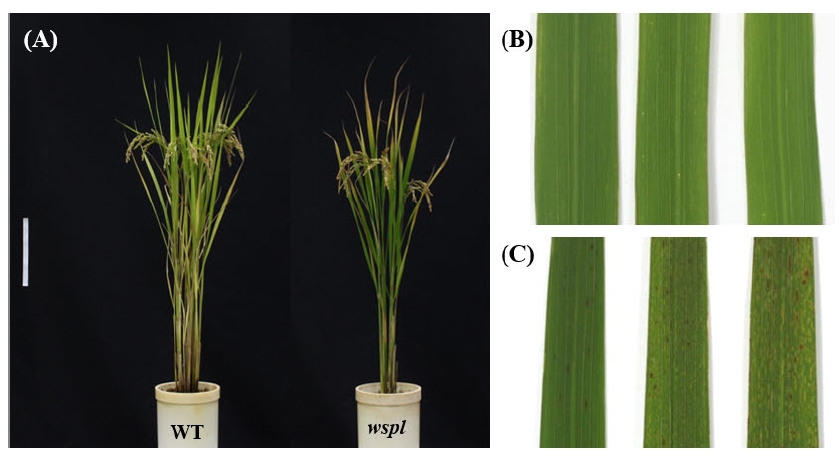
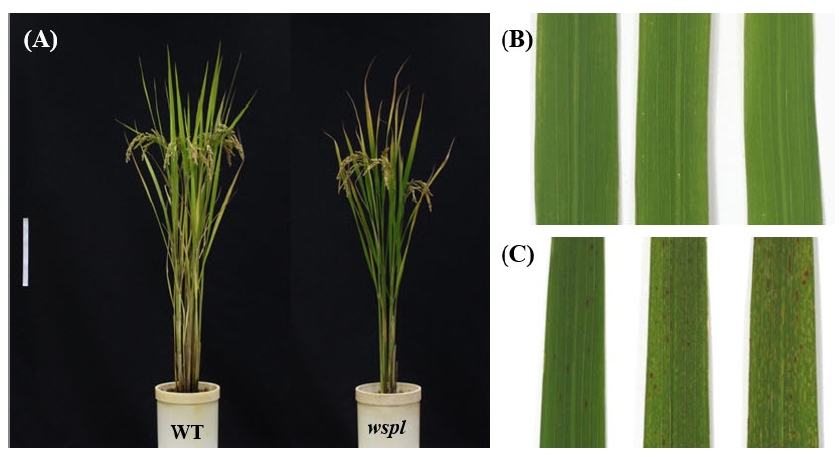
Brown spots or lesion mimics started to appear on the leaves near the tip of the mutant plant from the 5th leaf stage, and the spots increased from the tip to the basal part of the leaf with growth. Unlike other spl mutants, white spots were observed together with the brown spots in wspl mutant at the late tillering stage. As they grew, both spots showed more clearly on the bottom leaves than upper leaves in the mutant plant (Fig. 1B, C). Lesion formation became more severe at the heading stage, the tip of leaves began to lighten up and turned yellow toward the basal at the heading stage in wspl mutant. However, the wspl mutant displayed dark green leaf and leaf sheath across the entire life of plant except for leaf tips (Fig. 1A).
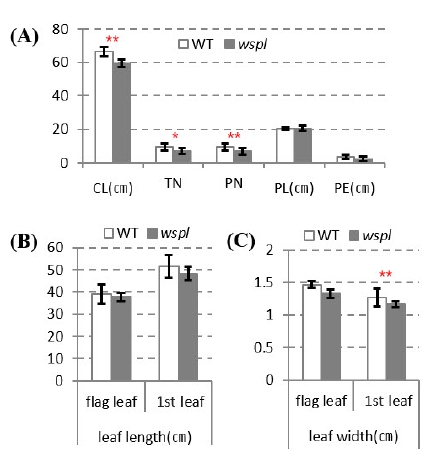
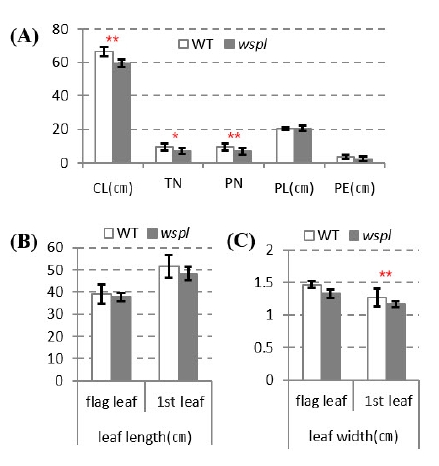
Most of the agronomic traits of the wspl mutant were similar to those of the wild-type. However, the CL of wspl mutant was significantly shorter, and TN and PN were significantly less than those of the wild-type, Ilpum. No significant differences were observed in PL and PE (Fig. 2A). Leaf length and width were not severely reduced in wspl mutant compared to the wild-type; however, significant difference was observed in the width of the first leaf in wspl mutant (Fig. 2B, C). For grain related agronomic traits, as shown in Table 2, the significant difference was observed in 1000-grain weight which was decreased in wspl mutant, whereas GL, GW, and fertility of the wspl mutant were similar to those of the wild-type.
Analysis of chlorophyll contents by SPAD value
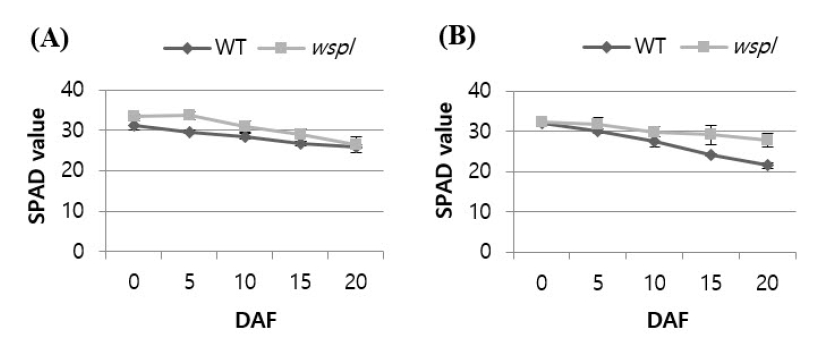
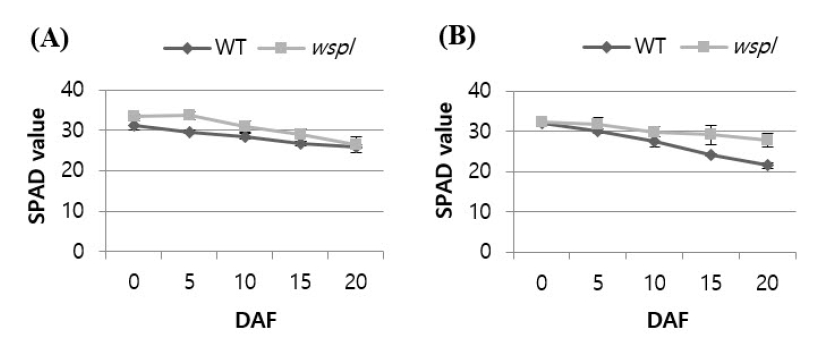
To establish the relation between spots and degree of chlorophyll content, SPAD values were measured in wspl mutant and wild-type plants. SPAD value, indirect indicator of chlorophyll content, of the wspl mutant plant was slightly higher than that of wild-type in both flag leaf and the first leaf (Fig. 3A). In addition, although the lesions expanded more on the leaf, SPAD values on the leaves of wspl mutant slightly decreased than wild-type on the first leaf (Fig. 3B). These results indicate that wspl mutant leaves naturally have higher chlorophyll content compared to the wild-type and the destruction of chlorophylls was not accelerated by the emergence of lesions.
ROS accumulation in the wspl mutant leaf
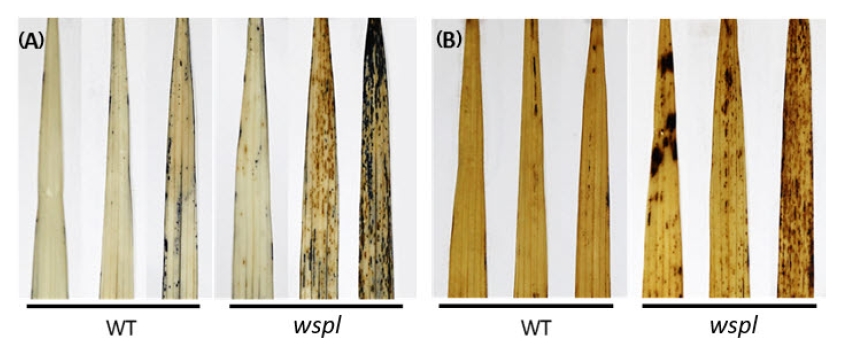
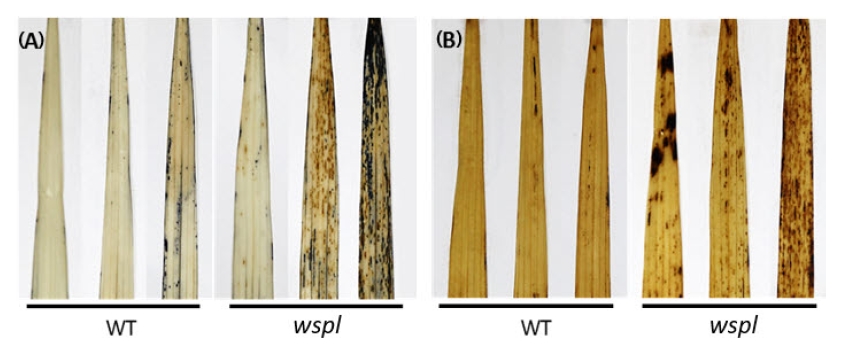
NBT and DAB historical staining were applied to determine ROS formation. Strong NBT staining, an indicator of superoxide anion (O2 ) accumulation, was observed in the second leaf below the flag leaf, whereas there was negligible difference in NTB staining of the flag leaf between wspl mutant and wild-type (Fig. 4A). Similar results were obtained with DAB staining, which indicated H2O2 accumulation. The older leaves, the thicker DAB staining was observed (Fig. 4B). These results indicate that the lesion formation on the wspl mutant leaf is strongly correlated with ROS accumulation.
Genetic analysis and mapping of wspl mutant
F<sub>1</sub> plant derived from the cross between the <italic>wspl</italic> mutant and its wild-type, Ilpum showed the wild-type phenotype. In the F<sub>2</sub> population, segregation ratio of phenotype between the wild-type and the mutant-type was 3:1 suggesting that white-spotted leaf trait is controlled by a single recessive gene (Table 3).
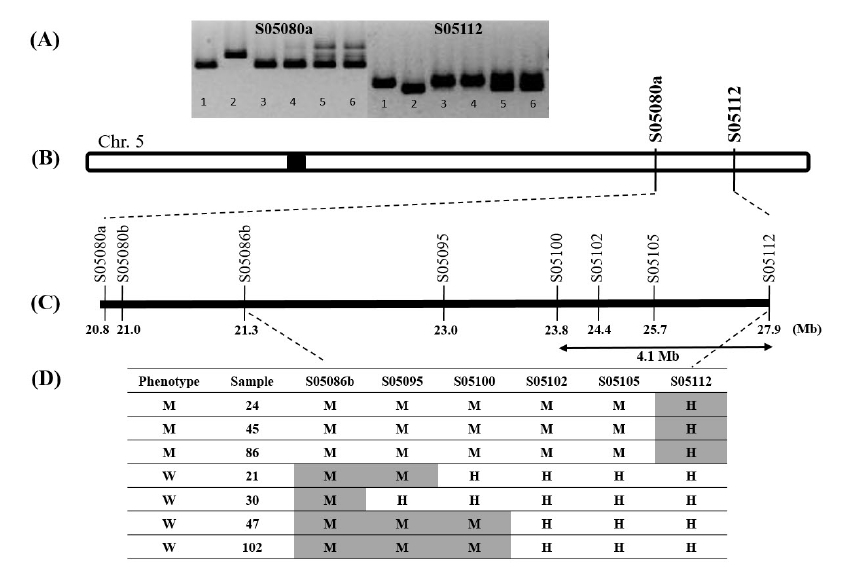
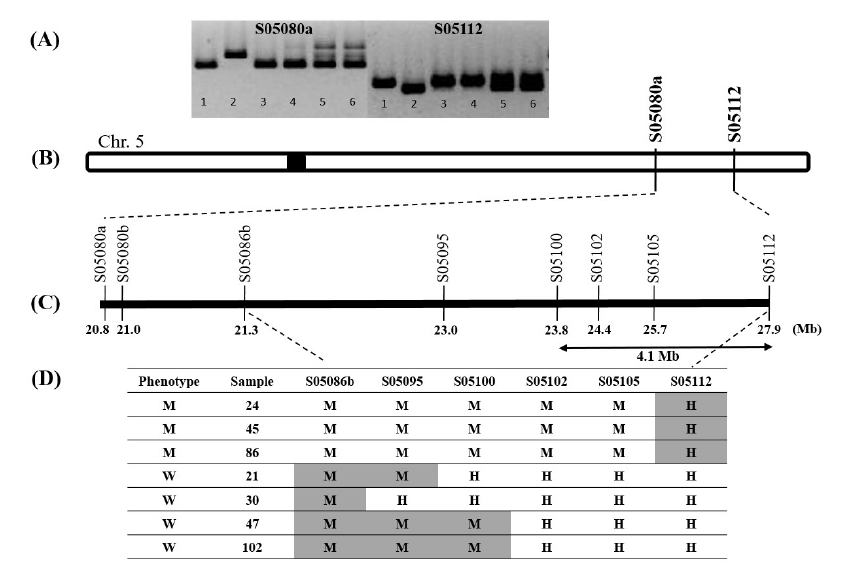
To determine the physical location of the wspl gene, bulked segregant analysis (BSA) was performed using F2 population derived from the cross between the wspl mutant and Milyang23 and revealed that two flanking markers, S05080a and S05112 on the long arm of chromosome 5 were linked with the white-spotted leaf trait (Fig. 5A). To narrow down the position of the wspl locus, six additional STS markers (Table 1), which were located between two flanking markers were designed based on the variation of genome sequence from available databases (http://www.ncbi.nih.gov/ and http://www.rgp.dna.affrc.go.jp/). Of the 175 progenies, there were five recombinants between S05100 and S05112, and the flanking region was narrowed down up to 4.1 Mb (Fig. 5B-D).
SNP and MutMap analysis for searching mutation point
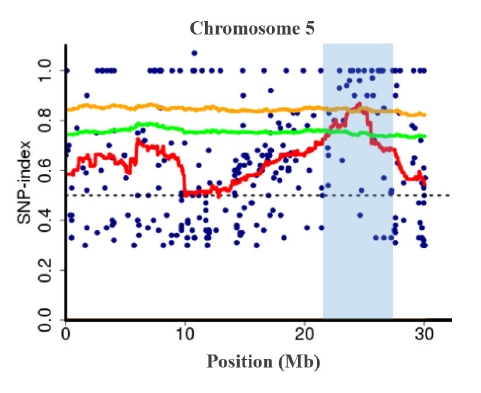
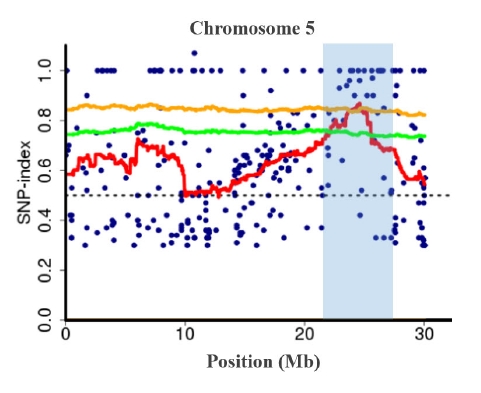
SNP and MutMap analysis were performed to identify the candidate gene and causal SNP position rapidly using whole-genome sequencing data of Ilpum and bulked F2 progenies displaying the mutant phenotype. The bulked F2 progenies DNA sequence reads were aligned to the Ilpum reference sequence, then we calculated the SNP index of each SNP position and generated SNP index plots. As shown in Fig. 6, the average SNP index peak was detected from 22.18 Mb to 25.58 Mb on chromosome 5, suggesting that this locus is the most probable region for the candidate gene. Combining the results of MutMap analysis and brief genetic mapping, we identified two homozygous SNPs with an SNP index of 0.9 to 1 in the genic region within the candidate region based on Rice Genome Annotation Project database (http://rice.plantbiology.msu.edu/) (Table 4). There were two predicted genes, LOC_Os05g0482400 and LOC_Os05g0490000 harboring homozygous SNPs in the coding region. Among the candidate genes, Os05g0482400 encodes Cytochrome P450 family protein and Os05g0490000 encodes KRR1 interacting protein 1 domain containing protein. Further studies will be needed to validate the gene affecting white-spotted leaf in rice.
Spots or lesion mimics show various phenotypic class. Diverse color and size of lesions have been reported, and the time and conditions of lesions appearance are different in the mutants (Lorrain et al. 2003). In this study, we identified a novel white-spotted leaf (wspl) mutant induced by EMS treatment from Ilpum. wspl mutant was genetically controlled by a single recessive gene located on the long arm of chromosome 5. Unlike other spl mutants re ported previously, the wspl mutant has a unique color of lesion on the leaves. The white spots showed together with brown spots in wspl mutant. The white spots/lesions were not observed in the young leaves but increased in number as the leaves matured (Fig. 1B, C). spl20 is the only spl mutant which has small and white spots or lesion mimics reported in rice so far. spl20 mutant was identified from the fast neutron treated mutant lines of the indica cultivar IR64, and small and white dots on the leaves appeared about two weeks after sowing but usually became inconspicuous later (Wu et al. 2008). spl20 mutant has white lesions only, while wspl mutant mixed up white and brown spots on the leaves. In addition, the lesions lasted until late growth stage in wspl mutant, whereas the white lesions were vanished after tillering stage in spl20 mutant. Different phenotype of the spotted leaf mutants which have white spots suggests that lesion mimics are caused by genes involved in different biological processes, and wspl mutant would be a useful source for dissecting the mechanism of programmed cell death related to spots or lesion mimics.
Using SPAD value, we measured the chlorophyll content in the leaves of wspl mutant and wild-type. Interestingly, the chlorophyll content was higher in wspl mutant leaves than that of the wild-type, and wspl mutant leaf maintained higher chlorophyll content compared to wild-type at the flag leaf and the first leaf below the flag leaf (Fig. 3). Despite the density of lesion mimics being higher in the first leaf than flag leaf, the difference of chlorophyll content between wspl mutant and wild-type was greater in the first leaf. However, in most previous studies, the chlorophyll content was decreased in the leaves of spl or lesion mimic mutants. Moreover, these mutants were strongly relate to the early senescence phenotype in mutant leaves which may be caused by the formation of spots (Xu et al. 2014; Sun et al. 2017; Lee et al. 2018). As shown in Fig. 1A, the wspl mutant exhibited dark green color in the leaf and leaf sheath compared to wild-type, and leaf senescence was delayed until late growth stage, except for the tip of the leaves, although the spots or lesion mimics were dispersed on the leaves. We assume that “stay green-like” character of wspl mutant might contribute to maintain high level of chlorophyll contents in the leaves. In addition, several lesion mimic mutants are defect in chlorophyll biosynthesis or degradation result in abnormal accumulation of photoreactive molecules and ROS production (Bruggeman et al. 2015). Defects in chlorophyll catabolic pathway is also able to lead to cell death. For example, disruption of enzymes involved in the degradation of chlorophyll generates spontaneous lesions. (Mach et al. 2001; Tanaka et al. 2003). These studies indicate that regulation of chlorophyll biosynthesis and degradation is essential to cell survival or death. Further studies are needed to elucidate the relationship between chlorophyll contents and the spotted leaf phenotype in rice.
In this study, we identified and characterized the white-spotted leaf rice mutant. Further studies including cloning and the functional study of wspl mutant gene are needed to be performed, and will help expanding the knowledge of programmed cell death and defense mechanism in rice.
This study was supported by a grant from the Next-Generation BioGreen 21 Program (No. PJ013165) of the Rural Development Administration, Korea.
Fig. 1
Morphological comparisons between wild-type and wspl mutant plants. Plant of (A) wild-type (left) and wspl mutant (right) at the ripening stage (bar = 20 cm). (B) Lesion mimic phenotype of wild-type. (C) Lesion mimic phenotype of wspl mutant; first (left), second (middle), third (right) leaves from the top of wild-type and wspl mutant at the late vegetative stage.
PBB-7-340-f1.jpg
Fig. 2
Comparison of the agronomic traits between wild-type and wspl mutant. Comparison of the (A) culm length (CL), tiller number (TN), panicle number (PN), panicle length (PL), panicle exsertion (PE), (B) leaf length and (C) leaf width of flag leaf and the first leaf below the flag leaf of wild-type and wspl. Error bar represents SD (n > 10) and statistically calculated by Student’s t-test (*, ** stand for significant at the 0.05 and 0.01 probability levels, respectively).
PBB-7-340-f2.jpg
Fig. 3
Comparison of the chlorophyll contents using SPAD. Chlorophyll contents in (A) flag leaf and (B) the first leaf below the flag leaf of wild-type and wspl mutant. SPAD value were measured at the indicated times after flowering (DAF, days after flowering). Data show means and SD of biological replicates (n > 5).
PBB-7-340-f3.jpg
Fig. 4
ROS staining in the wspl mutant and wild-type leaf. ROS staining using the flag leaf (left), the first (middle), and the second (right) leaves below the flag leaf of wild-type and wspl mutant at heading stage. (A) NBT staining, (B) DAB staining.
PBB-7-340-f4.jpg
Fig. 5
Bulked segregant analysis, and genetic and physical maps of the containing wspl locus. (A) The two flanking markers, S05080a and S05112 determined by bulked segregant analysis (BSA) from F2 population; 1: wspl, 2: Milyang23, 3, 4: Mutant type bulks, 5, 6: Wild-type bulks. (B) Primary mapping of wspl locus on the long arm of chromosome 5 between S05080a and S05112. (C) Fine mapping of candidate region using additional STS markers. (D) Graphical genotype results of the fine mapping. W: Wild type, M: Mutant type, H: heterozygous type.
PBB-7-340-f5.jpg
Fig. 6
SNP index plot of chromosome 5 for identification of genomic regions harboring the causal mutation of wspl gene. Blue dots indicate SNP index values at a given SNP position. Red line represents the sliding window average of SNP index values of the 4 Mb interval with 10 kb increments. Green line shows the sliding window average of 95% confidence interval. Orange line shows the sliding window average of 99% confidence interval. Blue shaded area indicates the region presumably harboring the causal mutation.
PBB-7-340-f6.jpg
Table 1
PCR-based molecular markers designed for fine mapping.
Table 1
Marker Forward primer (5ʹ → 3ʹ) Reverse primer (5ʹ → 3ʹ) Physical Position (Build5)
S05080a TGGCCAACTTTGGGAATTTA AAGAGTCGTGCAAATGAAAAGA 20804350 - 20804578
S05080b ACTTCATGCAGCCCACGTA CACGAGCTCTCCTCCAAGAC 21003920 - 21004165
S05086b CGTTTGATCGTTCAGTTTCG GATTTTGCCGCTAGCTGACT 21295727 - 21295971
S05095 AGGCAGCAAGAGCATACCAT CACTTGACCCTTGCAGGAAT 22968727 - 22968913
S05100 CACATTTGACAATATGGGCC TCAGATTTACGTGGGTGTTT 23767244 - 23767356
S05102 GGGCTGATATGTTCCTCGAA TCAAGAGGAGACCATAACCATTG 24396221 - 24396397
S05105 TGGCGTCCAAGAAGTAGGTC TCTCTTGAAATCAACCCATCAA 25704179 - 25704411
S05112 GCGCTCTTACCACATCAAGA GTTGAGTGAAGCAGCGAATG 27884417 - 27884596
Table 2
Comparison of grain related agronomic traits between wild-type and wspl mutant.
Table 2
HD GL (mm) GW (mm) 1000 grain weight (g) Grain fertility (%)
Wild-type 24-Aug 5.53 ± 0.18 3.33 ± 0.15 25.97 ± 0.09 82.15 ± 7.98
wspl 20-Aug 5.58 ± 0.10 3.37 ± 0.05 21.12 ± 0.32** 85.64 ± 5.46

Values are mean ± standard deviation. Comparison of the heading date in 2014 (HD), grain length (GL), grain width (GW), 1000 grain weight and grain fertility of wild-type and wspl. Data show mean and SD of biological replicates (n > 10) and statistically calculated by Student’s t-test (NS,

*, and

** stand for not statistically significant at the 0.05 probability level, significant at the 0.05 and 0.01 probability levels, respectively).

Table 3
Genetic segregation of wspl mutant in F2 population developed from the cross between the wspl mutant and its wild-type, Ilpum.
Table 3
Total Wild type Mutant type c2 (3:1) (P = 0.05, c2 = 3.841)
190 148 42 0.085

Values are mean ± standard deviation. Comparison of the heading date in 2014 (HD), grain length (GL), grain width (GW), 1000 grain weight and grain fertility of wild-type and wspl. Data show mean and SD of biological replicates (n > 10) and statistically calculated by Student’s t-test (NS,

*, and

** stand for not statistically significant at the 0.05 probability level, significant at the 0.05 and 0.01 probability levels, respectively).

Table 4
Candidate genes and SNPs position in candidate region for wspl trait.
Table 4
Position Status Reference Query Region Gene ID (RAP-DB/MSU) Description
23834064 Difference C T CDS Os05g0482400 Os05g40384 Cytochrome P450 family protein
24174423 Difference C T CDS Os05g0490000 Os05g41100 KRR1 interacting protein 1 domain containing protein

Position of SNPs was based on the Nipponbare genome sequence, Build 5 ver. (http://rgp.dna.affrc.go.jp/E/IRGSP/Build5/build5.html).

  • Abe A, Kosugi S, Yoshida K, Natsume S, Takagi H, Kanzaki H, et al. 2012. Genome sequencing reveals agronomically important loci in rice using. MutMap. Nat. Biotechnol.. 30: 174-178.
  • Bruggeman Q, Raynaud C, Benhamed M, Delarue M. 2015. To die or not to die? Lessons from lesion mimic mutants. Front. Plant Sci.. 6: 24
  • Chen XF, Hao L, Pan JW, Zheng XX, Jiang GH, Jin Y, et al. 2012. SPL5, a cell death and defense-related gene, encodes a putative splicing factor 3b subunit 3 (SF3b3) in rice. Mol. Breed.. 30: 939-949.
  • Chin JH, Kim JH, Jiang W, Chu SH, Woo MO, Han L, et al. 2007. Identification of subspecies-specific STS markers and their association with segregation distortion in rice (Oryza sativa L.). J. Crop Sci. Biotech.. 10: 175-184.
  • Dangl JL, Jones JDG. 2001. Plant pathogens and integrated defence responses to infection. Nature. 411: 826-833.
  • Dietrich RA, Delaney TP, Uknes SJ, Ward ER, Ryals JA, Dangl JL. 1994. Arabidopsis mutants simulating disease resistance response. Cell. 77: 565-577.
  • Dietz KJ, Turkan I, Krieger-Liszkay A. 2016. Redox-and reactive oxygen species-dependent signaling into and out of the photosynthesizing chloroplast. Plant Physiol.. 171: 1541-1550.
  • Elmore S. 2007. Apoptosis: a review of programmed cell death. Toxicol. Pathol.. 35: 495-516.
  • Gill SS, Tuteja N. 2010. Reactive oxygen species and antioxidant machinery in abiotic stress tolerance in crop plants. Plant Physiol. Biochem.. 48: 909-930.
  • Huang HL, Ullah F, Zhou DX, Yi M, Zhao Y. 2019. Mechanisms of ROS regulation of plant development and stress responses. Front. Plant Sci.. 10: 800
  • Huang QN, Yang Y, Shi YF, Chen J, Wu JI. 2010. Spotted-leaf mutants of rice (Oryza sativa). Rice Sci.. 17: 247-256.
  • Huang SB, Van Aken, Schwarzlander M, Belt K, Millar AH. 2016. The roles of mitochondrial reactive oxygen species in cellular signaling and stress response in plants. Plant Physiol.. 171: 1551-1559.
  • Huysmans M, Lema AS, Coll NS, Nowack MK. 2017. Dying two deaths -programmed cell death regulation in development and disease. Curr. Opin. Plant Biol.. 35: 37-44.
  • Jabs T, Dietrich RA, Dangl JL. 1996. Initiation of runaway cell death in an Arabidopsis mutant by extracellular superoxide. Science. 273: 1853-1856.
  • Jin B, Zhou XR, Jiang BL, Gu ZM, Zhang PH, Qian Q, et al. 2015. Transcriptome profiling of the spl5 mutant reveals that SPL5 has a negative role in the biosynthesis of serotonin for rice disease resistance. Rice (N. Y.). 8: 18
  • Kosugi S, Natsume S, Yoshida K, Maclean D, Cano L, Kamoun S, et al. 2013. Coval: improving alignment quality and variant calling accuracy for next-generation sequencing data. PLoS One. 8: e75402.
  • Lee D, Lee G, Kim B, Jang S, Lee Y, Yu Y, et al. 2018. Identification of a spotted leaf sheath gene involved in early senescence and defense response in rice. Front. Plant Sci.. 9: 1274
  • Li H, Durbin R. 2009. Fast and accurate short read alignment with Burrows-Wheeler transform. Bioinformatics. 25: 1754-1760.
  • Li H, Handsaker B, Wysoker A, Fennell T, Ruan J, Homer N, et al. 2009. The Sequence Alignment/Map format and SAMtools. Bioinformatics. 25: 2078-2079.
  • Li Z, Zhang YX, Liu L, Liu QE, Bi ZZ, Yu N, et al. 2014. Fine mapping of the lesion mimic and early senescence 1 (lmes1) in rice (Oryza sativa). Plant Physiol. Biochem.. 80: 300-307.
  • Lorrain S, Lina BQ, Auriac MC, Kroj T, Saindrenan P, Nicole M, et al. 2004. Vascular associated death1, a novel gram domain-containing protein, is a regulator of cell death and defense responses in vascular tissues. Plant Cell. 16: 2217-2232.
  • Lorrain S, Vailleau F, Balaque C, Roby D. 2003. Lesion mimic mutants: keys for deciphering cell death and defense pathways in plants? Trends Plant Sci.. 8: 263-271.
  • Mach JM, Castillo AR, Hoogstraten R, Greenberg JT. 2001. The Arabidopsis-accelerated cell death gene ACD2 encodes red chlorophyll catabolite reductase and suppresses the spread of disease symptoms. Proc. Natl. Acad. Sci. U.S.A.. 98: 771-776.
  • Mahalingam R, Jambunathan N, Gunjan SK, Faustin E, Weng H, Ayoubi P. 2006. Analysis of oxidative signalling induced by ozone in Arabidopsis thaliana . Plant Cell Environ.. 29: 1357-1371.
  • Michelmore RW, Paran I, Kesseli RV. 1991. Identification of markers linked to disease-resistance genes by bulked segregant analysis: a rapid method to detect markers in specific genomic regions by using segregating populations. Proc. Natl. Acad. Sci. U.S.A.. 88: 9828-9832.
  • Mittler R. 2017. ROS are good. Trends Plant Sci.. 22: 11-19.
  • Murray MG, Thompson WF. 1980. Rapid isolation of high molecular-weight plant DNA. Nucleic Acids Res.. 8: 4321-4325.
  • Parent C, Capelli N, Dat J. 2008. Reactive oxygen species, stress and cell death in plants. C. R. Biol.. 331: 255-261.
  • Qiao Y, Jiang W, Lee J, Park B, Choi MS, Piao R, et al. 2010. SPL28 encodes a clathrin-associated adaptor protein complex 1, medium subunit mu 1 (AP1M1) and is responsible for spotted leaf and early senescence in rice (Oryza sativa). New Phytol.. 185: 258-274.
  • Sandalio LM, Romero-Puertas MC. 2015. Peroxisomes sense and respond to environmental cues by regulating ROS and RNS signalling networks. Ann. Bot.. 116: 475-485.
  • Shen HC, Shi YF, Feng BH, Wang HM, Xu X, Huang QN, et al. 2014. Identification and genetic analysis of a novel rice spotted-leaf mutant with broad-spectrum resistance to Xanthomonas oryzae pv. oryzae . J. Intergr. Agric.. 13: 713-721.
  • Song G, Kwon CT, Kim SH, Shim Y, Lim C, Koh HJ, et al. 2019. The rice SPOTTED LEAF4 (SPL4) encodes a plant spastin that inhibits ROS accumulation in leaf development and functions in leaf senescence. Front. Plant Sci.. 9: 1925
  • Sun LT, Wang YH, Liu LL, Wang CM, Gan T, Zhang ZY, et al. 2017. Isolation and characterization of a spotted leaf 32 mutant with early leaf senescence and enhanced defense response in rice. Sci. Rep.. 7: 41846
  • Tanaka R, Hirashima M, Satoh S, Tanaka A. 2003. The Arabidopsis-accelerated cell death gene ACD1 is involved in oxygenation of pheophorbide a: inhibition of the pheophorbide a oxygenase activity does not lead to the "Stay-Green" phenotype in Arabidopsis. Plant Cell Physiol.. 44: 1266-1274.
  • Tsukagoshi H, Busch W, Benfey PN. 2010. Transcriptional regulation of ROS controls transition from proliferation to differentiation in the root. Cell. 143: 606-616.
  • Wang SA, Lei CL, Wang JL, Ma J, Tang S, Wang CL, et al. 2017. SPL33, encoding an eEF1A-like protein, negatively regulates cell death and defense responses in rice. J. Exp. Bot.. 68: 899-913.
  • Wang SH, Lim JH, Kim SS, Cho SH, Yoo SC, Koh HJ, et al. 2015. Mutation of SPOTTED LEAF3 (SPL3) impairs abscisic acid-responsive signalling and delays leaf senescence in rice. J. Exp. Bot.. 66: 7045-7059.
  • Williams B, Dickman M. 2008. Plant programmed cell death: can't live with it; can't live without it. Mol. Plant Pathol.. 9: 531-544.
  • Wu CJ, Bordeos A, Madamba MRS, Baraoidan M, Ramos M, Wang GL, et al. 2008. Rice lesion mimic mutants with enhanced resistance to diseases. Mol. Genet. Genomics. 279: 605-619.
  • Xu X, Zhang LL, Liu BM, Ye YF, Wu YJ. 2014. Characterization and mapping of a spotted leaf mutant in rice (Oryza sativa). Genet. Mol. Biol.. 37: 406-413.
  • Yamanouchi U, Yano M, Lin HX, Ashikari M, Yamada K. 2002. A rice spotted leaf gene, SpI7, encodes a heat stress transcription factor protein. Proc. Natl. Acad. Sci. U.S.A.. 99: 7530-7535.
  • Zeng LR, Qu SH, Bordeos A, Yang CW, Baraoidan M, Yan HY, et al. 2004. Spotted leaf11, a negative regulator of plant cell death and defense, encodes a U-box/armadillo repeat protein endowed with E3 ubiquitin ligase activity. Plant Cell. 16: 2795-2808.


Download Citation

Download a citation file in RIS format that can be imported by all major citation management software, including EndNote, ProCite, RefWorks, and Reference Manager.

Format:

Include:

Characterization and Genetic Mapping of White-Spotted Leaf (wspl) Mutant in Rice
Plant Breed. Biotech.. 2019;7(4):340-349.   Published online December 1, 2019
Download Citation

Download a citation file in RIS format that can be imported by all major citation management software, including EndNote, ProCite, RefWorks, and Reference Manager.

Format:
Include:
Characterization and Genetic Mapping of White-Spotted Leaf (wspl) Mutant in Rice
Plant Breed. Biotech.. 2019;7(4):340-349.   Published online December 1, 2019
Close

Figure

  • 0
  • 1
  • 2
  • 3
  • 4
  • 5
Characterization and Genetic Mapping of White-Spotted Leaf (wspl) Mutant in Rice
Image Image Image Image Image Image
Fig. 1 Morphological comparisons between wild-type and wspl mutant plants. Plant of (A) wild-type (left) and wspl mutant (right) at the ripening stage (bar = 20 cm). (B) Lesion mimic phenotype of wild-type. (C) Lesion mimic phenotype of wspl mutant; first (left), second (middle), third (right) leaves from the top of wild-type and wspl mutant at the late vegetative stage.
Fig. 2 Comparison of the agronomic traits between wild-type and wspl mutant. Comparison of the (A) culm length (CL), tiller number (TN), panicle number (PN), panicle length (PL), panicle exsertion (PE), (B) leaf length and (C) leaf width of flag leaf and the first leaf below the flag leaf of wild-type and wspl. Error bar represents SD (n > 10) and statistically calculated by Student’s t-test (*, ** stand for significant at the 0.05 and 0.01 probability levels, respectively).
Fig. 3 Comparison of the chlorophyll contents using SPAD. Chlorophyll contents in (A) flag leaf and (B) the first leaf below the flag leaf of wild-type and wspl mutant. SPAD value were measured at the indicated times after flowering (DAF, days after flowering). Data show means and SD of biological replicates (n > 5).
Fig. 4 ROS staining in the wspl mutant and wild-type leaf. ROS staining using the flag leaf (left), the first (middle), and the second (right) leaves below the flag leaf of wild-type and wspl mutant at heading stage. (A) NBT staining, (B) DAB staining.
Fig. 5 Bulked segregant analysis, and genetic and physical maps of the containing wspl locus. (A) The two flanking markers, S05080a and S05112 determined by bulked segregant analysis (BSA) from F2 population; 1: wspl, 2: Milyang23, 3, 4: Mutant type bulks, 5, 6: Wild-type bulks. (B) Primary mapping of wspl locus on the long arm of chromosome 5 between S05080a and S05112. (C) Fine mapping of candidate region using additional STS markers. (D) Graphical genotype results of the fine mapping. W: Wild type, M: Mutant type, H: heterozygous type.
Fig. 6 SNP index plot of chromosome 5 for identification of genomic regions harboring the causal mutation of wspl gene. Blue dots indicate SNP index values at a given SNP position. Red line represents the sliding window average of SNP index values of the 4 Mb interval with 10 kb increments. Green line shows the sliding window average of 95% confidence interval. Orange line shows the sliding window average of 99% confidence interval. Blue shaded area indicates the region presumably harboring the causal mutation.
Characterization and Genetic Mapping of White-Spotted Leaf (wspl) Mutant in Rice

PCR-based molecular markers designed for fine mapping.

Marker Forward primer (5ʹ → 3ʹ) Reverse primer (5ʹ → 3ʹ) Physical Position (Build5)
S05080a TGGCCAACTTTGGGAATTTA AAGAGTCGTGCAAATGAAAAGA 20804350 - 20804578
S05080b ACTTCATGCAGCCCACGTA CACGAGCTCTCCTCCAAGAC 21003920 - 21004165
S05086b CGTTTGATCGTTCAGTTTCG GATTTTGCCGCTAGCTGACT 21295727 - 21295971
S05095 AGGCAGCAAGAGCATACCAT CACTTGACCCTTGCAGGAAT 22968727 - 22968913
S05100 CACATTTGACAATATGGGCC TCAGATTTACGTGGGTGTTT 23767244 - 23767356
S05102 GGGCTGATATGTTCCTCGAA TCAAGAGGAGACCATAACCATTG 24396221 - 24396397
S05105 TGGCGTCCAAGAAGTAGGTC TCTCTTGAAATCAACCCATCAA 25704179 - 25704411
S05112 GCGCTCTTACCACATCAAGA GTTGAGTGAAGCAGCGAATG 27884417 - 27884596

Comparison of grain related agronomic traits between wild-type and wspl mutant.

HD GL (mm) GW (mm) 1000 grain weight (g) Grain fertility (%)
Wild-type 24-Aug 5.53 ± 0.18 3.33 ± 0.15 25.97 ± 0.09 82.15 ± 7.98
wspl 20-Aug 5.58 ± 0.10 3.37 ± 0.05 21.12 ± 0.32** 85.64 ± 5.46

Values are mean ± standard deviation. Comparison of the heading date in 2014 (HD), grain length (GL), grain width (GW), 1000 grain weight and grain fertility of wild-type and wspl. Data show mean and SD of biological replicates (n > 10) and statistically calculated by Student’s t-test (NS,

, and

stand for not statistically significant at the 0.05 probability level, significant at the 0.05 and 0.01 probability levels, respectively).

Genetic segregation of wspl mutant in F2 population developed from the cross between the wspl mutant and its wild-type, Ilpum.

Total Wild type Mutant type c2 (3:1) (P = 0.05, c2 = 3.841)
190 148 42 0.085

Values are mean ± standard deviation. Comparison of the heading date in 2014 (HD), grain length (GL), grain width (GW), 1000 grain weight and grain fertility of wild-type and wspl. Data show mean and SD of biological replicates (n > 10) and statistically calculated by Student’s t-test (NS,

, and

stand for not statistically significant at the 0.05 probability level, significant at the 0.05 and 0.01 probability levels, respectively).

Candidate genes and SNPs position in candidate region for wspl trait.

Position Status Reference Query Region Gene ID (RAP-DB/MSU) Description
23834064 Difference C T CDS Os05g0482400 Os05g40384 Cytochrome P450 family protein
24174423 Difference C T CDS Os05g0490000 Os05g41100 KRR1 interacting protein 1 domain containing protein

Position of SNPs was based on the Nipponbare genome sequence, Build 5 ver. (http://rgp.dna.affrc.go.jp/E/IRGSP/Build5/build5.html).

Table 1 PCR-based molecular markers designed for fine mapping.
Table 2 Comparison of grain related agronomic traits between wild-type and wspl mutant.

Values are mean ± standard deviation. Comparison of the heading date in 2014 (HD), grain length (GL), grain width (GW), 1000 grain weight and grain fertility of wild-type and wspl. Data show mean and SD of biological replicates (n > 10) and statistically calculated by Student’s t-test (NS,

, and

stand for not statistically significant at the 0.05 probability level, significant at the 0.05 and 0.01 probability levels, respectively).

Table 3 Genetic segregation of wspl mutant in F2 population developed from the cross between the wspl mutant and its wild-type, Ilpum.

Values are mean ± standard deviation. Comparison of the heading date in 2014 (HD), grain length (GL), grain width (GW), 1000 grain weight and grain fertility of wild-type and wspl. Data show mean and SD of biological replicates (n > 10) and statistically calculated by Student’s t-test (NS,

, and

stand for not statistically significant at the 0.05 probability level, significant at the 0.05 and 0.01 probability levels, respectively).

Table 4 Candidate genes and SNPs position in candidate region for wspl trait.

Position of SNPs was based on the Nipponbare genome sequence, Build 5 ver. (http://rgp.dna.affrc.go.jp/E/IRGSP/Build5/build5.html).