Skip to main navigation Skip to main content
  • KSBS
  • E-Submission

Plant Breed. Biotech. : Plant Breeding and Biotechnology

OPEN ACCESS
ABOUT
BROWSE ARTICLES
EDITORIAL POLICIES
FOR CONTRIBUTORS

Articles

Research Article

Heat Stress Induced Potato virus X-mediated CRISPR/Cas9 Genome Editing in Nicotiana benthamiana

Plant Breeding and Biotechnology 2022;10(3):186-196.
Published online: August 31, 2022

Department of Agriculture, Forestry and Bioresources, Research Institute of Agriculture and Life Sciences, Plant Genomics Breeding Institute, College of Agriculture and Life Sciences, Seoul National University, Seoul 08826, KoreaJFIFddDuckydqhttp://ns.adobe.com/xap/1.0/ Adobed     ! 1AQa"q 2#w8B36v7XRr$9bCt%u&Ws'(xy4T5fH  !1AQaq"2B Rbr#u67Ѳ3sTt5v8Sc$4ĂCÔ%UӅFV ?_Aנj- H>>,m*>fzp"TrKkr^r.|_&]|*vPuܶvoQ1mwVJUhu-I"=LniAƕ8"۲ k*ҿ[yu:.vUQ+)%F DHyVBk>Hy8jݹ q~9D4KRmzQ)^ʔ.J%k_tVi5NTjg!'ky|5asOȻ)R۸ߩFMԿ3L4j6dڜ#NIwUF]JqB/(FafJRzq3\G՛ ?~\ 6)6W4m[O^L0E&rRMض*C .]Unl-1 1r#Rj/&QɈ׉˩s6Rj=5Tg.y.·Pӡ:JJS:C8-2u]d&vUz;7p9 5VnL֢"y)">iי(IDDd| Yj0; LRfS:ktYK%*N2^m|&dğth":ey)uPQZW)gcC3Pv&MMWd&Ŵ۲mvTRoժM03*F3Yd6\8,\hݻ kߔi<k NTwSԪmljj[>->ptU%'LR>&EBH$MQAUx[$Z6vi&_a.KIQ{hyƒ j"JOC9eFҝfj;˚Ω<[3_m% lQ@4g=5$(J]Yc-OMq<Ǎ wSzڗ)k$7VIP붾ͯnV+卵*t]iЎD31~SA1éC2u)ʼnQn-Uoi3:grI8ؓWm*G zܕ)ZקJ}Y YlGeJ6cB2I NS3Q>k=KTBT]W6+SOXQgGR? telˊ%-Re\hѯ2TF"C/OJΩ6r[N.0{SpljjX1“jOsӥ;ҭhe}xu`Ք&.)yO̒ Fߑ.$Qw;9Iw2o+RVJMSOj[SoҌZ%;`d$blQ{Ro{Imڌ>3egf\O֝Uzx"䢸g+mv%Gʆ:|V[N'&ס-ޝ'kfE|K,G&˳98Juin/\\Qݿ̋v~Ǩ!rtWU d|E߫R4d}.qPw*Ӭv5YEcn~f5c%MTMkb-F>5JT,})QHg%{("ӔȸWMsYyWNRrkkJr0XドnͫT}r-jj,Ŕʍ\Q2Ri>v$5!]"JB2WɅ)]VԜUc8i|.jeRO6^V.¸ Q&#|ܶ-*uOG%JAtRZRr]FFG\۩w+?'zչSѧt jz>KW&ot{7P&2D;&\\>Q2JzܗAKSfeNn[jRrԕf6,q,F1tRfԗ>vֶևj-&R'Zi2=xv~Elbsvm8=ӛ"ū񕜈BȩlWau[]ٷBߨF~J!|Ipr3R̴#Yp)={7:G{+:\W}n|Q#%)7^-h"Ƒq:M*%J&$T軨I333׎g_- ucBwwjp[6i25$̏bU’ٱRv?G\~#Iͪb7<<}Ezt" q_Inw,7-d,G÷%T* Wg1"䥱kq/A.,_KhqŒxwvo u2ۥۧ.bQ}XκA$֣ +K״ZUNmڸII{.v{5z5ѮRme[moyƾd~cRݾK'j.\i&/S6f|b=5: p!6i_ 4j6=.si˧eƾtS^c.Y^RJVS-Vi3,esi08?H$GvZgg?gi䤟2adw릿:"۪lkSN>q-4kI܋ێe̊qۅgDoѨ9; #T.Q;7#~_Ufstb_'w~Xw1Xk,vcOt._}v}8"(4Z\ۘgk?J?bm_c!g{HZV]Fkk%~gEt)b秴vΰB|꽸}mp~E6ݹv;7P٤v+ri*3Ԣ|'O14_~7nP{7ZU\Vű[ +7󖱅o#:ǥŬ\|3r%TJX]V7ez¨Y]lc|O3V! R zbJ'PnGqVJ"19WVeOF埜EaEJωqCN5Z g-9[S<$sUK5b|7sn\7x qmv##FF\ w[=-43$^ooVSiXօv7iB۴yg>]Vf"r$J3""32!Zh[K%7GvNLs+4nB/B{vlsobJaҺJR:0g%&zR\ S3T[&ִor*ⷳc3ʊO[iozW٨%$gn:ܶWwFBԹjHP&z u&F2\f;ipW73 [; '_̽b;vib!oec dC-tS__$Xs]l9&z$2/N>%'[}b{h/{`{Ji׉׏ YJB/X%}.|+{(S:qz]4_Kѵo`^tY_4S#* ^zvݾMr+TrkQ g.8Ͽ^i>ӈǙvix>$o( ^qt*&t1oJVu-ql5U6jCЉmĻ*"?JT=K'O/|=Vo}l0b}}f?X[?/\JSBe,kP8ETJ==?.p5ފgbU9}ǶdNKk—_$8̸͓ۍ8Di\BԿ-1v{FF]|.^ۅ{vl12׏z7-R7wE?\nh\jN/Kձr_oBw"N QMBZqe-m:ӨSn6j4%!hQ;sv'm4kcM=!8\m[M4{SMliۇ%eֽR&N:{2A8)THLK3Zj[jPBx#BگMf:G1\`edcʮ?|w(-̮vXt,bW2;.ιNHRR#YwTM"<;mk\.foIDjmlJ;vxy7o7i\,KQŊ9d^Mmgc L*.T6tLeIuOH3SJQ3=F/ʿ<9\JM6mN6=<{xkP!F1QR[I$6ُimXu2An2yԒMU q f[IB-'䤯jYm52&JG\zд\~vdg QtHGXw&1Lw+nDEdC1w|YJmvP)HZ>i0BPβә?R:QO["]I_Jʏۍ>QKyu^bycBq4lXF~l [\*N>-J6,Gq(Zr5h]CwYӤU~ʶߑ u*SIv%ZfJ7)! FS*s_\|IŸZ)J ]ܜi4"z[+Z,MOZ))}|Ʀ(RUNIII.S'ˍO~˨rn}M)xxӕ0 eyҵ7YMAB]ӣU:/ѭ*6bcwP͵ "+qēVjŹO|GtY4V j[mLV M -m>",B$ GD1~j6O4|LxnNmqATNR3ε|DŽa[fmn-ڭ+FiK7Pcm;r5 l8r{#-]'nrFh2ruycb;pW=njRqRJ(d mnpckNnʹ+6]tz~E=ʕ l ZZ5jSi3#47.Lcfe`9؏v囜.F\-UZ:*0_<Νu9Lӵm&)_3\^ҹ3"1n1v_|uRʞͫr'iȧN_kH׺8xXrj=\МH)V\ˬ.Xʸ oVRC}ySU9/OBY먌5 ٿwޞ)rw8Ӫi5*5ZΗcGƱ !ZۄlmpjJ -l <R̵/JAպZuq\IdUS 48wXJJtcg4cI~aqߓwŷrm-v)G7yS^7H^-\mŌAq|"m9IBnF㏉9[N+mmy/!KKۉ%n +BdddfFF6FQRN-U5;Sv'm4kcM=Mn)\qιqUd9F%",6MGdT%-+~ f%+y֛^3SrF>6lc(֪vۊN;g._0Sѧ]ETWرkQKzGe9ʨsKA"yC y2\[5 rԭ7Gk5Mzw_4sM3hxЊ'oÍ5jsub )ͪ~tR2H]R͍>̋m6=%(˿(Wrr-܅y5(ܔJ޺YunW̹븹NsqK ]/QR#"ZMDfD|43Qw|._ԡSqTZBg??O Ϥ)/E_U|i}2 9Z?¹0:x'3,whǣ?C y-A~=daJј&M?D1_PS+Oi&;a @;Dž7[ zZC"bv:jjMQk$M RԸ3uA\=wI.AwC"^.{?-\NSiˏ"b}T/}q/ o.1M}R%:-ZniʒL$SgrBW*,Mw'N\ɇ{s\j]VryG'8f`}'N<*/`U숻z CwHq18J+vԕKss4R53/&XTt1bZƟo\=%nO)h$rBi-nKĪ^ ջڜlwkYm[̑+/QrZo%TQ;TLs($2C:s.%+eoNttq۰kK7O0m_t_pZ1SsSM7"mevFZ[w -FJ*T*jФQRg BSu|]g:ɵzjqwmltL.e3sRMچkSmjkmWœިm++¦'tILk*բQ D,PB\lI[9{%Gb R6öۍmX-MaʉA931cs..G4CujQտ[9 }G-xwl)IQz j Ó"rqe&=]꾧֎c)<kӳ+0JrRR3'TnXi^xMF Bު*tIL.[h"2"nKzZe'ZV/RrNYz]8죝n]Ķܩ>^Ժ]u-7^\mZjܣ9+Rmn ߑv?oꋘ?&ƪy^N4o=3-ؔ̿*`}V݁ ƒPu8%$ ݗ]wt;\y\>='OjPIp/nJU8{϶FNMsf"ίNqƹ(+ ݮF2Km |jܴZs%zf*eȫ?]4)I۵nR&FX + [jDh(#哑9q9Eծj8noǕZf\J-l&Z˫}`ӎhyrΉn\űn]9pʌӣ"׮Wt?N4_I_~54#/my1Xr*척aS#DT >q ssΛW;3oUaJSRMDgQnt:Ql,/ ܷfRqiM Ȼ>Cob;A>ڦWقM9X~/!'MW.}Vrߔꔵ!5|iB(0-zF=}okڢE$^wW~nokY߮\6՜̌{i-AF*9)\t9IV6۸5ZUF6R$ŨQIq砳YUZ]eyv >hI櫥N )&l JulwE1GDOuFN2| }馥uC1rޫV+^gdb&W[4<^e4YW,d|htͮsUM)۸8:{3d{AѢ)~ \#J=NdƮꮓ90 |1K$v*?мS ]i$J,C,SG?/_՜pMSƯM|mG1V1$~K>CSvkuj=&) -,yLjuFHK{c駗.SOua;BrSqj-ۍZ#'Jys7[g2z/.u4+XV2VQ.ޕ)$"(%)#Z7suZ%j }BǬݕe)Jvz8zJf:hIN|svO1O#IEcۍjݽ:SdὮvu^@:o^5cs>i/VqmVm]ؔܢn6'vޑ̗J4Wn@OlKbX ;n:hgJ9ŻyǑz8f܌q&Y fN0N;[69 rbׅC2/#kE l&2~èMR.*%g=Ft.%؝e8<.e=Uv{~㻏"EˑnvDѭ͜Lu3u0:U֝$[M5<:oi+V4V9 6nXvx&_ q Qqw3W:uϔ2yb/(ɳ|5zQiJ#r|Hw#.W?4aDŲ\ugWG;Cw鐢K|xg)##=O.dF˟jMUvWĻsr.z]kPc9"]R)mkfOd*uYf١RsB Aîh=k]ʳUrrZsq`d#r$/Ը3o^&lRWȍyuW̦Y4QDUMJ65ƒ[+ygk XK_±k#y:8(TJOSQhJt2.DR}"5[) r)6V6u5k:eXZmv𭤔!푊Q[qQ}ҹLE- 8qIZG|UM4j}Mܕ[Vwm{} Naqµ"ԈM zOpKѰ?IAD3Ir0'/q1itoB5{%wkOBn-ۜduqIzYK60{+DʕܞqIt";r1mG/\/ym[6JƫR \L=S=OT@Ix[TMm{>ݾտ֒ݸӉLYIx>+"JVNzx||5rI?C{oz8۹e\R-^\A2F R+N9 vlT]"ۭ d)t֞i #E2jB@׵=#/N+!ĕhx}I!cM`ąZ*ŻɄҒ߮Y.Z}='/oۙ3IpW̮hT7cTSuz9>B}΄&h!>lӵn~j˅IvU.'v'CSZw8QK3G> ,J59ٷ+HSg䧎hJdzvwv-cvxS5[̊n~ؿ%ַX?O0\6ne 6kn9.ϯ} *h 8_QhLݣ7q +=XBҲ5?[[)+F`=4 }B,sNg==u*Nj9k_GJ)+R~GSPBȒZ:(K]heL=vKPӢwq(NrG^ثϣ?#tC?.ͼ[ۅo؞y#%ǛjVyLSw%T*s92JTM%"YkQО.q)gCͲn8cgi6j1MѾ[{9h^vƘǚםidfi.^RHmg&rׇz:}݃}xT$ضk'5s-狶,\vpbPD،=Okf.c#cdz2FK5T!&)|ntD<+OŹU i-G[EE*FDfeaf2QƤM\UG_{ǹm%\yrGy:.\4wjPGUJޕUV7Do\7Vy_13w;[?c]H\$IJ,*L]3b%L{y.JRKG2sq,B6T}(#nW|km+q5] r㪍bJ@y{byz,b踊3ϻJ,'^xd،)JVw#.Vټc''ÝպWtbRؒJz۠8!o9IۄS95E9ؔ-e9JR{dmnッ<[~n${~Њ$W?&ՐY_? #a.ߑv?oꋘ?&ơ|y^N4o=3t=~7!/M3>n8W홎2M`Qx+ z qy8%]7_~540ۦ彷]Wq CѡwkďyF5Dum_}~P(5.(X,K9vᯐ?leB9;Jhm#3{CxGE-S{;@Fz˙]=O'!ɿ]' r`:7'2bЖ>Iy,/eTy/V<.H?UYY{\^#ѣr9^7?xoRȆ7EoS_&??zϾM?(~Q-K&>"~aߨ t7Emsϛ+?;fCr)fY+>z$tIkjn_>vnrֳki-˹l= t;'EyC¥|/BLwBJdgjۛ$s S1|ɍV%JI6KvəhzIlBYɒ|0"Sy0F>eo5W)O+X˻u';v)2vVq۳kۮws?UʑBǴYO漪e2MIjPAک\b1)DDؚKm6ZWΨgȕ۶yjڳ 2ضN[C[|r@9Jfo<_eI7q.|cÊV߷:i.:$ȋ)1%%)ADZCEBxJ0MJۥy(bNsKM9k43IwNt.\%N簤I'.j|ƃ2$grBEٌ\}9:v*!n7M(ɽ]7c@XxƱԨ37īf62cTTfFK]9wntQHͮvٱI/f|j=7}\_V5U^+:uljSȃY(XI.ȱmo1甅jڎIZ2>#\*:gY|4k\8ZwSqtyA!+];бޞKծË¥e)#5ap.QK^8VdU{*ѽL\=qmjnB5>{ Ӟ`v±5 ^k&O~Oshɷ,;6nOW>u6{RqS`)S%jp\ipdEBLfTWy$GIYw~䲭J.1vSY5z.V>^+Ǎvc.I[R{QsNR3ӎfhd>y?UJ*}~[e\i5U^͛E]G_FS(Iɿ]i8:4zj~շsW,ˆsy:%O}iur]iF5~3M:Ӟ#N06)4ߧgdawIotiz:1r5YDZLHBSi;NQc44la=Y kQIT*ըl:tq2(է9VO4뒳܂~2rq'nrVZŦ[t7\oլfb/mlpc.I8콚q^1iE~䰳mi[dۧw֤ICfdFeCsg:i| 6擣׋* 96lust^{%99UNRvaMܽo ammi$em4D6DD\nA%$$#}۷/ݕr99JMն[oT޲E"KTaP+HGkŴj5TM5xƱOS-k`ۛkٝWz;{kS}F;~q|~^_|euwnE'pSupUP)V]vE+t =ZRaVdG6= *.ϼnj9:UɷbېmF_tޫgHjVS'śǕًdkkѻ_]Kv?nT>)^e=Ar1'3ԔILyD?:-^in):{7.؂\.:V }#뺾.3r̸*xbFM aȵz 6SQ:ײj[ 8nn iFMw rR"5M5I旘35f^j='j:nNW.ʭocZvZKV^ɚJ.cM1ZI7E'6rg탸5oZ=[m Z`\hbMUR١Ȗĉ):Jin!_7Dй+f̷eKҷvͨBPR(V`y6tw*MRΝcB.ڭTnc;P$8nFvm4(D(R#R-L -2:FP lxZKQc6I("Km%$E, 78uXIFA$RQI$JbInG]c[ֹ:ZM+n^')JmJMJRu{e)7jQDw~%yQl}BZujSSf۩QZ+Dzhd5o%BIc'GZ?}΍:>Ɵivז-%݌J5MqGWTVʦh݇ܟ~Օ_6 n'{3~mϬj'J11OȻn߃r Qr\3y٘+WӍ'WxEs^O3 o~[|7>]]H9݇ZomT@]?5B:Z߂'`V_+/MSKX߆ޠk3?o7y:4R/7þ] iG߬aBRU&?r&/} cQߥGj2?C5Yśe7hU=?+ x龳f-܈czW^7p%-(\D4h{UK&ӡn^m]Fݢ:`δvj俜F+) y[{{ 7 tu>gvrěOj'5 iRg[ͶFjGe n~qT$ci ۚ0oԹc*jL[sVWqj\ݻ&6"WoK:cnWmrv)o>66(F>=W^bf#c zzʞtپy%mՉPël e}J.\Zk4ttt>oEM=q)hJjI=ͥ(%]脼_88ф;͛gWG;Cw~˘$4=uWdĜTثNDkiQL9U*O"4XP`02,Ge-k5$h>ܼ]3vr6!9RQPIVSnM(ۓ{>;/Qͱv{3&-[rc)ܚI$n{Sv3[j00)-D3z}MRzVQпj,T[uVs0\}Sid;r(ݝJ>æʺL&c[jPK0~d(FKÝW\m]GTcF|Iׁ)I3~#oX%vҦEݑؼ5Żv2qAZTE^..M{ʐfȏ2##.R}*KʛZz^ӞN*lPťLf\G6[WVQquV]XAi)5J!,$iJ6o$tPZc;Kjx_n3`qIelV~vLy{fn匋Ѿn%;zV.n'-ұdd2߽1bZksPe3TI9)$ԩIN9Vơ\=2885N\ p)/a柛w9g_lױo8ݷ iixJV& ғRi{N^_oAŮE6Y7I$Nk$|Q)-*4Z)^¸%4Qm [I%.c-OV+C֧R#%ѨCe3i;w$G+_dy| Fzj$DI(=OA gj%v/]8qԯNIS*֩',Q%\44ZZ%D|Ǧʴ6&vֵI$%8(ԬƾS&#Z. }6z?b/|Jl{ץv&mpx4Z$”ڝ4-H%dGKfM:sKSRWeJAn]>s6应-W9'H]'uȫYvgK^\czp|My\鏩w/ËQ.)]\QiS`8uL뚛̸=J"ܻi\å'-)54Ue]:K\퓡vK xwBqrH\*֕TnzC.mT=t-H]SČ~Nu╏NÅ3f|͡G~B+Xm[Q7U{9"~jgK Zoʰ7"qJ,ekSeNGgϳ] ^.6:s}_,%eRg<5⿨z{ZPun#jRІ.6g T.!]xa c#jN$Zpl̋H WZu8WmMRýsĮ?Mco~sx TU҆Q :KDG4n42.<3/'^?6/ܠڒ^yrrÿr2\D}}B]^E~^T cɛ7϶Y[<֞[7d}2%QPqOLEQR\CIsj1?\}%tJ0e~ *sk"*)&ۓEi#{1J8Hrt|'ܝRr8)=ƔN'RVz:cf]F7bZyZUȘ4x8,#JG̒?.W9XnO]KO]%]ƻ O5Γ/3qÓj؍/r̺rƵ 5\&m6h.xoeX[=<3%< lZ"2h\Z[&jW3ejm?k&[]ųj+{N{66leu_+lj]q* 7g*knأYv= q ەdxЬZ|%GUrQ3jLŒqET]1% qkXYūYc[7Ś]QY\jko\</Lc7+'hMSUc6qXyؙ~6#ѯv.0$BQi5YyIhɍiy=KD!n3Vm[V%W-B%swa97ajۗ m+9~]fKq|Ddaˑ0A]_v޺mM5* F-BYHJ5}q>ʉ.6hyDmpD׬'-_v5;5[8K[viJ.3dR:oYHHh9I7:۽fi+wm^ [)odPѱ52CZUJicSw\&_s0uBȍh32džzQflcd^m|7GѹE!fO5]]H9݇ZomT@]?5B:Z߂'`V_+/MSKX߆ޠk3?o7y:4R/7þ] iG߬aBRU&?r&/} cQߥGj2?C5Yśe7hU=?+ x龳f-܈czW^7p%5|Y:SJE\U-(a_cƣUǽXXKiȞNlmۊڭڄR!**ܤMeȽ$|X5(Ź\rJ~ܮ]>'HB0cp XFr_c?f?7<ukSgov¥iG>>䙗i.+t+bOjIܶ . i^:nm}s}(3>NZ$2Qg([".>i.ƾ)B̋M8+"- >eE6DݥJnJˣt׻ 5.˅nJGwZD~!i۶a,Db3ZQ3O#KO5/֍ozuK'GbRi᝘NV_ҝcvם ZoX}F6z 7e5_e:ۓj=AB+iܔERadMBq*ԯ DwI/Gy*mĥiRKg6skY/#SN4e$-yXM YL?^ĸNNӪ{$r1JJRSLO]Aqm>V/s[~i/j+m>z}eI"Qvp]{ZԼ:{vPAG2=T͡@ڐ#u"E*>C;o$~C#_d/HBq^YRٽzIKbOm\~żjFFGdiQ(*/i*#.FF]©m=BmpQQQSP&Ҫ!T&^>:y)$ˑÐFčI Bӡ-t!bM WҦŶ'UZ=}zvn~oT/\ǒ'nr8 AJIӆz<^uߖ4eFC1i+v!3qNyߕni?4JZlmYFXFۼO0B\m[ tʄU3s"Sr(NJ;SKW72L4̏BVdf^Ҹj\]ȱ۪(ӷm?J-KEmWڽ^4<8qu%9pŹW~877ܾeVгS(յe^C]yX͹! םm4FGȋ\y'Z FX7e)|Gjt߹#gb\ŧq_([R8[qU$Z (ʻezV2V!iQ,i$JE˂٩ a(GK'O{vnBvryRd-RK4=qxZJMl_CuuIz @Rt㮽޳!|68\-l[џ84-2Pu" RJ_^OL>G1~XnBŬw6J0*Uvlږ1N G1q9IUm*'oWu][&UyYZbBZRZNfEJf"+2nF~Eû7n1xv.RUM$6 lAxSQJ&n5ܞwlEói"#>4׿Q.nEq7Oko[1wg8ZQwZYiqtm&~">Bo?w͡ni2峋NCEy Ҕ+%ZJ ʩq*fpˤl,~^Mχk1+:ݕ z&Y`KLӪУDr3[*Z :(SL&ݻ۬Vqsyԭs x|iI߽zZrg.:mp%6ԜvgmpIUt;QbS.Է) ǨKSV,*lڌ|5Jt3#NP.=+OZ~/G سIgbꥹJnl_DUM\iM!֔wVZuԺ,yV.Q>f v:݇WiaŸN5Ҕ[M7SsrvǣrMW= \8ZW-jsnڕ.ZnF2qt ً[ٻޘY۷Zm"Jxr&NAfA-݌to9s359݆mZ+N1-qS$D=17 x׵+%_ ve4ir6Z$FDڗnFtOr'7'{9C˨ꤡaYoace{Refnft RR"4%ʌm:Sj3)OdInTO>X'vxV#jܮw9Fog;5.~Y5\~18YQܹvj4+~t7S ﬕs %^۵ڴDZV69R^Y+rj$ԇoJKR5wB9C>Y:l+EǎS{ʲ{T6Wi* ^^9k/y/Cs\g*qڵgn4T8mERr|Ti+iPe;;.i\EBEJ 丬i9ɧM-ԼsGDrZ>r#R>~X9y4b棇9JwV۔%m(b[Tjvl}۩~nDԺ{Zo-YuK1vx.nWuO+jN [ٮ0%"΢CdTJK-RަH"$I(*ve &҉FzB,_Vpqp9m8werv')E;o&QE׵^d9˦j\_,ڵugZȻ̧8k+jK{wmr@3ӭ2 wFkzFVqs1؛.v'I%$[iT]D5Dl2 nk7qUxԫLS+sا3/ΖeZYK<["%-g/kRs:f3;*E ت wJ%)5&+&rw*霣i|sMҴ|;R+fm䡩.!**dӶ-6s6,]zAXMWjmnz%SJߴm2UXw7MQ%<!tKys#P,W>s;3IYwx<+i_\\\U6 u7P|xbn_k&ӓVOe䦒 VUr,-㘘"-LZeOSҠթrEvq8Kf%5%&K"#%vD/.ZYYŏ+p$nZkvއuW9㓱Z G wYIFyf)?ƎUm5ԉ/'k84{KO:rQI}XRuԪ|*lu)3qZ[mSm5R3".Xcَ5c®ࢫI*۳~wRϿQWޝ(EJrri&ۥ^ʶ齲Im|[yb;mnm֩uiܘq>E+Ikx߄3r33-5𹻖09ϖ9[Tz~mr5NsWl$oPusޛ^{Z;);sڹf\3oٹZmԉ/'k84{NO:rQIBø8Bݱ3n֤DiK4u& ofSȒܩx<˘|N0Fչ]qsp"}! QWw@t4ӭ+cO5%]'*{eM߲DRO1y*q8w++e!c߶ܪlZWّM欼 CQ̼빶lX{vib/V/ ai;x6~]+z]MWB>re-:lgk}պ!#9?%܋V-c[z!W?c7YNm/jRr[HOzԻefճ0q15Zp#rkQQ0tU-AmڵP/cȕ?0cZYj;:0ZM=D6g ?'UN+ձ[K ܖB2'xq9{|۫N0ku 7xaj;n\ 2[VznMlWiKbSk))f..)Km)&bGZ=>OR܍W:j'rM'wYz&/鶧{Sʵb"vջq[I-ՌZH._x*BagC'T(Q:$ͳQcMCKy?3g'ߝqnT);qs #ؤZ}OOI:cfnc8W~qy.;^pVl]Hԓ>^H^@7-AA܃nmL(uWܻS߿ Td95Bdh4t6*dDh!EhI[iŨ\L.&Nc ܮf^;$R)\rip9I|ٺ?#R.ZDZ;/]nݻqs\QE9M&Bd ]N mN*D>tgbK>+ˏ.!23]BȔR1ɝ^j'k2ƮqBQq[$di]icV/e`޵B.FIIJqbi>Ӥ|p; 6${)RU>_e}^dzdfzi %ekRVUS?6'hׂ)5.\+qUgzE2C˷ecŏ^֔ibk shesFWJ#~> Wk~ݨ}ڶ>ơǚ)׽ZƉo~B-ڼrvoE:Ʃ3ۣK7+Y`WirS):{>ڛ}:wԨ(J_";6R%[u&ƫdZ_\'np| RJwNeTW,=rrbnkڄ[M3ܴz)3- R.?:okۼ0TU'w{6&w7j1z3ON'fGoO?)S_bQ_¿R(^ԴԴG.EtMڇ&RUiW uQjU> Kiu1d<ѥIQ'RQ1:O/lŗᏩiʂv&Jc{D5 Tt)1.n[n۶X}RjqnOʽ(~[Ns{ސ⛌uO,kgo֢dRNQȄ .'6W!׌P朼tdZjFGE"]K@'i۪N;sI[{SOzk>`rRR+!σj8&TjlvA̷Q?HyjyLHNտJMjܶT۽lG?SnKN%<‘ nq[N0Sq[Ta(&t(|HGO~gvkݻTR4&Z$#ViOY1r$6YF?e4U/Mvxų:zbU^gQQ+NW_'4jfz^c'#`rvrڡ(IJ/J ݦ6 ]-CW |_{v*_q3^DZ}Ic6Uڌ8p7{crZq5ki`)mU6|-Z5^iEz3P=:Cu7DF'k%}<C-޹ֲ̱#\,(f88%X-N(ck0VLR~} G"-8ӏ/ϰKq?(#nrVTmZ;zióM4 m |UT'C^_1X.gXM{%ʤd 4\ovN":"y-,T)fLQgۢr=/CƹǨJVr[a+!rT|%Y\ٱzsS>jͱ.oOc6f$q% ǒGo;n[];ߎjrk{~\VۓNIGn:iqxo |~t5)Rxעri{Vi&NUOl_ѮMfsޕkЄay.0P{7N((BaIP$ K"U6Gl ݙqJRu+qN$ m#*p<|{:>-Ev=86N*MM긭U*uѾ?/^o7;'u,h4݌xښRM:5.(/ \իU.{F^rmF-Jɷ.>Q"[4xT^OZ~mK}T0ݛ^SAo9u?lX(' qj%=X}"^e4wˠ|rܫ 6I\Ķ;Ӻw!'ڍWg{ i U_9Avhۣƾ+:vs/MK[ɭīe{`Zgb}r[i'GE2J7Nez579wRq+Un ]J.cJ4M:h箽Wxxm^ pc\wcN%'My $$| :$Fqɏ¾^қP9J6Wxvu}ݵP>Z'FFdg"-; [¢cmWkÎT8nG%ݣ7*\խCLRYZͤiD&J#'ehbSyXK|y*ӞpS̍R`[pTr/Eg)K+92{_ n3zwz'oŸۤ+sOj J:`T>Cf*lwd\fYOP"R E֢̔L4ɥ :;.b(B02rJ蠟9>V'9M%)IqnhP<%,r'P/vNSwr#w"ݨaqc(|{kd=^0jTMR2ULNz|.<|^PfY22##!,K~E BEJۜ&jRNsHަޛg\r,v؜.jK3)[EJ2ii{KEiHP^&]Gn8x=K}Wx/KI9-ϵwQ%spܾ[^R}S3$qvq8M[ ozKxcqmJ/ӿ{_}7&ݨ\f6ZSyQz& 7ۉ[8~UNn|nkiTB+4RI8'Nc%tn{!]Ȋo.nEmʱn𵵥J A+wy#+ikǒڂ;՛s85'KmE:Ђu""Iģ5p=БbTY-ͽڔ詻ngL2Q}$de# fs^o{DUUsfwӶ;s1T,ǤtޒQ\෼J=.tKU,7čJ5 N$y3kdSMQU~mO[03 $zAڟsF5^뜞"Կ QHmrR"ӳηer+ҔZ]hE-6Jmt'ޒ=O[sQj)6K}?e4v_KfZheޓ=BV[bY}lݒTTЬ{ȫvO_qpRApVŗ 6ju=*BR)g "O1yhb=tqJ gtm\b3RY+JQ^Ō֍\յ\>+uSi{=x ^w;uӘ#ĸzLn*$anok߷CBӷ}5Yqvdž<( "_OWit5:EZj2 B ρ1̊fi[n!HQF82q1牙nqnEpT(2RMoM4ϳOu ':֧_Xjsg jP^(ڙ{2%E͖j^}ZU[Q$'U) <܂%!s"m R'G5M0<+zM6qYm$ڕ$3ǧH]?o2N<8F1̻r_my[Rf59NjpzBnl7*{.QP 3N&^BLJPjAHCK2Q}$#~YMq8 k(MFMU)8MEqTy+Tʞ-ar5yܕOXw!e;q-Jqܶ䓊Y:LC UE{/t>r"lI9)3KJjϤA 6SEE$d߇3KG*En|P\ԭTn6I-ƍKTj<1H_zwGr19wF N8ݝ+a9ɫM6mhePi%mmD! """"""*1bRKrD"vnrM۫mmĽm]ӡiG~e"˩ lhRTMk^MX["Jݱk7_ޕ*DqĒ&flՒ}`W}~SմZ{ĕ~wm*/{{ѹ_-0ط#P]xlڱ~Tn5wi*lڪ (JxioϏbqKYR|!|KN53 OS222$jzww%i}>N)E+rۥ7c$Ofl/LNث\6H9: FY󡈾I)fB֔JI_ ֣^: 9mY{66㒢7Uj]:.-os[R&gMF3˸#໹kmjq^8W"PΦURjʄWa˧T!͋ lW48JB2ko+ /Nw QwQzQ ے%$ޓ7^YL|r7!v%Trܥ &|M8~ybrn[RV gSn{{*#2#ԽᢏӴHak" ӌcwҜw&RJ07ױ>Ļ =^ BɆ)v32.M1=#6%̠tҤnzqMwԣ~s*%-j|_m*.Yx9Sz=)qE4 3pk+,`=kNRڥ=B=nŔNAx)Q$ԩȧ4z3t#Z2lҮYn$S%y- JzGpu|LBV7ZW#;Wwipܷ%(6jFG5#{$D"uۭ~]֫SrD܃fҎӾ+Tu>-ZTQ& N|$沸ii>eRWݳu'[O̻j8JۻEѩ[]vni= ڒ,[_%kC7I3Nv$4ɎЈeٸoUu:[}Do5|zNq=Tre%ɧ6&~DȍF]ƞG5q m]/w/ \ʲr8=oʔe9U(W"|S]uZd#?Se[W"ֿh][-7Nu:T=)R}.;ml*5Dlf $fF(̏T hiIUU4Szɕ t(%_|2 ~6eM;TƗK[f&]LK^CE2[ȏBOd;Mi|cx,^6;sیGpQ\NuJIFTJ~đArh* B"$H쉩eXPRj?sl"ԥ)su]xpԴY%VESH"ЋJǰ K&5^Ukzׄ8kEgS2h&Se\ Yl]WҶp-ZUvi7QS:4byqOo+[̺腋[6-_Fo.6[7$p&^ _GZԸߍkc.qqoI[9m߸YxOZЦ1uoiSH)P9Uʄjcq= S>֙NeR><;+ڌk%_qT].srNO?s[=vH[]RZHRMtᩗVؾ:/~u)ԍdg%=edVrISb{6vSu=(ܥ)mTv/J}̇8 S3ad:^hBSf؉OɔLhI_1d8,L><_A0y3rXq"'(۱;mFNII.v5_(^q~X>y{3צ I*Vܛv/jW' T'NR'j%ꔩ:mJ3SB}΋!-H-RJBТQoedi9tjENenPpke.%4]#{:>mkEɱdYWl\\\'nRM4&U>?Ќˉk÷!𴪛]]5}UqG~ݏI"O~s6(Ļ)qO~h}uԕd}Q~G,oE!&G&/]_H-O=o{k\̭bkv.Ô܈+;arZx)m?M\3lU$mk-CFXjTv6u' g:Vn_*qk:VC A%'4JV%EY)#BғO4<e׿jQQ]yUr4=wm[K1r׵%Iũ-O}|kC;/VcݩWZ)EHdžTru]8hgĵ-;=>U_ InvTm_jBM+QiF"9*{DI/iuo(=TzϖmPQl_v4z>T*ȴ>YF;ε\t]EH4ꌇ[VrLzef 2T^V>g2~kg5~Nק;{~Z~W}&ŒBӿS2$J?~(Yœ"˲ߩ\O]: J׉ښT{mmIѩn3˧)4LdFZ/zUG>U> n 5& ϴ-KJi2o]uKljvK3$bԔҚV旧iY5.ίfi96v7!v))FJM4{jG~Jt/lUE%pTAFe4qQk\ve۽/u/Im+W')v{\-E|Pms7߮DZRr۞/mu*1ՙaB܆ -xg3#6ۥtRogʌU)׎]ZҞNnŞr}F1Nnޞ;cZ{N}ۿMiuxʉ*3qi'9KHQ$WJxXyرŔe~[v5~/jN9Q4o6rJv FrdxM*iRjMzUinHdн7ᾞS=S'7 } ̽zt7K|_g J=Lq+/Bw_\ۧx\HJUPzQ<hqF[V0x==CsU7q|^ {)Iq38$_A(VgcKu06Ƅ"%i~_ˉk QCܣB8Ku/񋇵u([w}$F|8TՠI.E !;RJ^}MɒD_q2];Ɖ{5}*n7nEInO{Mwv}&q+v [V}Ĝ@%>#dXQ$f;iep.GquixVt x6bj͵mlKقQ[T]zs/&yەnM'W}!Fp_d^Tu N{ɻ'l{խ2.sTu{W^H&;1s)Pӛ6>$mě;Łnj= fLT)>׸+qReɴ[UR\L*P/!$Ӊ3Q 'K=m~6XqW3^W+ųO_[F$rR*u"T%@O +%# ]˽!aܽz{ͷvQh쩎]hGތ5ɇ*DzJDRNLi 4:{~2FmXY-zzĽ^f=]uū{/+&c:Ma{ĝDp2m܍kHș/(--m_vݮK(V{R}.k&yƴ7i^4@3f sK3^Ř˸B=]?gt5KbZB<e;kQLpxuWC}n 5ҴepB##~q= `x]KWF {GfŲ}?G.I9pjWkU]>={7q{kO/^I3==f1ɏ%nnʫ/Zu_yXN<57ۍ'vy/"8넭M2eԷ&Y,в33%IkjMr7xf nmQkX4踼>a-GcIeތw&U=-:qnW)z¥j :WqSZvԒ#j"KrIU)%qrmRoDGQ~SYRsu*V)  ,/x)MFD6O#]z 96[Ui(JRfw'y$GeUީkdMF-ݻ98F2d[o{Rn0n-xsV6Dh|Eb2E:KCOӪv4SJCr"J!!m,hRLD| ZYFm/X~ΧfrN&4Ƒ=Z9Mh.Mܵw/BdrܥniŪ8ɧ|y%œ[M=_tj?F!z5\evM:\ ~F-sg钬OWq“iiȍ<Gi%%n2rqͻllƑ)okw7}\Uk-:&fj솘XerV9yZuʼşdFC=rmo%~ZN78X(N)_7.Εn1MpJ}62jjJdI";R5&iLԸc:jmqiQj$ujp\{;v5B񥍪Xn Ą4qOERjzN(Ga٠䌡)p*v(J7#ZۻZ8O W uONb+^Qipv9GvֽƼϯrYƖKGJQDNPhRJjᡧC"21"9ѓS1;R_O7/WGz)8fE%F2ukmvSov/iZ&/]~KmI[:^~ͤ\kMi稜\ywJt3W7 8Ʒ~ݥeFgѼw"8VVSج\뻆}ݭ/J6Q)d|)zU3>k\L=;ow֯gN3pKѫ|wmkZ$z^2R:E)f>ς нd|#׆?\ǔpV{;\$ƵE%-ͪm0S6[n< kE[}mvE4DDZ^$OZ0*$~XUv҅B@^?]so#%ojw;Y#SxxueBگy v^i-)s)zV jC{7Gt.w3v,ygg8s]aE_,*E tY5k٨h=o"m泏:\6w噓aiL׎n^c\75AGkЯ0Lf46َ`egZ˓p/k;̛]kq!ݸzpԭG"}R9Ve>ˏHUjJ-&7nrnwG*Xv\˱/vN}O)ʼn&CV͍f̵]r\PMB-6Du-#RͰtRN^)mT _}nSȕC*_xBuTkJW[`ɩ`ejvsngP ڻ.-WUtܑqԹQj)t;vN&RNũT+8%IXӃ5fK՛-d9 ]CƑm|nZ-6=Hz,*aEm W3VzRšdY~Xf׀Xx"]s;)5u*ُHB BRGS6bݶؿ 9j[1*jױga7oX CUI%0v#~\-O-Ꙛuɷ쏪&5mY٦M`LJ2qK~HZbr =N'YobI. (^ ׾{_ ?OJ`S`3BN[}5w6:ǵ/iSlt=4F*d&T4y/#. ɵim5Uֲf 眕6Y7 fơ=3dϕq뚩$qTM-%r!$@A? ޾V0c~{[{;򥧅a~ڵ»&ڄv1ek=wb MLkNAԬw-x>~/r=e73VeVN)K%Sښe"+3uXuچrn ֺVzscJ峻m}vb㶓n\YbIUBT%*,0nov=;z꣓S/nSXSpl##k9mXGrZv^Gde!ŷRԠzQyjC]`gToPov{j~KRBMY}i[߶9KL2ԉO0K#m>wB[ٍ+n[[b٦DX ݲpo] [\m5qdT()mo4Oy9Ie b][wղmM~vmi۱~t \}$яimRk(L c Cvk7r9_r1 ;zv|F@KyZ[&jEji/"6$69ml#e]9s\{ScL}Ȣؿ0q/nZ*t,CLoD߉Njǚy=Pgmu6^]l-["çUʖMlʍp-"qmU>۷uFOJ%Ǔkx 'g=睋k[3u,{³WɘݪF]ՍeFX"Oy\,cچ=w/gn Ļ]#2? vqy-gXnR.^}ݺFs{ŝG]}e|#0mjx"ƬWكm?rgU^xVB":Dt>@LRbun~ݭ,w+v⪕;\U(RYa61>#Jm˞Μ9g9XKaG='u8gf}'qy#ɉw J]We.ʲ-<+&q%s?2dњztҼn`cΤmmqMdz O[-ߩӲ&;[tmܝVnr">{x<8U+p:Ig]zjGkt,uzf}dؠoJaکqEq -(:d<պ=eKy[˗^%ZXkX[C2߱\ITTLGzANM￵i]K>UsOGDDD.ZF6* ҃V Zhz{'xp^`wo8r0h ZmJ5"jb[l=yUu7-;7IT%:jFjߖm0tzU'K)څNۧYJ)4IQ}^KWm7kSP>q;ނ#)'n7&׊r?óM{IwR\j2Qn[v pe#/tAF\ϵ225q֒om6z})6҅*oqDsMf CNIN=T S2t,_ѧ}kveMF0J\Rnnݙܹy[rUc-j{yGtkQ%s]5qB.Nw.JN1LvR Ui5J ZESQԙr):MJ+g}χ!2;q([jAud][ljVK3$ײSJI=/|&tl'*n۽f.frܥ jQO8>&Z];.|7T/C}$ڋUmP2Reҭ8hFF\L 3~e v\۫]ݝNmrnB%*]Z«hKc=BTLG :V74$=Ǘy+EX'4tn(I:Ѝ;Df8c,k1%dJ6.j6ź{N~l6&*fœI7 WAlGOu-ҢH,,(ǔe뿋쩨kM܍ZſgRvQ' 9)?n|er˭|I|-fGK.rΛp8XV1%K6mvG+tc+qE&ǸC_Nm:l=_/m5^[dߌڇ.c<%:)tQ$Ow~-aY;UJ>=F)2[nk؆?훐M=l6[4(O.]2#-H^n#->&mp5~Fӛ+|| S,xag%qkEUzUgæBhߕP(7]kFnq?֖CpruZ6*rEڊtS|*tI*E}7R<,nUU֫^I7Q*mSly%rdȓd8hE<9oHhMfNSRj[i7D[Rj݊+kდq{"$$H?p\̅S?㭻;t~R߁)^/>Qj`yt[w ԛ;²~+ߔ_ YW~|o]?x^ᯛ `ʼn;g)T@vWn]>&4lp+$D̢1l|ȨF%-}.9[}w~ ԠLM9hСablfe&QoW!s?wjLK?s7yO>(=C~_nyǜu?v3vyo oI@qV-jeES^[9WoSܝh"l2C1a͔CiJ@3:Pճw=/7ovuk+\V;lDgն<[A+rX~d;m!_s8ݖ׷;;.0llUC+?i#_crʙ1~C.\–q ul8Hܶ2m`ܻM3Tov|Bs rɵ"oLS- DКw=Tv@f'6|YlD͓Y%׵-#Ѯo%:&!3o%\J<02;K87>^vgƓ# ;ݝmz^Y6=PS39U%~ &f# }o!muH;ʲŇ˷yvP+&.7e[3'vR4Yj̗IZ`e˽3o[WU{ m[sUbۋZǾۆl6~9'V*.\S2<Sd*zY[aŶ`]C$n.v^Ʌ dng>ەZ,Mmϑ :n6nϦezWqUJ4! ۇ4R! =>>Fn|Q[{pRO17ƕ~._I''00k=b՛o}Osðc2'o\3}ݭQ^2 . R1yKȣtAݿ-uܾw!`?1Whn|gzUo[ECWwjUIן)^h#1ɭ!/Z np;o;ΗŻkXs."6E`Z1 עӐ9Kl8qd q} 2Stt;#j>;խabONŗ=fwP1j)l6J̶|gV2`y/0E˛6+ԫ1? 6}KW c\KoKͨ2ۅFw–s*TԞLיuDx .kCzWXhy۶gLu|%TnupǺl-S* PRaLnT+c+*xl.v!.U=|; !_L̎뱚U=4hm:ٯ"y)$:>%(n}X'p[ȴ ^˒4kƓmzDx \ 'NqamP7nyN݅=j7%McSڵj%STy qXymvCg{w/w=wSW5r̹u erծˊsOm=DhEҚRb#n)QOxtվQwe]I}wCa'"[ۂ-z}2UuKP$㜉ԧ:mc<Ý>RoL?wu|%ҷ&K y_!y9 ??:tq3(UU-lkS'ɸ@jdzQˬR] EVPW1DJq2n:,c|ǻ̑;y{X,ۂ.u.b˕u.tKBjQ"[S園S`ٮdNبeJ&9Ơ ~0a(Vm٘L+Jr*vڑE( x0+tp˕ n';wm-ޜMOxX>{#2%jgb2M[`K*\5@8l'e=0u+w ֘鳾{y܀:R*Ya]"Ӧ%ktynlۣ65,3gU}{GYrb;ge'TKwǘ.,rpܚV]Tr,!dp /ԺU,xՉ>s׽~W5oTh yx?xrrx?)?ilbT׬,z$Ԏ.UH٠\U1pU:]JwSrGZq8àd驐,N67QYBӢD㏙W!Q25ϸo9ms-7-%3CihO.J鯽-;MZM8ku-7k9S$8]q2E(}bۏI[DKOK}3KUB^u %Y,u.-&f#]'܆o$x`Yu,dzwM;#oKxn;\[d7}Rb+*Y䛂ZuBӱl{j0O̓}LhK;[aֶaGL{Cb#S.T[>߃F]NK"u^LUʐ_ykW?!GRj29͖qa'0[npcDvV)qz9R)PۨM^aJx W] r>];eN3vxdmĘ(5W2K1䪖weF{mE/QP6\u54x5[hۮ-Nk”i[lUgL]J}5 S:EhiUrgHl!ŒJ$pe=q^b͵Q' ?6|R\,JA ڵ"TDꈭ:ymg`B5t%M] <N_zv2_Ortٵ/i/ReӮ*7[qүqEG* m"[I:6e^p"I$jԴęh!m)]GZkcjS!{e^z}+Cѥ9;R|/ֱeiUԏCNu2Zhcٗg$ݭwvr P8*7/Lk~I'Km1+MW%Bk|oOm>-#qj*|Dbѱkn|n{v#jĮqNpMIUm(7Liz;{ҜݞڝVƚVϬ+sO!OstGvxӉ']uӎ4g_ 1^-8ۦ k!)Ύ5O;YSB#2Zzχ;<.ֵOtge~.(RC#wFZeGZٸ6FFJ4e2ˇpJT$[wgV)q6muDGJ56q\I!̗ y/I~RtJ9kJ]Iy*'FN0s.[l!fw'y(7$œ WƫgyΙdMEU JQJv̋vmrۖ.jWR_M֨djYgSj0^\y'EoECjm$ IƩK>Z28J2TiJ2N#}.s cArl嫶nB.FIJ.)۔\ZiM>/hLĸ=C1s[?YMqp|94- 鮝𦔽/k^#NT(Y LS$6˩}{;5 )B۷W$qpN)qqoot}ZDVә;7TiK|6f3h$dԄ}fqݡ>Nb򗉉+ͶO]>ߡ_VtYf79ڰիF sq~prս|QM)g%l0ocJȨHz V;Bb/kLAcfPJ,ԭ{ƍgpjNR6VSI*$!yV足jᇑ.](EܣqM\qJ2eZT).<9UB/(B0j)mtKEj#׿fDI-=rZړj|'Nڤ]k*i$5qt"ݙPM6E4ke^Z8ۏhz$Q(R Ay2zfRñnpnkbkI:=j &ΝșW?׵d{+ύM'??XqeeĽ.[o=UxFS=ӷdZwenՄ]_X=ĭVa* pKs0ބۍfJ3 gz̚i|wnxtjc¼5${(1fXQ65ȼb̶Zkn>%FQMJXӡ{TZEVNᖣimT/37cNJUPnP҂ZOE~"-Rc4^b- FEͧtf5[)S!OZIښݲ͑;tvܡ+N)AR=hCNn;wL16-:特7M$=Tҕ-.R[HٷnXk sn[ҞD-0WS9p9:-Ϸ-jѬNu{ҹfv)[Ľvwfg(ٷfe+0mYj8Q1\ݧg]Eǎvڿc!4#j5̋C2"}BRriFp7=ô\TZ:\BLfj#I22װ<;صZl j 6:l"6]۸ K'6RTѯ^ئOԓV\?$x7s#r:Oh{ց=MmuHԷd{pN /܅:UE#Yy+(SgQ(Щ)RHzw>^Ѿݻ>mK&^ '$Jۻ&w%F|xfz%˳ L~3N?Cy9 v w/{ƿ kz3x> sXv}vP"@WyC z`'톽Dw%-tt yVY\wmuPYQA0iG-2JP,6/gˢ]u.-n!Zw.N7Q]Df}Q0({a\@=i_X7gFǘ8^⻲}G MZ1)WEfO12G+=-B@z\`||w6ċj߬m}UwRox֢I &c~XGP6Qndpvܻul'V7^FJt^{b^B(L~sѣ6@߿^xqU!ڙ5|Vpvef-uӥ^3  FSDɯKD%0r}FF穛r7 +o"V8tv̖NQU!5uFd"bCr^bJ=֤fM#ʳԷP0O-9xRBm\=`r-:;~3Tl(nXtXi%2Vٛ#vwqƴ`L@"H‹qW.j,JM5B[)WܺUeZFqc'V˷1W7V̾-MHФwn8N;HPSdݷC7&2j.W\τGŎ'Vb]c.x+Rx1%C2T{myg[qU|+m:M:շ8҉yWd)ՋWS%%:iqlʹmGwݹ WnNŤѩ5(9hTٵDdGUi-)vSs2 2{OnT$Xck n:¶(lASLeȔBjμPpTb2~N2~%^k[ܗ[Jzs0ӓHBKq[}JَA-$dFQgjxxFv4r/x*Rm% `4J(&iv7SkԲmSH1YWmx 8n.k']:Z˭_W >ڃXЩ. jTq%Aā[E}amc]D:rmHRiu:uӚӢ\p(5-q%e)(۬ҖȽIf<߽pr&ݫVfY91q2ĭEQgYbTGQ&,yL+N$[q*RVۉQ=FuTܻ>f>f㋳8N6$܌n)9&»iˤsX,݅܍ȩv+sRTpO}d?Wn/Inpȸ%O]StQO|v5\}7Zwb.AIVK^:wb{[uݯcytO߶S<{8KSRׁH̏N7ۚ[xkwYy_'ZӵF+>쌛ZUĦreE9F[24De{}@:ExWs-\ǻ7K-\JNvEk%:s˙#κ].oͳ;լ7wB6nwu:$L; DkI#Wz.:Xp(˅v$Sq,wn\qIN-e<5Oe+vuYTpcojUI_ާP8 O 7&VL8z$_B-H-[uh]T{|8=qVRN-:Ij:7PUtXϷmy鉿:RIM~33ӸS2#׳GdŲ5+/Bx{(WzȨ5Y㞎#|˖+ ط.|e<o/rߔX>7s}VE.OVti׽ .5nNJO"95{#q}Ay9do]R"M6z\tnNS-D!@3N_jicWsy*5uٮRcWv/.,j}=S)j5C^> Ie =gu9ӛqjtz]۪TMoߧI!Ǧ¶m:,"[L!{qAv-o 3{"KʼnrIkfٶj2ƙ؄S`7` k6jzޞ?e5G&6uʷ2%ԒRKE*G\Npom F/V |C0.q_eenƣ<5Oh'67ɪn[SĽ{ڔjǘzs;~׌(ۂ`ܢ1ƣ` _l9Va6%UQWh~P~\F^ZHR@:ۧCJ{ôGeBh;~ۧnU J\O+n2 RҠ)ng}Kh{5+S×ܛ.1ZjG)iRȤIN 4%{oΜ/eO[Nffd ĹK?nnԼMqX'܌nZvq<ķbFnͪaQ`5 s,M_լ?-@_{w{ӺձJ}GF[%v\5[ŒGkOw/ΜM9rjË%2+rd~+󲕛C9U۳r[aJǭm|˒LAʨSCq[XMۺoubfp:t+ΤĻo ][ zt-*67kvS7D·MMCQXm;)܎n_h%]4ܙnRk!]ڵsDUF"`R, &#R_*[z*ZqFXɻ]7|۵w+'pFDەs=r./ᐚm3Hשy yD"jHCr':sA65نѮ^o1V/ f;nFr3VM)e*- s D'H݅fӧ\*޷[k<7u<-]֍Q8R h|p=WlW3s%Q %3l}@U-K6f-NϿu|ڴmWN׮[׸F*mW\%r! C78:޳vBG7ŵ.JթԚ2x)ST!řn~9 W:Wpܢ件{xf8ٳwKE ҰWxVB\qBZ 2wMb[lGSnyԚ~z9ZmያvoN2Afnݽjf>)j3 !;gOYʹK" Wftڎ+׭b*2ϻK>ۢӱeyԪXISUm[z+ugX%0lϏnvg!;t{BqPj>PyvR7Cj]O%+ݲ :qiMj6W}3vC/R=4Som]ŗ=ю, TF6U_-\6MyskwMr&Q\wjKܩyMϣUj0*}RZܷSdY3>Zjqj6TgzpA/M`/Cmл,޻feE[/+uk^Vs1W$G(JsW2ٰu*߻q*Y޵.Wi:ur5T),=0uRmho.twܖiYwrWHntvEj8qhf`Ͻpf(R&>Ki%I7$QӖm-2 ~yߗQ-앑/ x[k8nw.c㩵k}]FkbJl:{.(˩n0Hqvαp7 귎.Gupx[N`Yq'+ruU7[ү+>!xrȫoSo]OC# d^Q]\>!ƛGw^Mx"-+%vdX-:M2UR%d>%l ioSu6lsj7D P>XxHz Ukà(n^Q V>5cVtWj SEiJdznyej[lE' 3kuٌNn4JW)gB {4 j6&]' m-(ZMEz8cz>WZ6#7+[,MR-Z!4ܓtCyE|umj1ƽvƷV\;%>Q :#Le(iVz5 4ũۤUWxX ^(ҔsլB2w-V ^R+; ˂M\z+Uwr+RWY⺧~ Q*JcYSNSλUd8in=v K낫k\IRרSUaCFmϿ5̗P|u ZTԕ}>oYѲ1sfP+sQkX8Gb~6r,s>^\,mGL+7[n-E\.Fqḕcl*Jmjb5 ,m]c}NXfeVlǸJ5eˡ$4%g~N p4Y*WwW٧<8v#;qԩTut,m"#Y D\5V`\\Lȋ];LȇiS6ϝZ l>LruR\v=ǘϔDg=ԈdFZ+M{=|,[;0>RiSi4,S5}yxw&(E7&fݙ4UՕ! ~'Id)]ǽu2K-fޭ \08Vڅ쓬=Vy^^ IhyKR-B#Ըr=]mܻӾ'*Umkoy rTqT_i,/8Q^<ݤ|4ԻO(܄"'5N~#m.(Ҿ2i6Uev&I*<}҄$eNtÛzyWJubW^iBW.܅Wڮg]irO6Ve90sgv.+sV޿aޔ[p?3q*FutUo*eL\KM'EG*ZcAFfG5J 5jj=MJ3OK:k˝'NMB7m3uFҕ\-Ywg%PRqMIyZGY9|μvn߻5cWݷa^+X֥vnݘ\v7m>Fgzv"-;Ew֝}1|RjN𿊀7g#֟*GQQ|#/bo]p$>_Un9гUbn9׃ErQBU-^vDmVh'<R[fdHT]*~}3j;nvjc7s-rӳ Y8[n[1pJx kX[Jk9Mn!_Nю6x:iZ˦U |߉^Ԛ݃hYxk &U^bwKk.[jE+P(˞=9j@snCv7%c_7=xǁ<l {t'酚+1F‹l׭:ݻILruǶkL-L(K0L1&>wXB(pm;1fpnlp֓%Skidkt(U +xulo'/ڕeN r=^pZZ:Pnj8Hf"48ijY[ N[yZٻ+=  ø:3 ?^ܷ^Sr#YK[UF?CuhC b]GM')mڏsNrܗI]ljq6VB. W,UK"YX5{c >Iqā> T:n!,5l2VzCl|+I[*SrjnS6٨y+x,@>П.g+!rn9>N|W>OZT_ut Y""v7|sfި;Pclm EùN,{'fNT%U&LfH8~1v>Il}统u6P˗c(WV~H^bMU.o*oOF0N:_:6Smr_.b+|ݶYY غF,mwjv>f*>QM뭱Sd:`N{l/⎱;n-z~"Gze퇎J5S KG9!Gn;N1 ݎ h6m|S?ɂ5'WOÞ 7|7^ao @mxGmi^jϽ>01Mf0լD3-2T. VXR"ɥV Kl J O7|u?bvа;6.eߓ|[1bmRr,eRz`z 6܎-ͨku͹Fː dPhYgZUj}nvX;z=gVեTv_J }\1n7w2J?ޘγc\E 1Aޑzq;\r]]\Y&[nsNei\uURje*Qk2CSl*xJz-xٶlm+|UjUؓ`Ladqiĩ!Gd\W~fz;Tn*PdRM&T4`չSWq5k훶(N"Ӎ% V]֦wb.nUO!u*J&Oӕ2e|Z=eV쫚΅g#+/RW:طnbi*Wyo)p{:ETKؚR(RY+r웓r(IF) VmȵNB:h Q1ғ|u8E]{,'$-TR[j49l*3"I鯴zhd>Q+\BkNF=.$ZR4Nwհ(IpNi.(Gi33#33e$FXK*NdWrud[r{xnk$v2ıh+J1TQ[#JQl[tRO]LHKٮ NӍnF񨔤֞Em'MILB"ԋ%dBŋ+p̿_17jzT~4pc Vo\ƹb9Rq-'1j;8ܗ)hE%DZKS<璸Bu*%*Yw5ڻ9ۣ^z4U; Ñk\U(o~G?VUĎ:?P?_F_Kߤ~ᓾI |pr.Ok\SklRhҪz{­P .}SktZ7UQ4ڌIM8̈eaӊJZ%FFZu,KZvln廐SNFIVtuNi?CM5]+Ph,{jN JSR$IS^tSUVrORYu.9WyP6 [Kiu m!X|]Y79ӄ)\ģ)pbڳr%*&ꑶ_-H*dzk)1 V3')UAϹٶWRxe'պn۫h7AR9 EAJeGLms!%D| A 5]/Q3eb̄vnVn%za\m kZnv([emqrIҕij|""><hjJשvvǕ|Pޟs}V~2&Z?+2N&Z4w@)4iSڪ_>/JN9Hiۏuf8'It[ȲR.hZ$ȋ_Y ~U<UUO*6b)Ovzڜj\R̋.$FsQuҊj^נ䈈y<zZIuP[}Qm=C?zN(Exqu/kn S-FzKZzOסӽjJ\)F3b!r5ٝ|;6 o=-3*λ]αb\abqRi-w޵⦪~b8Kpo)Z=>)ғ"5/GTZLE-輵f7ݘ۹~+&+w/7GFI:l33fg.N~۲\2|*cnermnnM+Fq"ѪIz%j =YW8@~gc/~?N'?)«qȸs➟n=k" X“m֮VreMh2[uݖ] *FܖN)MȐ`f0 g,C9̑o;ddudJ=In13:ݒvvdMUEJLp^,6t-@͐9'{7m{-3,>hnF;ѰM)->>+Ěz!R* :`e--m7nB\u{b U>[8֪]6^ߤLʦ\DFNo$$dͶlgno8OrsQ\l̯hRo8tuNo+ CTxu!2[>ctFpeޓƻֶR"3QrQuOѳgwQr;S~)6HhZw/GgVTmUf_yt7%$];zLWF̰xy2Ʉu!MCmš_0[W6jf#a-KLi+3Q7c^qg%s<1aYIQeZf+}>;S6L0]Yu_h9߻<ƅpmiM$AVvŚ,*#t2.8Y)-Zhshü97/#Oro"u^/uFgWɺ,p:6a,^x%$Yve^3PƗMnTP&yS}OJ '덫MH^:rXԴJۋ/rI;S*,+yz1hv)Qw^ڍJ2oL׊q(\fDj:^T%vOadɂnS}ZO)N*λdaȜkG_PIEO}нa(^iQX᯦-7^)%g'SJx(.S9zVɴZ{E ))ۅi/s7 VIV-|sj0*UBTHIqRf>FP$KqN0 R̻8j\GcC}IUz\i 6F)Q{Gҧ3qSzKj-Az VЛS-zy:8*mNk|D鿓ND2u+0Yŝ7kqm·?8Ib]u>˗^_>(]vӋzv+ݩ){vZrJ2RQ몋C$z [,pp,8mڊbR]Il .f~d/ݓs㓓mͶ{mgjQwn=Oic9ܚm4Q/6ݨ[TƧ?nԶoytf{@AzT{e{[O'ZRZt~AGD?s3􌿂ՉIw'|~U\ w~di:Kޱ)U/sU%njѩ&GSP^ǝd)..!^U` 1wX[aԇSxoFV6_扐)T 2Mfd=ۖͭiZ7KK Bi9%7@<3<ճԻU,},a}FRqɛr i@ONJvK KLN M, ʖv0n-]DwlI-X6ܶ$Jʴh5O+mOI+Ra瞠\ MG7BفjYo1#͖0V`Ѱ2M?c8>-Crt*JkIGS:e#hPKx[鱼>{5m;wcն&>j-M֥^َ) 6yȜl_w{-ō̱r> U=]iw3)r*]:K]6BdCTZ|>gf}LW}[$'Y5 &c -j.z6R 67MԷFMnÌwI7w5E}o޽+K ֵy4܌ȥW"COyR[q5Ӱ͙f[v"_#q{MV6܍3"u9BK(41ӯqˇc${ߝCi6I(OmθzҜ5k^:>Jzw.>qV8{vU[ڶEm|DžBz].KHjI]x;Mɗ{m,qZXr忇2u^RO2Z}ZێS[2Jen!*NDcrBUً4<ǼMҲs1Zw57c3&ĖڻzmP*FuJG1-dN:|OU}ҵgi2t~F^^Z.VxjvŧnNNh<:]^~NN+ge^g.SԔGFe߯'[vn'(ScJ]kܗ7eJOlRrfziݮq̋S"\*U<*W]k$FջV}? 7g#֟*GQQ|#/bo]p$>_Un9;l S VvQU%OLU{οmU6bZ1MTx%!֙Q7, J=!3 ;Q,ڌ;6ͱ݅q^&ߔ·n #WbwӖX.HtG)N&d̵zpI,n cu ޖUj+VXUp[w]N o.J6Z8Ts&utxln;~HPHS/xw`G\ʡ¿rj Z^vt"[L:SD\h0sUwR,}[x^X,R2Vn< ]2YDr[SRKs8tXb̷G?Ps Tv 3be,zVz D[/I.KOEQrm'$7|[J>r S`5յwT#\w1FTz\Ԛ &"ׅhSHrD\'r]~/>p;:Piuu:"9ő=tTaS7V2rӷk7mb[^WmPp*[y.Þ6f]cizJCgRR@UVl큝.WJP1N{/\whZ ػϧӱE7|E֫Sί.x-Y&pi%v''-x6r'Ws*6=DwwUu]=C?MK [yrtܒG$!WGqJ*%SAz ED[^)/tė/g=#Omd.|^n/sl׉g DZqemqowݮRzUܜ=ڽ-o/Iۖ;qVʘgPp|mm;6zGl9.8pwWgsJ2qPbe}}UpNjٯ}7TMQKrؽtEx%v w߾8%|j;~|}pK]ơ/ w߾8%|j;~|}pK]ơ/ w&~e_H 8PL7:%ʭ5Kw&U2vwR_+rm'}C7#rWoO&HoG?M$UR7{FU]u ;# !Wk`|W>׹潇9Vn)6)*ҹ{%qV4q>W1vi#T"Qk&GwxcJBJ- Ϸ^ˁxkU}ԣ/3.;]J=<*)cS)ROK9H=,r zX @)cS)Da^ԽQ gxJI=w֣gf*TRj

*Corresponding author Byoung-Cheorl Kang, bk54@snu.ac.kr, Tel: +82-2-880-4563, Fax: +82-2-873-2056
• Received: August 11, 2022   • Revised: August 15, 2022   • Accepted: August 16, 2022

Copyright © 2022 by the Korean Society of Breeding Science

This is an open-access article distributed under the terms of the Creative Commons Attribution Non-Commercial License (http://creativecommons.org/licenses/by-nc/4.0) which permits unrestricted non-commercial use, distribution, and reproduction in any medium, provided the original work is properly cited.

  • 15 Views
  • 0 Download
  • 5 Crossref
prev next
  • Targeted genome editing using CRISPR/Cas nucleases has become the standard approach for creating mutant plants. Significant progress has been made to enhance the editing efficiencies through optimizing CRISPR/Cas expression, including applying heat stress. In this study, we used heat stress to enhance the Potato virus X (PVX)-mediated CRISPR/Cas9 mutagenesis in Nicotiana benthamiana. We show that heat stress at 4-5 days after PVX inoculation effectively increases the mutagenesis efficiency of Cas9 nuclease. We observed up to a 5-8% increase in mutation efficiency depending on the sgRNA construct when heat stress is applied to the pPVX-Cas9::sgRNA infiltrated samples. Furthermore, analysis of the effect of the heat stress on the pattern of mutation types in the target gene regions showed no obvious changes in CRISPR/Cas9 induced mutagenesis pattern between heat stress treated and no heat stress treated samples. Overall, our experiments demonstrate that heat stress treatment at the optimal time after viral inoculation is most effective in increasing the PVX-mediated CRISPR/Cas9 editing efficiency in plants.
Programmable site-specific nucleases for targeted ge-nome mutagenesis is an important tool that has been widely used, customized, and improved by researchers. Clustered regularly interspaced short palindromic repeats (CRISPR)/ CRISPR associated (Cas) systems has been successfully utilized in many plant species by delivering Cas9 nucleases along with a single-guide RNA (sgRNA) complementary to the target DNA site in the host genome (Soyars et al. 2018; Manghwar et al. 2019; Zhang et al. 2019). Using CRISPR/Cas9 mediated genome editing (GE), various genome-engineered crops have been developed, for instance, powdery mildew resistance in wheat, herbicide resistance in rice, and Pepper mottle virus (PepMoV) resistance in tomato (Feng et al. 2013; Fan et al. 2015; Ma et al. 2015; Nishitani et al. 2016; Osakabe et al. 2018; Wang et al. 2018; Yoon et al. 2020).
Plant genome editing is mainly achieved through Agrobacterium-mediated transformation of T-DNA carry-ing Cas9 and a sgRNA. T-DNA-free lines with the targeted mutation can be selected in the subsequent generations through transgene segregation and genotyping. However, it is time-consuming and difficult to remove transgene from vegetatively propagated plants or hybrid cultivars with high heterozygosity (Ariga et al. 2020). Because of these and regulatory issues, biotechnological approaches for developing genome-edited plants without transgene insertion in their genomes have gained utmost importance. To overcome the limitations caused by tissue culture, plant virus-mediated genome editing technologies have been developed. One of the promising approaches to this end is the deployment of plant viral-based delivery of CRISPR/ Cas9 reagents. Virus vectors can deliver CRISPR/Cas reagents into a plant cell with a simple experimental procedure. In many cases, Agrobacterium-based plant viral vectors have been used to deliver CRISPR/Cas nucleases into plant cells by simple inoculation methods (Ali et al. 2015; Ariga et al. 2020). Both DNA and RNA-based viral vectors have been successfully used for genome editing in several plant species. DNA-based viral replicons (decons-tructed geminiviruses) have been reported to express Cas9 successfully (Baltes et al. 2014; Čermák et al. 2015; Gil- Humanes et al. 2017). Previous attempts to use plant RNA viral vectors for the delivery of sgRNAs were successful in inducing mutations in plant genomes when Cas9 nuclease was delivered in trans (Ali et al. 2015; Cody et al. 2017; Hu et al. 2019; Jiang et al. 2019; Mei et al. 2019; Ellison et al. 2020). However, the cargo capacity of these vectors is limited for delivering both the Cas9 and sgRNAs. Recently, potato virus X (PVX), with a simple filamentous flexible structure (Kendall et al. 2008) as has been successfully used for delivering both Cas9 and sgRNAs without physical size limitations, making it an important genome editing tool for developing transgene-free genome-edited plants (Ariga et al. 2020).
Recent studies suggest that improvements in editing efficiency can be achieved by treating cells with chemical compounds (Yu et al. 2015; Liu et al. 2020) or by applying heat stress (HS) (Moreno-Mateos et al. 2017; Xiang et al. 2017; LeBlanc et al. 2018; Malzahn et al. 2019; Vu et al. 2019). HS treatment increases Cas9 ribonuleo proteins (RNPs) mediated editing efficiencies up to 15-fold in green algae Chlamydomonas reinhardtii (Greiner et al. 2017). In transgenic Cas9 Arabidopsis lines, four cycles of 30 h HS (37℃) and 42 h recovery (22℃) enhanced indel frequency ~5-fold (LeBlanc et al. 2018). A similar increase in editing efficiency was observed in Citrus plants exposed to seven cycles of 37℃ HS (LeBlanc et al. 2018). In a number of other plant species, including cotton (Li et al. 2021), poplar (An et al. 2020), and wheat (Milner et al. 2020), applying HS enhanced editing efficiency. In Arabidopsis, a single 24 h HS exposure (37℃) is reported to be sufficient to increase the editing efficiency of SpCas9 (Kurokawa et al. 2021).
In this study, we used HS treatment to increase the edi-ting efficiency of a PVX- mediated CRISPR/Cas9 genome editing in Nicotiana benthamiana plants. Our results showed that editing efficiency can be increased with HS treatment of pPVX-Cas9 inoculated plants. We observed a consistent increase in indel frequencies in the NbPDS target regions using PVX- mediated CRISPR/Cas9 system in N. benthamiana. This study will be useful for plant viral mediated CRISPR/Cas9 GE applications in N. benthamiana and other plant species.
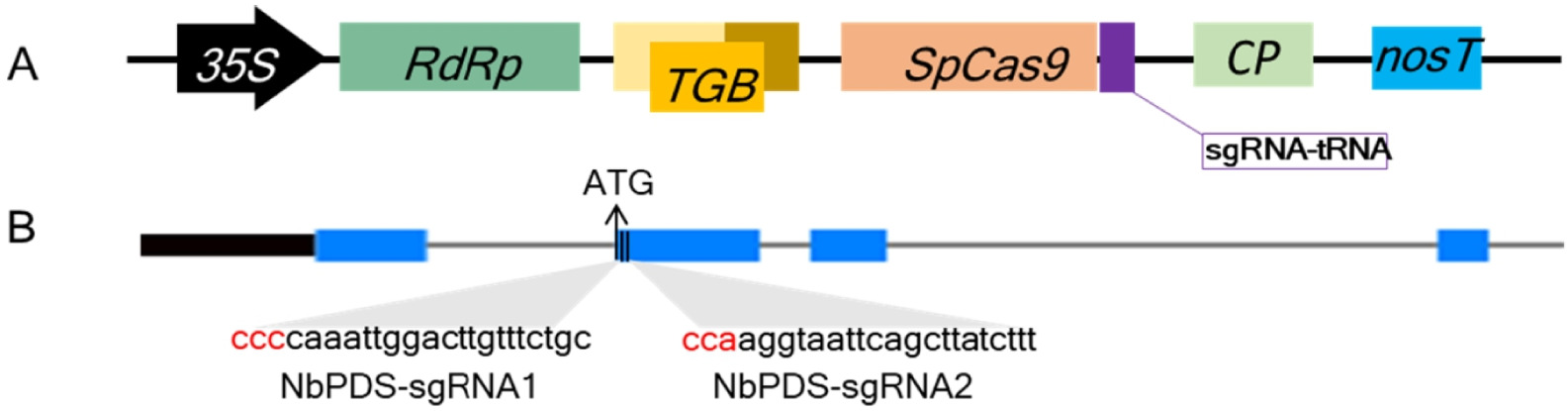
pPVX-PDS-gRNA vector construction
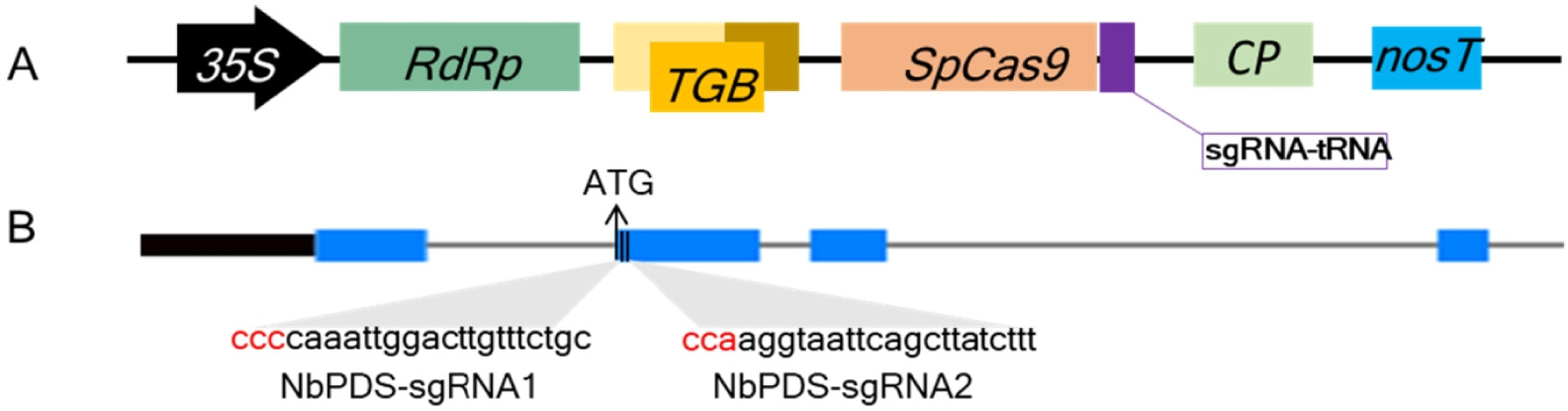
pPVX-Cas9 vector (Ariga et al. 2020) was kindly pro-vided by Dr. Kazuhiro Ishibashi (Institute of Agrobiolo-gical Sciences, National Agriculture and Food Research Organization, Japan). The sgRNA target sequences were identified using CCTop - CRISPR/Cas9 target online predictor (https://crispr.cos.uni-heidelberg.de/index.html) and PDS-sgRNA1 & 2 cloning primers were custom synthesized at Bioneer (Bioneer, Republic of Korea) (Table 1). sgRNA sequences comprising 80-bp scaffold RNA and target sequences of 20 bp for NbPDS editing and tRNA sequence containing 80-bp (Ellison et al. 2020) were cloned into the pPVX-Cas9 vector (Fig. 1A) at MluI, StuI, and SalI restriction enzyme sites using primers listed in Table 1. Details of NbPDS-sgRNA sequences are included in Table 2 and Fig. 1B. The constructed PVX vectors containing SpCas9 and NbPDS-sgRNA-tRNA targets were mobilized into Agrobacterium tumefaciens strain GV3101 by electroporation.
Agroinfiltration of pPVX-Cas9 vectors carrying NbPDS gRNA targets
N. benthamiana plants were grown in a growth chamber maintained at 24 ± 2℃ and an agroinfiltration experiment was performed as previously described (Hwang et al. 2015). Single Agrobacterium colonies for each construct were inoculated into 10 mL of YEP medium with 50 mg∙L‒1 kanamycin and 50 mg∙L‒1 rifampicin, and incubated overnight. Cells were washed with 10 mM MgCl2 and diluted to an OD600 of 0.3 with an infiltration medium (10 mM MES, 10 mM MgCl2, and 200 mM acetosyringone). Agrobacterial cultures of p19 and pPVX-Cas9::sgRNA constructs were mixed at a 1:1 and incubated at room temperature for 3 hours and co-infiltrated into the lower side of the 4-week-old N. benthamiana plant leaves using a needleless 1 mL syringe. Agrobacterium cultures carrying pPVX-GFP and empty p19 vectors were used in mock infiltration.
N. benthamiana HS treatments
N. benthamiana plants infiltrated with pPVX-Cas9:: sgRNA constructs and p19 were used for investigating the effect of HS on the CRISPR mutagenesis efficiency. Plants were subjected to a single cycle of HS of 37℃ for 24 hours from 2 days after infiltration (DAI) to 5 DAI. Plants were moved to 24℃ after the end of the HS treatment, while p19 and pPVX-Cas9::sgRNA constructs infiltrated plants were grown at 24℃ with no HS (NHS) treatment were used as controls.
Evaluation of the targeted GE
Leaf samples were collected from the N. benthamiana plants infiltrated with pPVX-Cas9::sgRNA constructs at 7 DAI, and genomic DNA was isolated using the CTAB method (DOYLE, 1987). Genomic DNA mutations resulting from the CRISPR/Cas9 GE were analyzed through the restriction site protection assay. The NbPDS target regions of sgRNA1 and 2 were PCR amplified using primers listed in Table 1. PCR reactions were performed in 50 mL reaction volume consisting of 10 mL PrimeSTAR GXL buffer, 4 mL of 2.5 mM dNTPs, 2 mL of each of the reverse and forward primers, 4 mL of 50 ng genomic DNA, 1.0 mL PrimeSTAR GXL Taq DNA polymerase and 27.0 mL sterile water. Following PCR conditions were used: initial denaturation for 3 minutes at 95℃, followed by 36 cycles of 10 s at 98℃, 15 seconds at 55℃, and 30 seconds at 68℃, and a final extension of 3 minutes at 68℃. A 250 ng of purified PCR products corresponding to the sgRNA1 and sgRNA2, two target regions were digested with BslI, and StyI, respectively. Samples were incubated at 55℃ and 37℃ for 2 hours and overnight, respectively, for BsaI and StyI restriction enzymes. Digested PCR products were visualized in 2% agarose gel made with 1 × TAE buffer. The GE efficiency was calculated as a percentage of un-cleaved DNA band intensity measured using ImageJ software.
Deep sequencing and mutation pattern analysis
An amplicon size of 531-bp length including both sgRNA target sites was used for Miseq. Primers for Miseq were synthesized at the Macrogen (Seoul, Republic of Korea). The primers with multiplexing indices and sequen-cing adaptors for PCR amplification of sgRNA target regions and deep sequencing are included in Table 3. Target regions were amplified using a QIAGEN Multiplex PCR kit (QIAGEN, Germany). A reaction volume of 50 mL included 25 mL of 2× master mix, 2.0 mL oligonucleotides mix (10 pmol) and 100 ng of genomic DNA. The PCR cycling conditions consisted of 5 minutes at 95℃ followed by 35 cycles of denaturation at 95℃ for 30 seconds, annealing at 58℃ for 30 seconds, extension at 72℃ for 90 seconds, and a final extension for 10 minutes at 72℃. Amplified PCR product was gel eluted and subjected to deep-sequencing at NICEM (Seoul National University, Seoul, Republic of Korea). Pooled PCR samples were used for high-throughput paired-end amplicon sequencing on the Illumina MiSeq platform at NICEM (Seoul National University, Seoul, Republic of Korea). Raw paired-end reads were joined by the program, ‘fastq-join’ as imple-mented in the package, ‘eu-util’. Mutation counts and patterns in merged reads were analyzed using in-house scripts. Sequencing reads identified with insertion/deletion (indel) within and around the spacer region were regarded as an outcome of error-prone repair of Cas9 cleaved sites by non-homologous end-joining (NHEJ). GE efficiency is displayed as the proportion of DNA sequence reads with NHEJ-induced indels against the reads count.
Detection of PVX viral coat protein accumulation
Enzyme-linked immunosorbent assay (ELISA) analysis was performed at 7 DAI to detect the PVX viral coat protein accumulation. Samples were collected from inoculated leaves. ELISA tests were performed as per the manufac-turer’s instructions (Agdia, Elkhart, IN).
Data analysis
At least 4-6 plants per treatment were used in restriction site protection assays. The ELISA analysis was performed with six replicates. Statistical difference between treatment groups was calculated using Duncan’s multiple range test (P ≤ 0.05).
Effect of HS on PVX viral accumulation
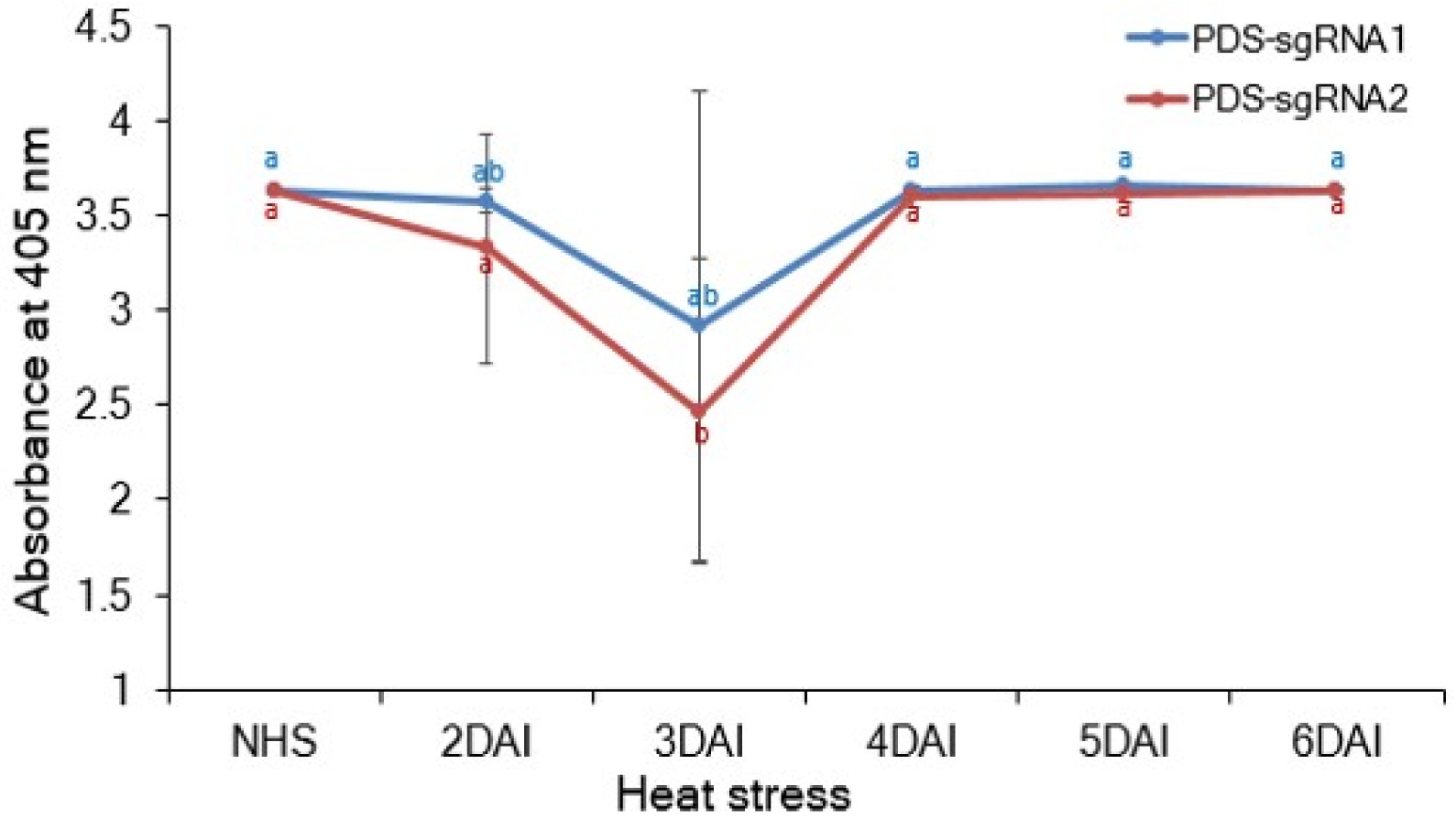
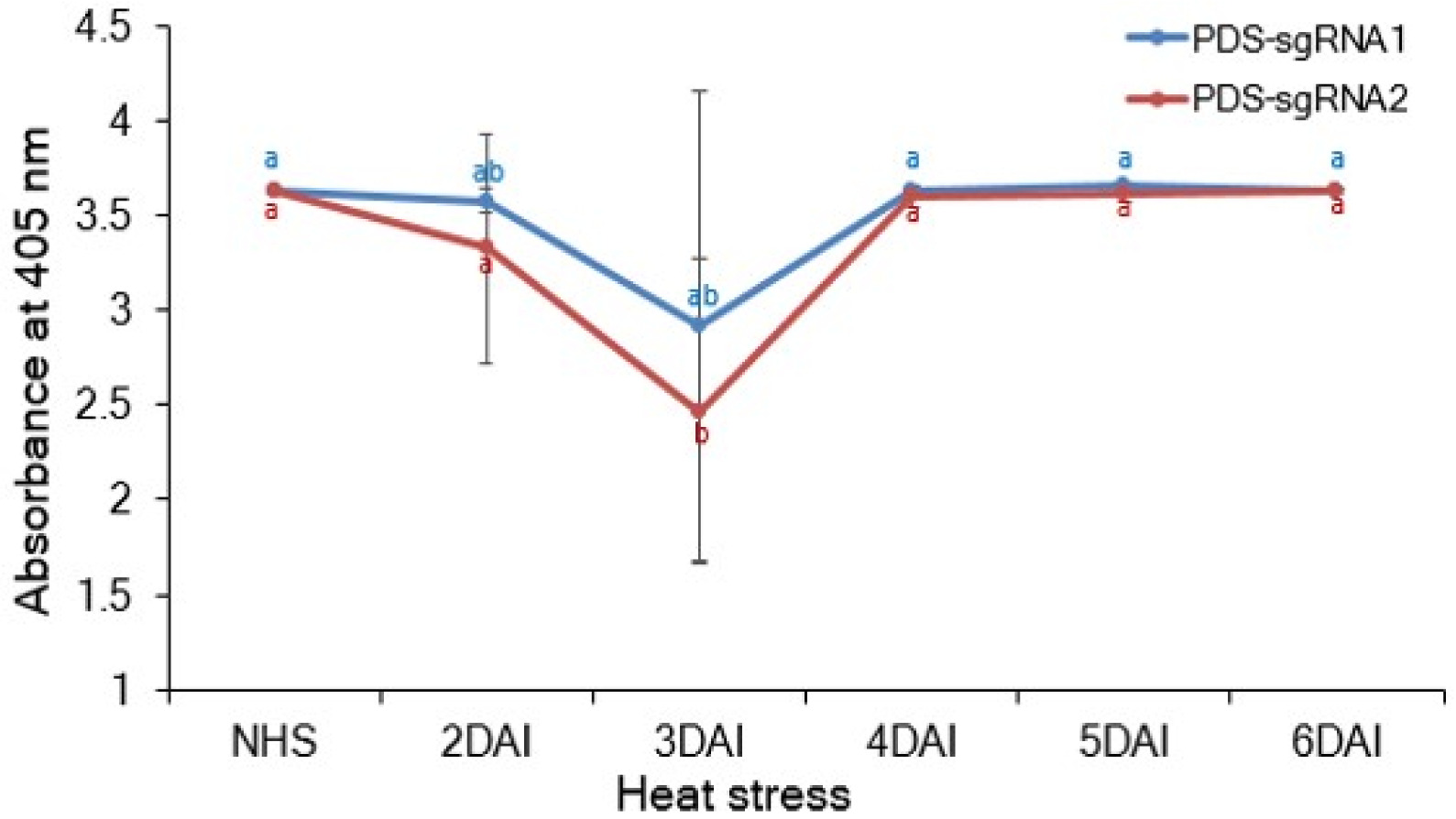
To explore and improve the PVX-mediated genome editing in N. benthamiana, we firstly tested the effect of HS on the accumulation of viral particles. N. benthamiana samples infiltrated with pPVX-Cas9::sgRNA constructs (1, 2) were exposed to 24 hours HS at 2 to 6 DAI. DAS-ELISA was performed to test the accumulation of PVX coat protein at the end of the 7th day. Samples exposed to HS at 4-6 DAI showed no significant difference in viral accumulation compared with samples not treated with HS (NHS) (Fig. 2). The sample treated with HS at 2-3 DAI showed a lower accumulation of viral particles. Thus, HS negatively affected the accumulation of the viral particles in the N. benthamiana plant, with the most pronounced effect in samples exposed to HS at 3 DAI. These results suggested that exposing samples to HS after 4-5 DAI is suitable for allowing viral recovery and efficient GE in N. benthamiana.
Effect of HS on PVX-mediated CRISPR/Cas9 GE
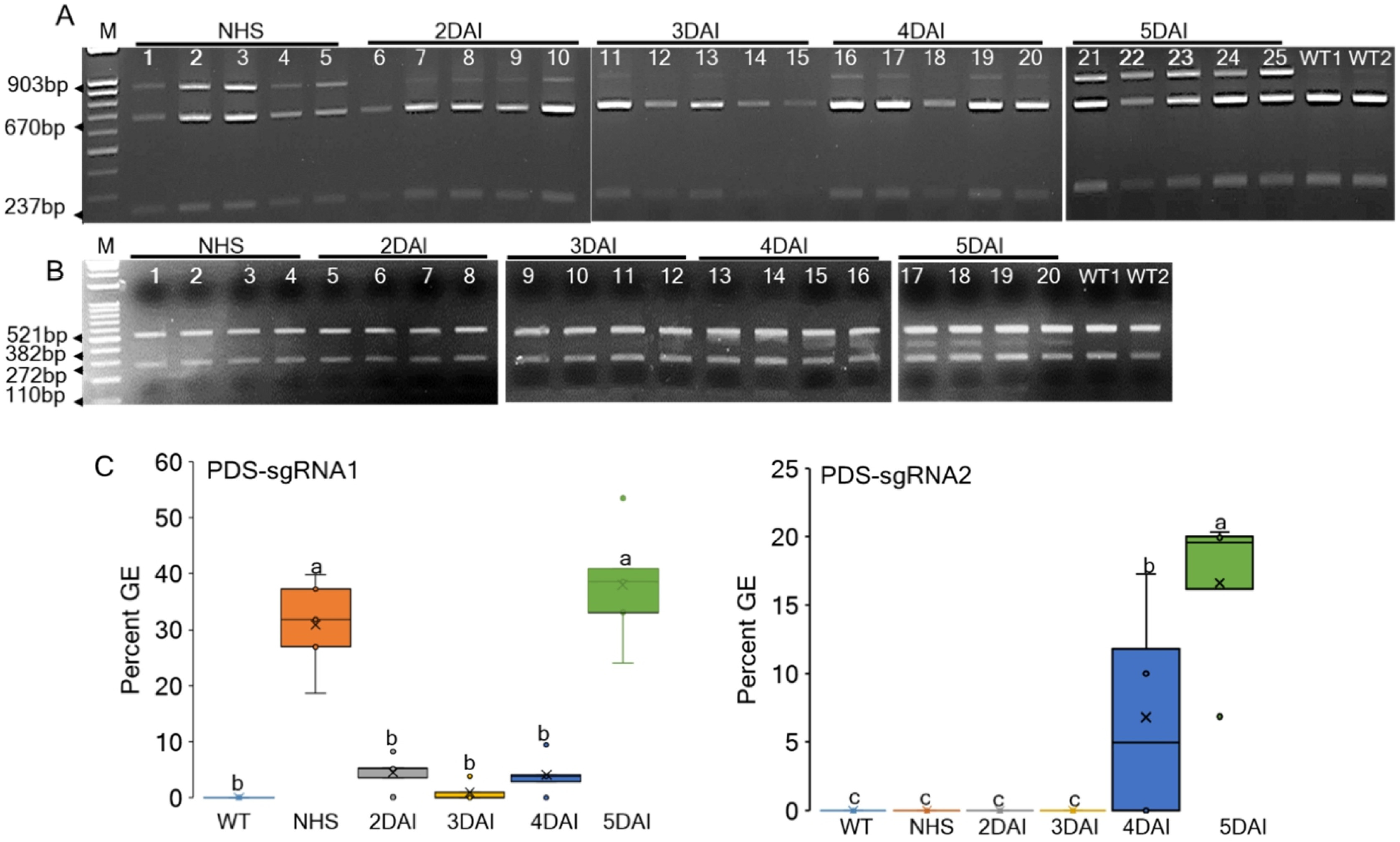
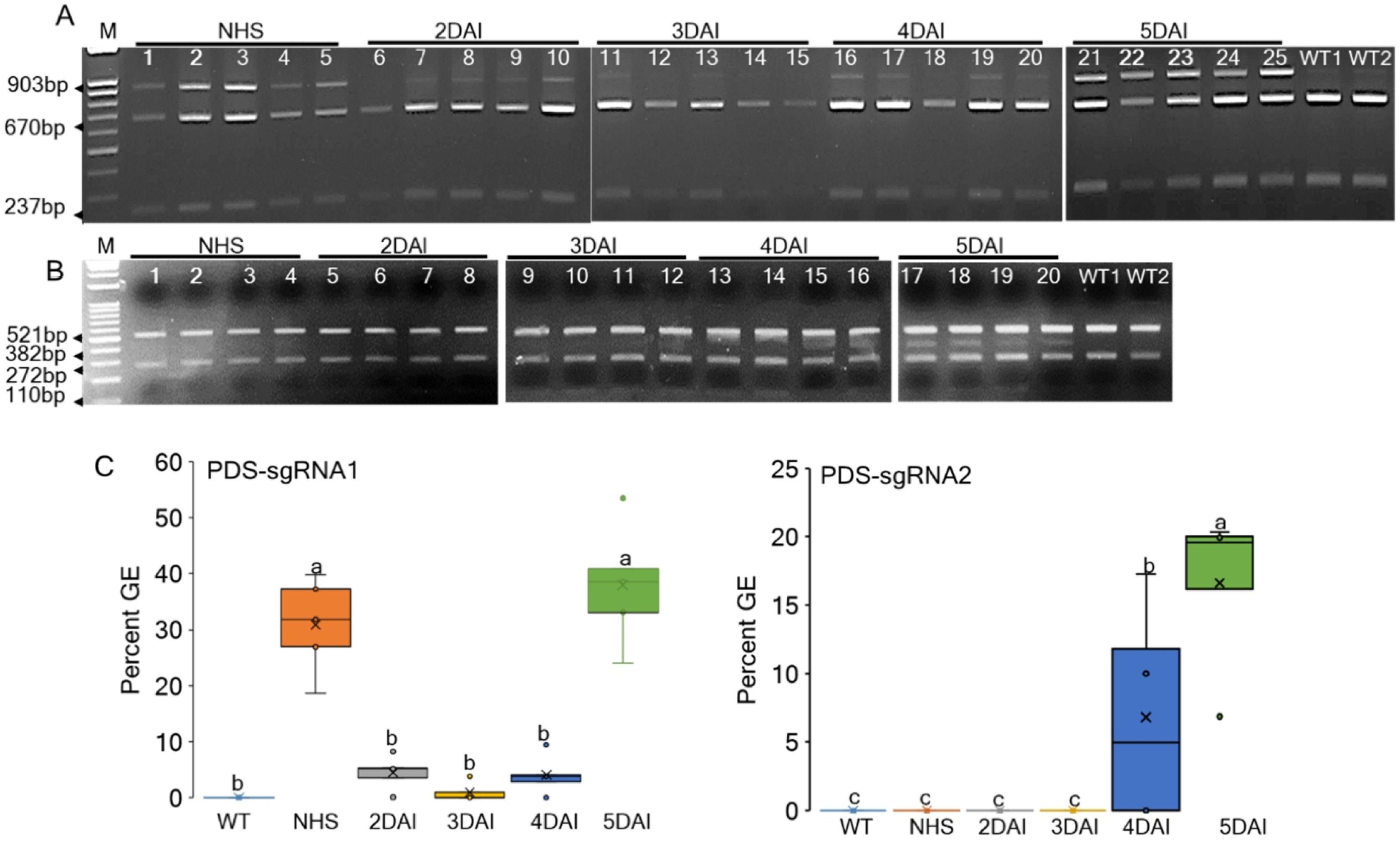
To explore the effect of HS on PVX-mediated GE, we exposed N. benthamiana plants infiltrated with pPVX- Cas9::sgRNA constructs at the 2, 3, 4, and 5 DAI. To estimate editing efficiency, we chose the NbPDS gene as the target and designed two different sgRNAs targeting exon two of the NbPDS gene (Fig. 1B). In the case of the NbPDS-sgRNA1 construct, an average editing efficiency of about 29.0% was detected in leaves not exposed to HS (Fig. 3). In the case of samples exposed to the HS at 2, 3, and 4 DAI recorded only about 2-4.5% editing efficiency. However, at 5 DAI, an average editing efficiency of 36.8 ± 16% was observed, with maximum editing efficacy of up to 52.2% (Fig. 3). For the PDS-sgRNA2 target, no detectable indels were observed in NHS treated samples and samples exposed to HS at 2 and 3 DAI. However, samples exposed to the HS at 4 and 5 DAI showed significant differences in editing efficiencies, with an average editing efficiency of about 6.8% and 16.6% recorded, respectively (Fig. 3). Overall, these results suggest that HS enhances the CRISPR/Cas9 GE efficiency, HS can also negatively affect the accumulation of the viral particles during the early days of infection.
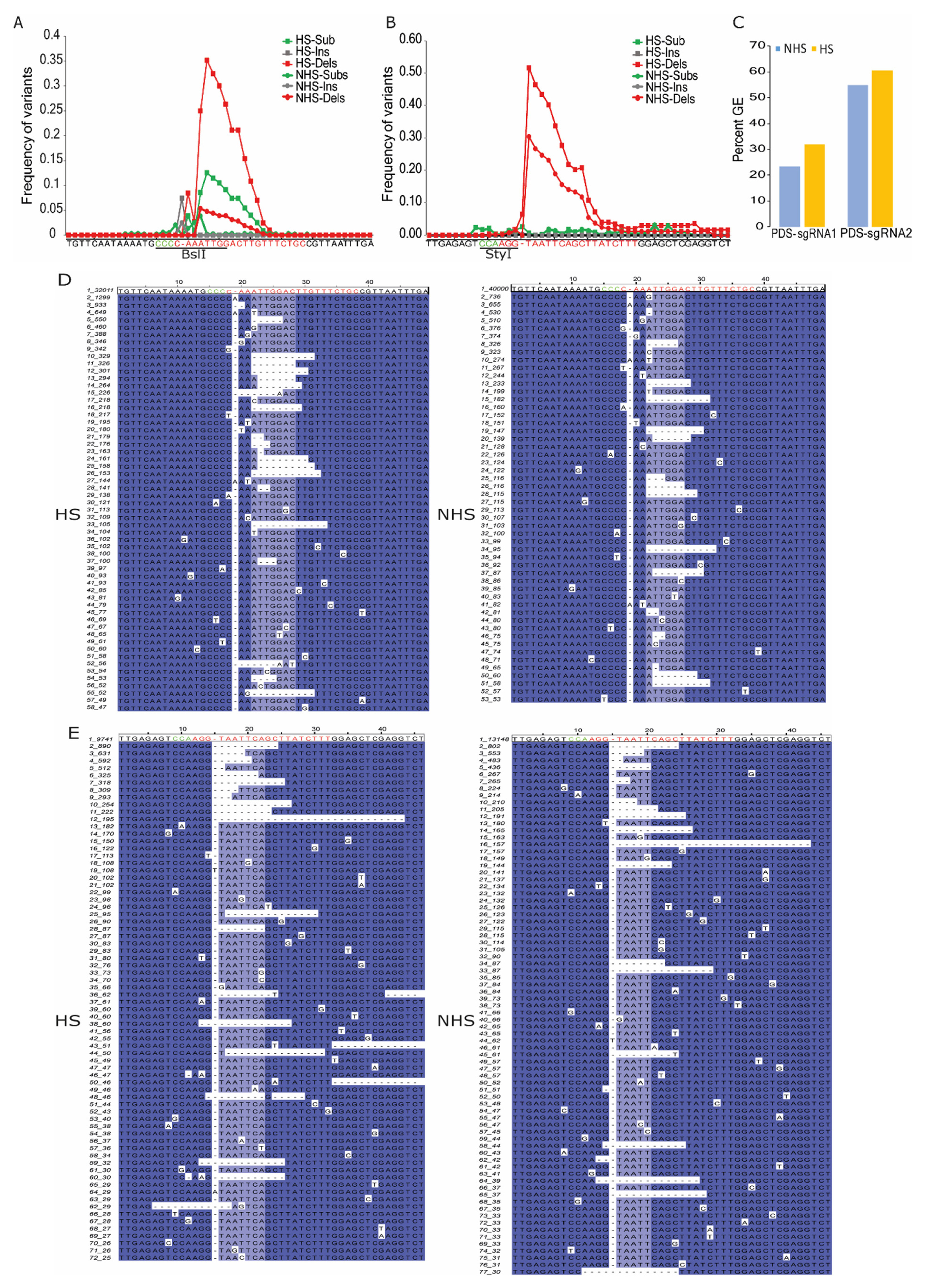
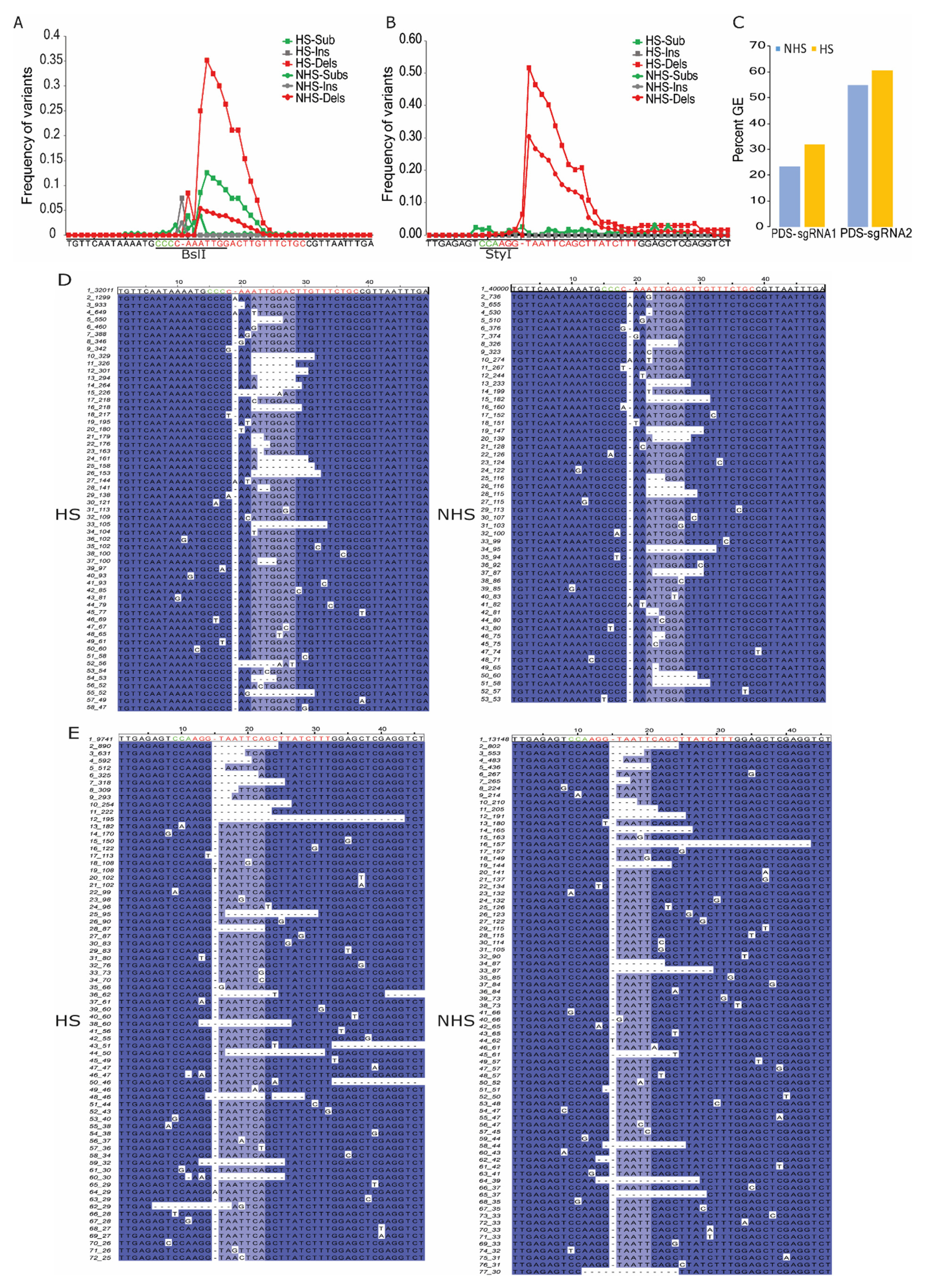
To further analyze the precise nature of the targeted GE at the NbPDS gRNA target sites, we used Illumina’s MiSeq deep sequencing to quantify the rate of insertions, deletions, and substitutions generated by NHEJ in the N. benthamiana pPVX-Cas9::sgRNA infiltrated samples of NHS and HS at the 5 DAI. In the case of NbPDS-sgRNA1, a large number of sequence variations included nucleotide deletions followed by substitutions and insertions. Both deletions and substitutions increased due to HS treatment (Fig. 4A). Similar results were obtained with NbPDS-sgRNA2; a large number of sequence variations were deletions, never-theless, substitutions and insertions were also observed with low frequencies (Fig. 4B). However, we couldn’t see any apparent changes in double-strand break site, length of indels, and the substitution pattern due to HS in either sgRNA1 or sgRNA2 infiltrated samples (Fig. 4A, B). Mutation frequency curves of NbPDS-sgRNA1 and NbPDS- sgRNA2 showed a similar trend of sequence variations (Fig. 4A, B). GE efficiency was calculated as the total num-ber of sequence variants against a total number of target amplicon reads revealed that in NHS (25℃) condtions, GE is about 23.2%, whereas in HS conditions (37℃), GE was about 31.8% for NbPDS-sgRNA1 (Fig. 4C). GE efficiencies for NbPDS-sgRNA2 in NHS condition is about 54.7 whereas in HS conditions (37℃) is approxi-mately 60.49%. These results indicate that HS treatment can induce high indel frequency, but is unlikely to change the pattern of indels.
The CRISPR/Cas9 system is a valuable genomic engi-neering strategy for targeted modification of DNA sequen-ces and has been used in the number of plant and animal species. Nevertheless, the editing efficiencies of the CRISPR/Cas9 system are highly variable depending on the delivery of CRISPR/Cas9 reagents and plant growth conditions. Efforts are being made continuously to improve editing efficiency further using various approaches. Recent studies showed that the high temperature improved the CRISPR/Cas9 or other CRISPR-associated nucleases editing efficiency in animals and plants (Xiang et al. 2017; LeBlanc et al. 2018; Malzahn et al. 2019; Vu et al. 2019; Kurokawa et al. 2021). Various studies have deployed different HS treatments ranging from a few hours to several days. CRISPR/Cas9 mutagenesis in Arabidopsis and Citrus plants was enhanced several folds using four cycles of HS (37℃ for 30 hours) (LeBlanc et al. 2018). Even elevated growth temperature conditions increased CRISPR/Cas9 editing efficiency in wheat (Milner et al. 2020). Here we investi-gated if the HS treatment has a similar effect on PVX-mediated CRIPSR/Cas9 GE efficiency in N. benthamiana. We have demonstrated here that a heat treatment at 37℃ for 24 hours at 4-5 days after PVX inoculation can enhance the CRISPR/Cas9-mediated mutagenesis up to 5-8% higher editing efficiency than that of NHS treated N. benthamiana (Fig. 4C).
In this study, we targeted the NbPDS gene for investi-gating the effect of high-temperature stress on the efficiency of PVX-mediated CRISPR/Cas9 GE. Our results showed that the HS treatment of pPVX-Cas9::PDS-sgRNAs infil-trated samples recorded higher CRISPR/Cas9 mutagenesis efficiency, consistent with the previous report that the high HS improves the efficiency of GE in crops (LeBlanc et al. 2018; Milner et al. 2020; Kurokawa et al. 2021). Though HS can increase the CRIPSR/Cas9 GE efficiency, HS can negatively affect the accumulation of viral particles in the N. benthamiana plant. We observed a reduced accumula-tion of PVX viral particles following the HS treatment at 2-4 DAI. This was reflected in the lower GE efficiency of the PVX-mediated CRISPR/Cas9 system (Fig. 3). These results suggested that exposing samples to HS after 4-5 DAI is a suitable time for efficient genome editing in N. benthamiana.
Although the editing efficiencies of sgRNA1 and sgRNA2 were different, HS significantly improved GE efficiency in both cases. The principal cause of increased editing efficiency at higher temperature stress has mainly been attributed to an increase in CRISPR nuclease and gRNA activity (Kurokawa et al. 2021). Previous in vitro activity studies of CRISPR/Cas nucleases and gRNA expression showed that nuclease activity is positively correlated with higher temperatures, but an expression of Cas9 is unaffected (Xiang et al. 2017; LeBlanc et al. 2018; Li et al. 2018; Kurokawa et al. 2021; Li et al. 2021). The editing efficiency of the target NbPDS-sgRNA2 was generally lower than that of the NbPDS-sgRNA1 calculated based on the restriction enzyme protection assay. However, MiSeq sequencing results revealed much higher editing efficiency than NbPDS-sgRNA1 because indels were created in other than the StyI enzyme site, because of which no detectable expected bands were observed in cleavage assay of sgRNA2 target with the StyI enzyme. Since high-temperature stress increased the GE efficiency with increased frequency of indels and substitutions in the vicinity of PAM, detectable cleavage products were ob-served at 4 and 5 DAI of PVX infection.
We next studied the effect of HS treatment on the pattern of PVX-mediated CRISPR/Cas9-induced mutations. To detect the editing pattern and GE efficiency, next-generation targeted deep sequencing was performed for PCR products of NbPDS-sgRNA1 and NbPDS-sgRNA2 target regions obtained from the genomic DNA from the sample treated with HS. The most common CRISPR/Cas9 mutations observed were nucleotide deletions, followed by substitutions and a few insertions (Fig. 4A, B, D, E). A similar pattern was observed for both NbPDS-sgRNA1 and NbPDS-sgRNA2 constructs infiltrated samples. All the indels, insertions, or substitution peaks of the NbPDS-sgRNA1 and NbPDS- sgRNA2 shared a similar location to that of NHS condi-tions (Fig. 4). According to their representative indel sequence data, the indel peaks shared similar editing positions in HS and NHS samples (Fig. 4). These results indicate that the HS does not change or induce specific indels with editing positions different from the NHS conditions. These results are consistent with a previous report that the HS does not affect the CRISPR/Cas9- mediated patterns in Arabidopsis (Kurokawa et al. 2021).
In summary, here we showed that the HS could improve the PVX-mediated CRISPR/Cas9 editing efficiency. Next generation deep sequencing revealed that HS and NHS conditions shared similar editing traits, but higher editing efficiency was observed with HS. However, our findings suggest that HS can negatively affect the viral accumula-tion in a plant cell. Therefore, depending on the plant species, optimal conditions should be determined to mini-mize the negative effect of the HS on viral replication to achieve maximum GE efficiency. The results of this study will be helpful for improving the editing efficiency of other viral-mediated gene editing systems in N. benthamiana and other plant species.
This research was supported by Basic Science Research Program through the National Research Foundation (NRF) of Korea funded by the Ministry of Education (2021R1I1A 1A01041938). This work was supported by a grant from the ‘New Breeding Technologies Development Program (Project No. PJ0165432022)’, Rural Development Admin-istration, Republic of Korea.
Fig. 1
Schematic diagram of the T-DNA cassette expres-sing the PVX viral components and CRISPR/Cas9 and sgRNAs. (A) Diagram of the T-DNA cassette PVX genome and Cas9 gene and PDS-sgRNA sequence under the control of the 35S promoter. (B) Diagram of the CRISPR/Cas9 target sites within the NbPDS gene. The sgRNA target sequences are shown in black letters, followed by protospacer- adjacent motif (PAM) sequences in red.
pbb-10-3-186-f1.jpg
Fig. 2
Accumulation of PVX in N. benthamiana samples treated with 37℃. Samples were infiltrated with pPVX-Cas9::sgRNA 1 and 2 constructs. DAS-ELISA assays was performed at 2-6 DAI. Error bars indicate mean values of replicates ± standard deviation (SD). Different letters indicate significant differences bet-ween heat stress (HS) and no heat stress (NHS) treatments according to Duncan’s multiple range test (P ≤ 0.05).
pbb-10-3-186-f2.jpg
Fig. 3
Effect of heat stress (HS) on PVX-mediated CRISPR/Cas9 targeted mutagenesis of the NbPDS gene. (A) Analysis of leaf samples infiltrated with pPVX-Cas9::NbPDS-sgRNA1 for the presence of targeted modification using BslI recognition site loss assay. Expected bands for WT/mock: 237 bp and 670 bp; Expected bands for mutated: 237 bp, 670 bp and 903 bp. (B) Analysis of leaf samples infiltrated with pPVX-Cas9::NbPDS-sgRNA2 for the presence of targeted modification using StyI recognition site loss assay. Expected bands for WT/mock: 110 bp, 272 bp, and 521 bp; Expected bands for mutated: 110 bp, 272 bp, 382 bp, and 521 bp. (C) GE efficiencies of NbPDS-sgRNA1 and NbPDS-sgRNA2 constructs infiltrated samples. Infiltrated leaves were collected from plants treated with HS at 2, 3, 4, and 5 days after infiltration (DAI). Different letters indicate significant differences between HS treat--ments according to Duncan's multiple range test (P ≤ 0.05).
pbb-10-3-186-f3.jpg
Fig. 4
Deep-sequencing analysis of the PVX-SpCas9 mediated GE. (A) Frequency of sequence variations by length detected by amplicon deep sequencing of PDS-sgRNA1 target region in N. benthamiana leaves treated with heat stress (HS) and no heat stress (NHS). (B) Frequency of sequence variations by length detected by amplicon deep sequencing of PDS-sgRNA2 target region in N. benthamiana leaves treated with HS and NHS. (C) Percent GE recorded with NbPDS-sgRNA1 and NbPDS-sgRNA2 constructs. (D) Alignment of Mi-seq sequencing reads showing the presence of indels at the NbPDS-sgRNA1 target sequence. (E) Alignment of Mi-seq sequencing reads showing the presence of indels at the NbPDS-sgRNA2 target sequence. The number following the sequence variant and underscore indicates the total number of that particular variant. Target sequence with the PAM is shown in green and protospacer is marked with red font.
pbb-10-3-186-f4.jpg
Table 1
Primer sequences used for amplification in this study.
Table 1
Name Sequence (5’-3’) Purpose
NB(12)PDS-F GTGGGTGAAGGCTAATTTTTCTCATAGTGT NbPDS target amplification
NB(12)PDS-R GAGTGACGGCAAAAATAGTTCAAAACAAACTAGT NbPDS target amplification
PVX. Cas9/721F TGGTTTCGATTCTCCTACCG PVX-Cas9 amplification
PVX. Cas9/721R ATCAGCCCTTGAATCACCAC PVX-Cas9 amplification
1pds-F1 AAACAAGTCCAATTTGGTTTTAGAGCTAGAAATA NbPDS sgRNA1 cloning
2pds-F1 ATAAGCTGAATTACCTGTTTTAGAGCTAGAAAT NbPDS sgRNA2 cloning
1pds-F2 ATGCACGCGTGCAGAAACAAGTCCAATTTG NbPDS sgRNA1 cloning
2pds-F2 ATGCACGCGTAAAGATAAGCTGAATTACCT NbPDS sgRNA2 cloning
sgRNA-Sal1-R CGGCGGTCGACTGGGTCTAGAAAAAAAGCA pPVX-Cas9 cloning
tRNA-Sal1-R GCATGTCGACTGGGTCTAGAAAAAATGCTTCCGGCGGGGCT pPVX PDS vector construction
CP. NR-R_SEQ ACGGGCTGTACTAAAGAAATCCCCA Sequence confirmation
Table 2
NbPDS-sgRNA sequences used in the present study.
Table 2
Name Sequence (5’-3’)
NbPDS-sgRNA1-tRNA ACGCGTGCAGAAACAAGTCCAATTTGGTTTTAGAGCTAGAAATAGCAAGTTAAAATAAGGCTAGTCCGTTATCAACTTGAAAAAGTGGCACCGAGTCGGTGCTCCCAGGCCTGCTCCCGTAGCTCAGTTGGTTAGAGCGTTGGTCTTATGAGCCGAAGGTCGCGGGTTCGAGCCCCGCCGGAAGCATTTTTTGTCGAC
NbPDS-sgRNA2-tRNA ACGCGTAAAGATAAGCTGAATTACCTGTTTTAGAGCTAGAAATAGCAAGTTAAAATAAGGCTAGTCCGTTATCAACTTGAAAAAGTGGCACCGAGTCGGTGCTCCCAGGCCTGCTCCCGTAGCTCAGTTGGTTAGAGCGTTGGTCTTATGAGCCGAAGGTCGCGGGTTCGAGCCCCGCCGGAAGCATTTTTTGTCGAC

Black and red fonts indicate sgRNA and tRNA sequences. Italicized text indicates protospacer sequence, MluI (ACGCGT), StuI (AGGCCT) and SalI (GTCGAC) sites are underlined.

Table 3
Primer sequences used for Miseq analysis.
Table 3
Name Sequence (5’-3’)
NbPDS_Miseq_1F TCGTCGGCAGCGTCAGATGTGTATAAGAGACAGNNNNNAACACGCTAATTTTTCTCATAGTGT Poo11
NbPDS_Miseq_1F-1 TCGTCGGCAGCGTCAGATGTGTATAAGAGACAGNNNNNAACACNGCTAATTTTTCTCATAGTGT
NbPDS_Miseq_1F-2 TCGTCGGCAGCGTCAGATGTGTATAAGAGACAGNNNNNAACACNNGCTAATTTTTCTCATAGTGT
NbPDS_Miseq_1F-3 TCGTCGGCAGCGTCAGATGTGTATAAGAGACAGNNNNNAACACNNNGCTAATTTTTCTCATAGTGT
NbPDS_Miseq_2F TCGTCGGCAGCGTCAGATGTGTATAAGAGACAGNNNNNACTATGCTAATTTTTCTCATAGTGT Pool2
NbPDS_Miseq_2F-1 TCGTCGGCAGCGTCAGATGTGTATAAGAGACAGNNNNNACTATNGCTAATTTTTCTCATAGTGT
NbPDS_Miseq_2F-2 TCGTCGGCAGCGTCAGATGTGTATAAGAGACAGNNNNNACTATNNGCTAATTTTTCTCATAGTGT
NbPDS_Miseq_2F-3 TCGTCGGCAGCGTCAGATGTGTATAAGAGACAGNNNNNACTATNNNGCTAATTTTTCTCATAGTGT
NbPDS_Miseq_1R GTCTCGTGGGCTCGGAGATGTGTATAAGAGACAGCTGAATGGCAAGATATACAT Common primer
NbPDS_Miseq_1R-1 GTCTCGTGGGCTCGGAGATGTGTATAAGAGACAGNCTGAATGGCAAGATATACAT
NbPDS_Miseq_1R-2 GTCTCGTGGGCTCGGAGATGTGTATAAGAGACAGNNCTGAATGGCAAGATATACAT
NbPDS_Miseq_1R-3 GTCTCGTGGGCTCGGAGATGTGTATAAGAGACAGNNNCTGAATGGCAAGATATACAT
  • Ali Z, Abul-faraj A, Li L, Ghosh N, Piatek M, Mahjoub A, et al. 2015. Efficient Virus-Mediated genome editing in plants using the CRISPR/Cas9 system. Mol Plant.. 8: 1288-1291.
  • An Y, Geng Y, Yao J, Fu C, Lu M, Wang C, et al. 2020. Efficient genome editing in Populus using CRISPR/Cas12a. Front. Plant Sci.. 11: 593938
  • Ariga H, Toki S, Ishibashi K. 2020. Potato virus X vector- mediated DNA-free genome editing in plants. Plant Cell Physiol.. 61: 1946-1953.
  • Baltes NJ, Gil-Humanes J, Cermak T, Atkins PA, Voytas DF. 2014. DNA replicons for plant genome engineering. Plant Cell.. 26: 151-163.
  • Čermák T, Baltes NJ, Čegan R, Zhang Y, Voytas DF. 2015. High-frequency, precise modification of the tomato genome. Genome Biol.. 16: 232
  • Cody WB, Scholthof HB, Mirkov TE. 2017. Multiplexed gene editing and protein overexpression using a Tobacco mosaic virus viral vector. Plant Physiol.. 175: 23-35.
  • Ellison EE, Nagalakshmi U, Gamo ME, Huang P-j, Dinesh-Kumar S, Voytas DF. 2020. Multiplexed heritable gene editing using RNA viruses and mobile single guide RNAs. Nat. Plants.. 6: 620-624.
  • Fan D, Liu T, Li C, Jiao B, Li S, Hou Y, et al. 2015. Efficient CRISPR/Cas9-mediated targeted mutagenesis in Populus in the first generation. Sci. Rep.. 5: 1-7.
  • Feng Z, Zhang B, Ding W, Liu X, Yang D-L, Wei P, et al. 2013. Efficient genome editing in plants using a CRISPR/Cas system. Cell Res.. 23: 1229-1232.
  • Gil-Humanes J, Wang Y, Liang Z, Shan Q, Ozuna CV, Sánchez-León S, et al. 2017. High-efficiency gene target-ing in hexaploid wheat using DNA replicons and CRISPR/Cas9. Plant J.. 89: 1251-1262.
  • Greiner A, Kelterborn S, Evers H, Kreimer G, Sizova I, Hegemann P. 2017. Targeting of photoreceptor genes in Chlamydomonas reinhardtii via zinc-finger nucleases and CRISPR/Cas9. Plant Cell.. 29: 2498-2518.
  • Hu J, Li S, Li Z, Li H, Song W, Zhao H, et al. 2019. A barley stripe mosaic virus-based guide RNA delivery system for targeted mutagenesis in wheat and maize. Mol. Plant Pathol.. 20: 1463-1474.
  • Hwang J, Lee S, Lee J-H, Kang W-H, Kang J-H, Kang M-Y, et al. 2015. Plant translation elongation factor 1Bb facilitates potato virus X (PVX) infection and interacts with PVX triple gene block protein 1. PLoS One.. 10: e0128014
  • Jiang N, Zhang C, Liu J-Y, Guo Z-H, Zhang Z-Y, Han C-G, et al. 2019. Development of Beet necrotic yellow vein virus-based vectors for multiple-gene expression and guide RNA delivery in plant genome editing. Plant Biotechnol. J.. 17: 1302-1315.
  • Kendall A, McDonald M, Bian W, Bowles T, Baumgarten SC, Shi J, et al. 2008. Structure of flexible filamentous plant viruses. J. Virol.. 82: 9546-9554.
  • Kurokawa S, Rahman H, Yamanaka N, Ishizaki C, Islam S, Aiso T, et al. 2021. A simple heat treatment increases SpCas9-mediated mutation efficiency in Arabidopsis. Plant Cell Physiol.. 62: 1676-1686.
  • LeBlanc C, Zhang F, Mendez J, Lozano Y, Chatpar K, Irish VF, et al. 2018. Increased efficiency of targeted muta-genesis by CRISPR/Cas9 in plants using heat stress. Plant J.. 93: 377-386.
  • Li B, Liang S, Alariqi M, Wang F, Wang G, Wang Q, et al. 2021. The application of temperature sensitivity CRISPR/LbCpf1 (LbCas12a) mediated genome editing in allo-tetraploid cotton (G. hirsutum) and creation of nontrans-genic, gossypol‐free cotton. Plant biotechnol. J.. 19: 221
  • Li Z, Shi Z, Fan N, Chen Y, Guo J, Wu J, et al. 2018. Verified the effectiveness of AsCpf1 system in a variety of verte-brate species. bioRxiv. 272716:
  • Liu B, Chen S, Rose AL, Chen D, Cao F, Zwinderman M, et al. 2020. Inhibition of histone deacetylase 1 (HDAC1) and HDAC2 enhances CRISPR/Cas9 genome editing. Nucleic Acids Res.. 48: 517-532.
  • Ma X, Zhang Q, Zhu Q, Liu W, Chen Y, Qiu R, et al. 2015. A robust CRISPR/Cas9 system for convenient, high-efficiency multiplex genome editing in monocot and dicot plants. Mol. Plant.. 8: 1274-1284.
  • Malzahn AA, Tang X, Lee K, Ren Q, Sretenovic S, Zhang Y, et al. 2019. Application of CRISPR-Cas12a temperature sensitivity for improved genome editing in rice, maize, and Arabidopsis. BMC Biol.. 17: 1-14.
  • Manghwar H, Lindsey K, Zhang X, Jin S. 2019. CRISPR/Cas system: recent advances and future prospects for genome editing. Trends Plant Sci.. 24: 1102-1125.
  • Mei Y, Beernink BM, Ellison EE, Konečná E, Neelakandan AK, Voytas DF, et al. 2019. Protein expression and gene editing in monocots using foxtail mosaic virus vectors. Plant Direct. 3:
  • Milner MJ, Craze M, Hope MS, Wallington EJ. 2020. Turning up the temperature on CRISPR: increased temperature can improve the editing efficiency of wheat using CRISPR/ Cas9. Front. Plant Sci. 11:
  • Moreno-Mateos MA, Fernandez JP, Rouet R, Vejnar CE, Lane MA, Mis E, et al. 2017. CRISPR-Cpf1 mediates efficient homology-directed repair and temperature- controlled genome editing. Nat. Commun.. 8: 1-9.
  • Nishitani C, Hirai N, Komori S, Wada M, Okada K, Osakabe K, et al. 2016. Efficient genome editing in apple using a CRISPR/Cas9 system. Sci. Rep.. 6: 1-8.
  • Osakabe Y, Liang Z, Ren C, Nishitani C, Osakabe K, Wada M, et al. 2018. CRISPR–Cas9-mediated genome editing in apple and grapevine. Nat. Protoc.. 13: 2844-2863.
  • Soyars CL, Peterson BA, Burr CA, Nimchuk ZL. 2018. Cutting edge genetics: CRISPR/Cas9 editing of plant genomes. Plant Cell Physiol.. 59: 1608-1620.
  • Vu TV, Sivankalyani V, Kim E, Doan DTH, Tran MT, Kim J, et al. 2019. Highly efficient homology-directed repair using transient CRISPR/Cpf1-geminiviral replicon in tomato. Plant Biotechnol. J.. 18: 2133-2143.
  • Wang Z, Wang S, Li D, Zhang Q, Li L, Zhong C, et al. 2018. Optimized paired‐sgRNA/Cas9 cloning and expression cassette triggers high‐efficiency multiplex genome editing in kiwifruit. Plant Biotechnol. J.. 16: 1424-1433.
  • Xiang G, Zhang X, An C, Cheng C, Wang H. 2017. Temperature effect on CRISPR-Cas9 mediated genome editing. J. Genet. Genomics.. 44: 199-205.
  • Yoon Y-J, Venkatesh J, Lee J-H, Kim J, Lee H-E, Kim D-S, et al. 2020. Genome editing of eIF4E1 in tomato confers resistance to pepper mottle virus. Front. Plant Sci.. 11: 1098
  • Yu C, Liu Y, Ma T, Liu K, Xu S, Zhang Y, et al. 2015. Small molecules enhance CRISPR genome editing in pluripotent stem cells. Cell Stem Cell.. 16: 142-147.
  • Zhang Y, Malzahn AA, Sretenovic S, Qi Y. 2019. The emerging and uncultivated potential of CRISPR technology in plant science. Nat. Plants.. 5: 778-794.


Download Citation

Download a citation file in RIS format that can be imported by all major citation management software, including EndNote, ProCite, RefWorks, and Reference Manager.

Format:

Include:

Heat Stress Induced Potato virus X-mediated CRISPR/Cas9 Genome Editing in Nicotiana benthamiana
Plant Breed. Biotech.. 2022;10(3):186-196.   Published online August 31, 2022
Download Citation

Download a citation file in RIS format that can be imported by all major citation management software, including EndNote, ProCite, RefWorks, and Reference Manager.

Format:
Include:
Heat Stress Induced Potato virus X-mediated CRISPR/Cas9 Genome Editing in Nicotiana benthamiana
Plant Breed. Biotech.. 2022;10(3):186-196.   Published online August 31, 2022
Close

Figure

  • 0
  • 1
  • 2
  • 3
Heat Stress Induced Potato virus X-mediated CRISPR/Cas9 Genome Editing in Nicotiana benthamiana
Image Image Image Image
Fig. 1 Schematic diagram of the T-DNA cassette expres-sing the PVX viral components and CRISPR/Cas9 and sgRNAs. (A) Diagram of the T-DNA cassette PVX genome and Cas9 gene and PDS-sgRNA sequence under the control of the 35S promoter. (B) Diagram of the CRISPR/Cas9 target sites within the NbPDS gene. The sgRNA target sequences are shown in black letters, followed by protospacer- adjacent motif (PAM) sequences in red.
Fig. 2 Accumulation of PVX in N. benthamiana samples treated with 37℃. Samples were infiltrated with pPVX-Cas9::sgRNA 1 and 2 constructs. DAS-ELISA assays was performed at 2-6 DAI. Error bars indicate mean values of replicates ± standard deviation (SD). Different letters indicate significant differences bet-ween heat stress (HS) and no heat stress (NHS) treatments according to Duncan’s multiple range test (P ≤ 0.05).
Fig. 3 Effect of heat stress (HS) on PVX-mediated CRISPR/Cas9 targeted mutagenesis of the NbPDS gene. (A) Analysis of leaf samples infiltrated with pPVX-Cas9::NbPDS-sgRNA1 for the presence of targeted modification using BslI recognition site loss assay. Expected bands for WT/mock: 237 bp and 670 bp; Expected bands for mutated: 237 bp, 670 bp and 903 bp. (B) Analysis of leaf samples infiltrated with pPVX-Cas9::NbPDS-sgRNA2 for the presence of targeted modification using StyI recognition site loss assay. Expected bands for WT/mock: 110 bp, 272 bp, and 521 bp; Expected bands for mutated: 110 bp, 272 bp, 382 bp, and 521 bp. (C) GE efficiencies of NbPDS-sgRNA1 and NbPDS-sgRNA2 constructs infiltrated samples. Infiltrated leaves were collected from plants treated with HS at 2, 3, 4, and 5 days after infiltration (DAI). Different letters indicate significant differences between HS treat--ments according to Duncan's multiple range test (P ≤ 0.05).
Fig. 4 Deep-sequencing analysis of the PVX-SpCas9 mediated GE. (A) Frequency of sequence variations by length detected by amplicon deep sequencing of PDS-sgRNA1 target region in N. benthamiana leaves treated with heat stress (HS) and no heat stress (NHS). (B) Frequency of sequence variations by length detected by amplicon deep sequencing of PDS-sgRNA2 target region in N. benthamiana leaves treated with HS and NHS. (C) Percent GE recorded with NbPDS-sgRNA1 and NbPDS-sgRNA2 constructs. (D) Alignment of Mi-seq sequencing reads showing the presence of indels at the NbPDS-sgRNA1 target sequence. (E) Alignment of Mi-seq sequencing reads showing the presence of indels at the NbPDS-sgRNA2 target sequence. The number following the sequence variant and underscore indicates the total number of that particular variant. Target sequence with the PAM is shown in green and protospacer is marked with red font.
Heat Stress Induced Potato virus X-mediated CRISPR/Cas9 Genome Editing in Nicotiana benthamiana

Primer sequences used for amplification in this study.

Name Sequence (5’-3’) Purpose
NB(12)PDS-F GTGGGTGAAGGCTAATTTTTCTCATAGTGT NbPDS target amplification
NB(12)PDS-R GAGTGACGGCAAAAATAGTTCAAAACAAACTAGT NbPDS target amplification
PVX. Cas9/721F TGGTTTCGATTCTCCTACCG PVX-Cas9 amplification
PVX. Cas9/721R ATCAGCCCTTGAATCACCAC PVX-Cas9 amplification
1pds-F1 AAACAAGTCCAATTTGGTTTTAGAGCTAGAAATA NbPDS sgRNA1 cloning
2pds-F1 ATAAGCTGAATTACCTGTTTTAGAGCTAGAAAT NbPDS sgRNA2 cloning
1pds-F2 ATGCACGCGTGCAGAAACAAGTCCAATTTG NbPDS sgRNA1 cloning
2pds-F2 ATGCACGCGTAAAGATAAGCTGAATTACCT NbPDS sgRNA2 cloning
sgRNA-Sal1-R CGGCGGTCGACTGGGTCTAGAAAAAAAGCA pPVX-Cas9 cloning
tRNA-Sal1-R GCATGTCGACTGGGTCTAGAAAAAATGCTTCCGGCGGGGCT pPVX PDS vector construction
CP. NR-R_SEQ ACGGGCTGTACTAAAGAAATCCCCA Sequence confirmation

NbPDS-sgRNA sequences used in the present study.

Name Sequence (5’-3’)
NbPDS-sgRNA1-tRNA ACGCGTGCAGAAACAAGTCCAATTTGGTTTTAGAGCTAGAAATAGCAAGTTAAAATAAGGCTAGTCCGTTATCAACTTGAAAAAGTGGCACCGAGTCGGTGCTCCCAGGCCTGCTCCCGTAGCTCAGTTGGTTAGAGCGTTGGTCTTATGAGCCGAAGGTCGCGGGTTCGAGCCCCGCCGGAAGCATTTTTTGTCGAC
NbPDS-sgRNA2-tRNA ACGCGTAAAGATAAGCTGAATTACCTGTTTTAGAGCTAGAAATAGCAAGTTAAAATAAGGCTAGTCCGTTATCAACTTGAAAAAGTGGCACCGAGTCGGTGCTCCCAGGCCTGCTCCCGTAGCTCAGTTGGTTAGAGCGTTGGTCTTATGAGCCGAAGGTCGCGGGTTCGAGCCCCGCCGGAAGCATTTTTTGTCGAC

Primer sequences used for Miseq analysis.

Name Sequence (5’-3’)
NbPDS_Miseq_1F TCGTCGGCAGCGTCAGATGTGTATAAGAGACAGNNNNNAACACGCTAATTTTTCTCATAGTGT Poo11
NbPDS_Miseq_1F-1 TCGTCGGCAGCGTCAGATGTGTATAAGAGACAGNNNNNAACACNGCTAATTTTTCTCATAGTGT
NbPDS_Miseq_1F-2 TCGTCGGCAGCGTCAGATGTGTATAAGAGACAGNNNNNAACACNNGCTAATTTTTCTCATAGTGT
NbPDS_Miseq_1F-3 TCGTCGGCAGCGTCAGATGTGTATAAGAGACAGNNNNNAACACNNNGCTAATTTTTCTCATAGTGT
NbPDS_Miseq_2F TCGTCGGCAGCGTCAGATGTGTATAAGAGACAGNNNNNACTATGCTAATTTTTCTCATAGTGT Pool2
NbPDS_Miseq_2F-1 TCGTCGGCAGCGTCAGATGTGTATAAGAGACAGNNNNNACTATNGCTAATTTTTCTCATAGTGT
NbPDS_Miseq_2F-2 TCGTCGGCAGCGTCAGATGTGTATAAGAGACAGNNNNNACTATNNGCTAATTTTTCTCATAGTGT
NbPDS_Miseq_2F-3 TCGTCGGCAGCGTCAGATGTGTATAAGAGACAGNNNNNACTATNNNGCTAATTTTTCTCATAGTGT
NbPDS_Miseq_1R GTCTCGTGGGCTCGGAGATGTGTATAAGAGACAGCTGAATGGCAAGATATACAT Common primer
NbPDS_Miseq_1R-1 GTCTCGTGGGCTCGGAGATGTGTATAAGAGACAGNCTGAATGGCAAGATATACAT
NbPDS_Miseq_1R-2 GTCTCGTGGGCTCGGAGATGTGTATAAGAGACAGNNCTGAATGGCAAGATATACAT
NbPDS_Miseq_1R-3 GTCTCGTGGGCTCGGAGATGTGTATAAGAGACAGNNNCTGAATGGCAAGATATACAT
Table 1 Primer sequences used for amplification in this study.
Table 2 NbPDS-sgRNA sequences used in the present study.

Black and red fonts indicate sgRNA and tRNA sequences. Italicized text indicates protospacer sequence, MluI (ACGCGT), StuI (AGGCCT) and SalI (GTCGAC) sites are underlined.

Table 3 Primer sequences used for Miseq analysis.