Abstract
The recent development of genome editing technologies using CRISPR/Cas9 has marked a new era in precise genome editing. This study reports on genome editing using seven single-guide RNAs (sgRNAs) to target different positions in the OsGTL1 promoter in rice (Oryza sativa L.). This research focused on identifying CRISPR-edited plants before evaluating the effects of OsGTL1 modification in rice progeny. We successfully developed gene-edited lines that have different types of mutations. Moreover, our study detected at least 35% of genetic chimerism in the first generations of the edited lines. This chimerism resulted in a mosaic of genotypes within an individual plant, suggesting multiple CRISPR-Cas9 events targeting the target region. We successfully identified transgene-free lines in later generations. Various modifications occurred in the targeted region, including large and small deletions, single-base insertions and deletions, and inversions. This study highlights the complex challenges and opportunities of applying CRISPR/Cas9 to improve rice traits, emphasizing the importance of detailed characterization of edited lines to fully understand a gene's function and its pleiotropic effects.
-
Key words: CRISPR/Cas9, Mutation, Progenies, Rice
Introduction
The recent development of Clustered Regularly Interspaced Short Palindromic Repeats (CRISPR)/CRISPR-associated protein (CRISPR/Cas) technology has marked a novel advancement in precise genome editing, significantly transforming plant research (
Yuan et al. 2024). The CRISPR/Cas9 system utilizes a bacterial Cas9 nuclease from
Streptococcus pyogenes along with a single guide RNA (sgRNA) to precisely target and induce double-stranded breaks (DSBs) at specific genomic loci in living cells, thereby simplifying the editing process (
Doudna et al. 2014;
Jinek et al. 2012). The Cas9 system can induce DSBs in nearly any gene, including multiple genes simultaneously. It is effective in various models and agricultural plant species (
Bortesi et al. 2015). This technology provides a novel opportunity to develop crop varieties in a more economical, efficient, and rapid manner (
Laforest et al. 2022;
Tuncel et al. 2025). The ability to simultaneously target multiple genes or genomic loci, known as multiplex gene editing, has emerged as a highly promising approach in plant research, although early applications of CRISPR/Cas focused primarily on single-gene editing (
Zhang et al. 2021).
The introduction of multiple sgRNAs to target multiple genes in a single round of mutagenesis or multiplex gene editing has been successfully demonstrated in rice and other crop species (
Waqas et al. 2025;
Yin et al. 2025). Multiplex gene editing facilitates the modification of metabolic pathways, gene families, and intricate genetic interactions. This method accelerates the development of crop varieties by modifying multiple gene targets within a single generation (
Abdelrahman et al. 2021;
Ricroch et al. 2017). The simultaneous deletion of multiple redundant genes through multiplex editing has enabled researchers to elucidate the combined functions of these genes and uncover intricate genetic networks (
Gaillochet et al. 2021;
Saini et al. 2023). This approach involves Cas9-induced DSBs directed by multiple sgRNAs (
Li et al. 2024). It is effective at generating quantitative variations in traits by modifying promoters, including cis-regulatory elements (
Tuncel et al. 2025).
Although CRISPR/Cas9 has been widely used for site-specific plant genome editing, most of the evidence is based on transient investigations or early stable transgenic events. Editing outcomes vary across species, target sites, transgene methods, and CRISPR/Cas9 complex constructs, highlighting the need for further investigation of transmission patterns, especially in crop plants (
Xu et al. 2015). Therefore, it is important to examine more closely how edited regions are inherited in subsequent generations of rice. The continued presence of Cas9 in mutants can cause variations in the modification patterns during plant development. The CRISPR/Cas9 construct used in these mutants may also enhance off-target mutations (Gao et al. 2016). Consequently, gene-edited plants lacking recombinant editing components require transgene elimination following genome editing (
Aliaga-Franco et al. 2019).
In this study, we performed multiple gene editing with seven sgRNAs targeting the OsGTL1 promoter region to generate multiple types of promoter editing. We further conducted multi-generational analyses to observe how the presence of Cas9 influences editing variation at the target gene across various tillers within a single plant. This suggests that the mutation type in Cas9-free lines is essential for identifying CRISPR-edited plants prior to evaluating the effects of gene modification in rice progenies, which will support the design of more effective gene-editing strategies in rice breeding programs in the future.
Materials and Methods
Construction of CRISPR/Cas9-mediated multiplex genome editing in the OsGTL1 gene
The promoter region of
OsGTL1 (
LOC_Os03g02240) was retrieved from the Rice Genome Annotation Project (MSU Database), and a 1500 bp fragment was submitted to CRISPR-P 2.0. (
Lei et al. (2014). Seven sgRNAs were selected based on their on-target score, position, number of off-target sites, GC content, and restriction nuclease recognition sites. To construct a polycistronic gene sequence for multiplex genome editing, tRNA, sgRNA spacers, scaffold sequences, and terminators were integrated according to the strategy described by
Xie et al. (2015).
Briefly, a polycistronic gene fragment was synthesized and inserted into the pRGEB32 vector to generate a multiplex sgRNA cassette regulated by the
OsU3 promoter, called the pRGEB32-NP07 vector. Sanger sequencing was performed to confirm the multiplex sgRNA sequence of pRGEB32-NP07. A Zappy Plasmid Miniprep Kit (Zymo Research, CA, USA) was used to extract plasmids from Escherichia coli cells. Electroporation was used to deliver plasmid DNA into
Agrobacterium tumefaciens (EHA105), and sequenced again to finally verify the sequence of all seven cloned sgRNAs. Generation of pRGEB32-NP07-expressing transgenic rice plants was performed by the protocol of
Nishimura et al. (2006).
The transformed rice plants (T
0) (
Oryza sativa L. ssp. Japonica cv. ‘Kitaake’) were transferred from the growth chamber to the greenhouse facility. The plants were grown in plastic pots containing sterilized planting materials with equal proportions of coarse perlite and coarse vermiculite. They were maintained under natural conditions of 28 - 35℃ and 40 - 64% relative humidity. Putative transgenic rice seeds were collected independently from each tiller within each line to strictly track inheritance. The seeds were germinated to obtain the first (T
1) progeny (
Supplementary Fig. 1). T
1 seeds were germinated and allowed to grow for further screening.
After 2 weeks of growth, the first two fully expanded leaves from two different tillers were collected to perform DNA extraction in T0 and T1 plants. Genomic DNA was extracted using the Genomic DNA Geneaid Kit (Geneaid Biotech Ltd., Taipei, Taiwan).
To detect Cas9, Cas9-specific primers (
Supplementary Table 2) were used to amplify the
Cas9 gene in the rice genome. Wild-type genomic DNA and the pRGEB32 vector served as negative and positive controls, respectively. The amplified fragments were visualized by gel electrophoresis.
Primers specific to the
OsGTL1 promoter were designed according to sequences retrieved from the rice genome annotation database (
Kawahara et al. 2013). Amplified fragments were visualized by gel electrophoresis. To determine the modifications, the amplified fragments were isolated using the QIAquick PCR Purification Kit (QIAGEN, MD, USA) and sequenced using Sanger sequencing. The chromatograms were analyzed using BioEdit Sequence Alignment Editor version 7.2.5 software (
Hall 1999) and aligned with the reference sequence to monitor mutation events.
Results
Multiple sgRNAs induced different mutations in the target region
To monitor the modification events in the T
0 putative transgenic rice plants (
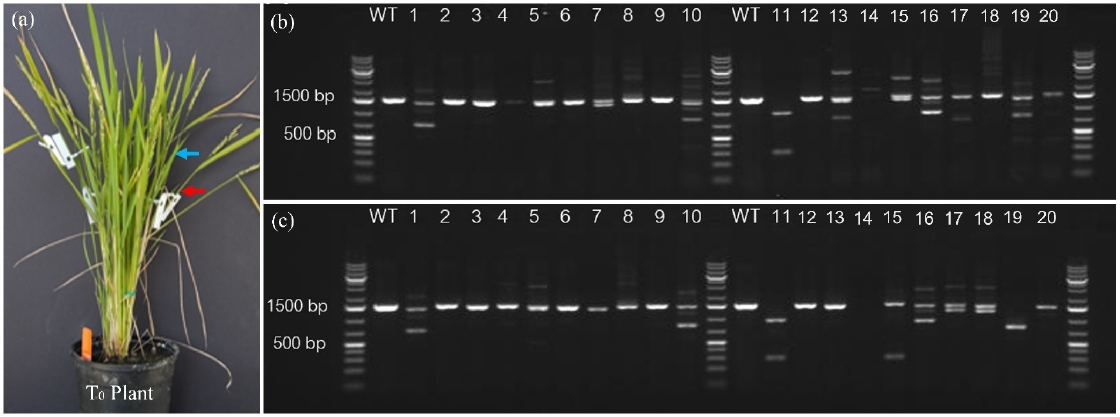
Fig. 1a), each tiller was tagged, and leaf tissues were collected for genomic DNA extraction. DNA was used as a template to amplify the
OsGTL1 promoter-specific primers. A 1500 bp DNA fragment was detected in the wild-type plant. Several putative T
0 transgenic lines (#2, #3, #4, #6, #9, #12, and #20) showed amplified fragments of the same size in both tillers tested (
Figs. 1b and 1c), suggesting that no editing events had occurred in these lines.
In contrast, some lines (#1, #5, #8, #11 and #16) contained amplified fragments of different sizes, with both tillers showing identical patterns. This suggests that the editing events occurred prior to tiller development and that these tillers originated from the same ancestor cells. However, in lines #7, #10, #14, #13, #15, #17, #18, and #19, different patterns of amplified fragments were obtained from the two tillers, suggesting that different editing events occurred in each tiller of the same plant (
Figs. 1b and 1c). This represents 35% chimerism in the T
0 plants. Overall, 14 out of 20 T
0 putative transgenic lines showed target region modifications, corresponding to a mutation rate of approximately 70%. The variations in size were attributed to insertions (lines #1, #5, #8, #10, #13, #15, #16, #17, and #18) and deletions (lines #1, #7, #11, #13, #16, #17, #18, and #19), with some plants containing both types of mutations.
To identify
Cas9-free plants, we screened the progenies (T
1 generation) from 10 independent T
0 transgenic lines. The seeds harvested from each T
0 line were germinated, and genomic DNA was extracted from the resulting T
1 plants to monitor the presence of
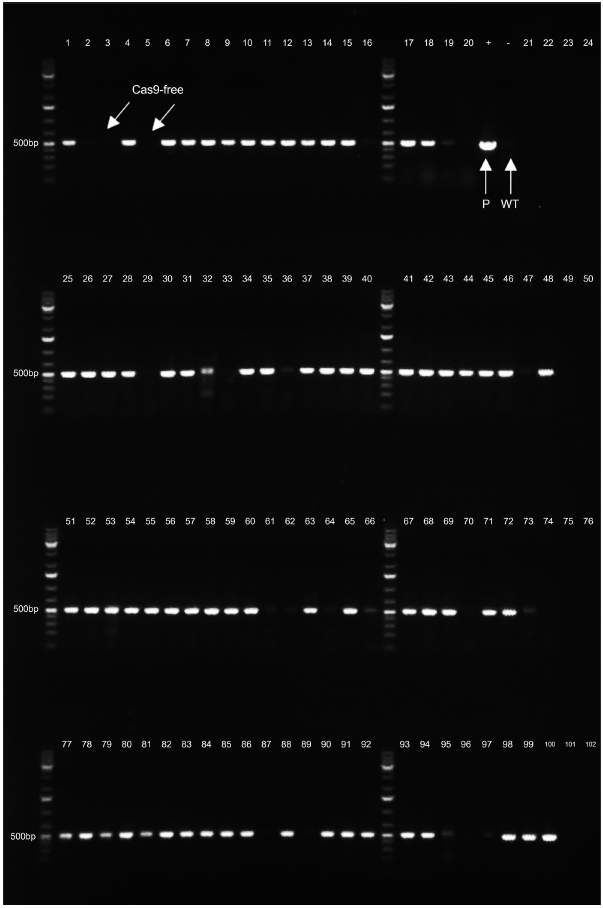
Cas9 in the genome. The number of seeds tested varied with seed availability for each line. In total, 102 T
1 genomic DNA samples were amplified for the Cas9 gene, and only 29 plants lacked it (
Fig. 2). The percentages of
Cas9-free plants in each line were also determined (
Table 1). The
Cas9-free percentage in this generation ranged from 0 to 100%. All progeny of lines #8 and #16 contained the
Cas9 gene, resulting in 0%
Cas9-free plants, whereas line #13 was 100% Cas9-free and line #17 showed 66.67%
Cas9-free plants. However, the number of plants tested for these two lines was limited due to low seed production (
n = 3). While these lines showed a high
Cas9-free rate, we acknowledge that the statistical limitations of this small sample size mean that a larger population would be required to confirm their segregation ratio.
To monitor
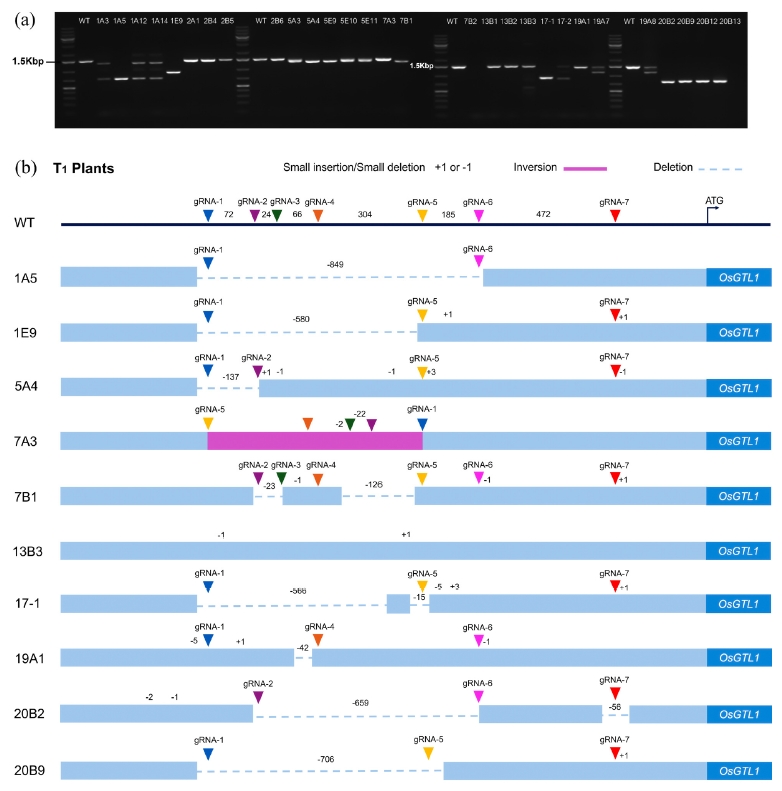
OsGTL1 promoter editing, DNA from 29
Cas9-free plants (
Table 1) was amplified using
OsGTL1 promoter-specific primers; the results are shown in
Fig. 3a. The progenies of line #1 were from two different tiller types: tiller A (lines 1A3, 1A5, 1A12, and 1A14) and tiller E (line 1E9). Seeds from line #2 were derived from tillers A and B, and seeds tested from lines #5 and #7 were also from two different tiller types in each line. In contrast, progenies from lines #13, #17, #19, and #20 were derived from the same tiller. This result showed that the T
1 progenies of each T
0 plant could contain different patterns of editing, even when originating from the same tiller, as shown by the different patterns of
OsGTL1 promoter-amplified fragments (
Fig. 3a; lines 1A3, 1A5, 1A12, and 1A14). The amplified fragments from line #2 progeny (2A1, 2B4, 2B5, and 2B6) showed similar patterns to the regions amplified from the wild-type and line #2 in the T
0 generation (
Fig. 1).
Ten amplified fragments of the putative
OsGTL1 promoter were isolated and sequenced. The chromatograms were analyzed, and the sequences were aligned with the reference sequence to verify the mutation events in
Cas9-free plants. Several mutation patterns were observed, including small insertion and deletion, large deletions, inversions, and combinations of these patterns (
Fig. 3b). Line 1A5 (mutant line #1, tiller A, plant #5) had the largest deletion of 849 bp. This suggests that sgRNAs #1 and #6 acted together to cut the DNA at 3-4 bases upstream of the Protospacer Adjacent Motifs (PAM) sites before rejoining. Line 1E9, a progeny of line #1 from another tiller, also showed a single deletion of a smaller size than the deletion in line 1A5, demonstrating that different editing occurred in different tillers of the same plant.
A combination of a 137 bp deletion, a single base insertion, and a deletion was detected in line 5A4, while a smaller deletion (-42 bp) combined with a single base insertion and deletion and a small deletion (-5 bp) was detected in line 19A1. Deletions in more than one region of the target position were detected in lines 7B1, 17-1, and 20B2. Interestingly, inversions combined with small deletions were detected in line 7A3. Sequence analysis revealed that this occurred due to the inversion of gRNA-1 and gRNA-5. The amplified fragment from line 13B3 was similar in size to the wild-type fragment, but sequencing revealed a single-base insertion and a single-base deletion (
Fig. 3b). This case demonstrates that PCR alone could not detect certain small mutations. Therefore, sequencing is important regardless of the gel fragment result. These data suggest that amplification of the target region could be used as a preliminary screening for mutations; however, we could not rule out the unchanged size of the fragments as non-mutated. It is possible that a CRISPR-Cas9-induced mutation can occur without altering the size of the target region.
Discussion
The application of multiple sgRNAs designed to target specific positions within the same gene or its homologous copies significantly enhances the overall editing efficiency through various mechanisms, and the presence of numerous active sgRNAs increases the probability of the Cas9 enzyme inducing DSBs at multiple targeted sites. Higher DSB frequency at target loci offers more possibilities for endogenous DNA repair mechanisms of the cell to introduce desirable alterations (
Li et al. 2024). Typically, Cas9 generates DSB a few base pairs upstream of the PAM site. The error-prone nonhomologous end-joining (NHEJ) DNA repair mechanism has the potential to create small deletions, insertions, or mismatches at the target site (
Gao et al. 2016).
Xu et al. (2015) demonstrated that the sgRNA-Cas9 complex remains active in heterozygous and chimeric plants, suggesting that wild-type alleles may undergo continuous modification. Several mutations were identified in the corresponding T
0 lines (
Fig. 1), some of which were carried over to the subsequent generations, where a novel mutation was discovered. For example, lines #1A3, #1A5, #1A12, #1A14, and #1E9 showed different patterns (
Fig. 3a), resulting in different mutations compared to lines #1A5 and #1E9 (
Fig. 3b). Lines #7B1, #17-1, #19A1, and #20B2 contained small deletions. This type of editing is commonly linked to classical NHEJ (cNHEJ), whereas larger deletions in lines #1A5, #1E9, #20B2, and #20B9 may result from microhomology-mediated end joining (or alternative NHEJ [aNHEJ]). Mutation patterns induced by CRISPR/Cas9 may vary for specific DSB sites, depending on the different NHEJ repair pathways (
Deriano et al. 2013).
Different mutations occurring in different tillers in the same plant would lead to different modifications in T
1 progeny, as shown in
Fig. 3. The shoot apical meristem (SAM) is a dome-shaped tissue at the shoot tip that generates lateral organs, such as leaves and flowers, after embryogenesis. SAMs also produce other organs such as branches and stems (
Tsuda et al. 2011). As the SAM expands and differentiates into additional organs, cells derived from the mutated cells eventually develop into an organ that carries this particular mutation. As a result, all aerial organs of rice plants, such as leaves, internodes, and axillary meristems, can show identical mutations (
Nagasaki et al. 2007).
In this study, some tillers carried different mutations. Each tiller originated from a specific axillary meristem derived from a set of cells in the SAM throughout its development (
Li et al. 2003); a mutation in this area is inherited by the axillary meristems that emerge from them. Axillary meristems derived from non-mutated parts of the SAM lack such mutations. Therefore, each tiller may have gained this mutation independently, thus leading to a scenario in which various tillers on a single rice plant potentially have different types of mutations. In another scenario, mutations occurring after cell division may lead to tissue sectors with different types of mutations (
Endo et al. 2015;
Zhang et al. 2014). Our experiment demonstrated that the first and second tillers had different mutations, even in the T
0 generation.
Edited alleles in transgenic rice in the T
0 transformation can be biallelic if both copies of the target gene are altered before embryogenic cell division (
Zhang et al. 2014). From our studies, it was difficult to clarify whether the different alleles in the same tiller were bi-allelic or chimeric. A previous study showed that genome editing patterns may vary throughout the developmental stages of rice (
Jang et al. 2016). In this study, we identified highly chimeric plants in early generations, likely due to the transformation methods used, as the callus transformation process in crop plants such as rice is more complex and time-consuming than in
Arabidopsis. Throughout this period, the
Cas9 gene remains actively expressed in plant cells and constantly edits DNA. Mutations can develop in different cells at different times, creating a mosaic genotype. This prolonged duration of expression may increase the risk of first-generation somatic mutations (
Xu et al. 2015). A single somatic cell transformed with CRISPR-Cas9 was used to develop calli. When stimulated to regenerate in plants, callus cells may have completely different genotypes. This can result in a chimeric plant in which different parts, such as tillers, leaves, or roots, may have different genetic makeup. Identifying the segregation pattern of the
Cas9-free plants in the T
1 generation allowed us to determine whether the parental lines were bi-allelic or chimeric. Plants that lack the
Cas9 gene cannot develop the new mutation; therefore, in the true bi-allelic T
0 tiller, the Cas9-free T
1 progenies are expected to segregate following a predictable Mendelian pattern. On the other hand, T
1 lines derived from a single tiller that display a mixture of multiple alleles and a distorted inheritance ratio confirm that the parental T
0 tiller was chimeric.
Taken together, the use of CRISPR with multiple sgRNAs-Cas9 complexes can significantly improve mutation efficiency and enhance the ability to produce heritable targeted gene modifications in rice. These results emphasize the importance of comprehensive screening of multiple tillers and subsequent generations to achieve a stable, homozygous, and transgene-free line. However, the presence of Cas9 in later generations can induce new mutations, rendering the desired phenotype unstable.
Supplemental Materials
Notes
-
Acknowledgments
Funding: This work was supported by the Thailand Science Research and Innovation Fund of Chulalongkorn University (BCG_FF_68_261_2300_064) and the Network Strengthening Fund - Program 16 (B16F640103). W.F. was supported by a second-century scholarship from Chulalongkorn University. We thank all CEEPP and Comai lab members for their discussions, comments, and technical support.
Fig. 1.Evaluation of promoter modifications in the first generation (T0) transgenic plants. The leaf tissues were collected from the first tiller (blue arrowhead) and the second tiller (red arrowhead) (a). Gel image of polymerase chain reaction (PCR) from wild-type (WT) and T0 transgenic rice plants from the first fully expanded leaf of the first tiller (b) and the second tiller (c). The expected size of the amplified fragment from WT is 1461 bp.
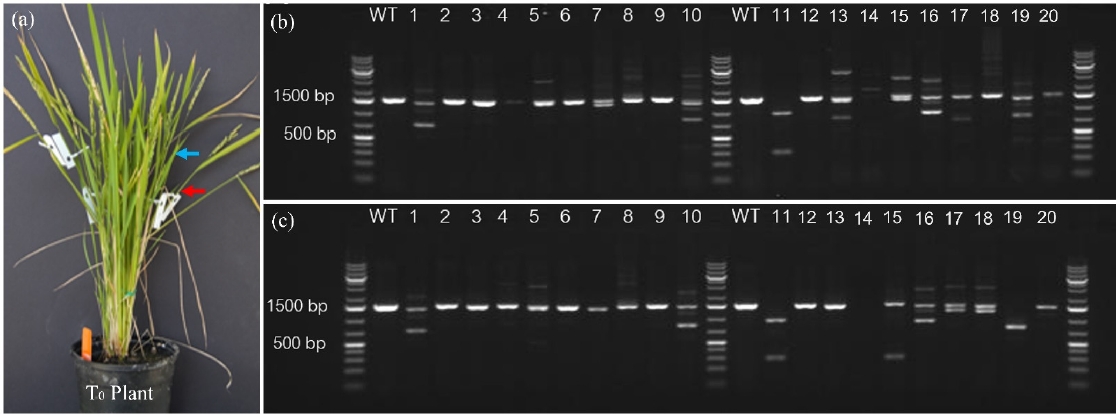
Fig. 2.Identification of Cas9-free plants in the second generation (T1 plants). Gel image of polymerase chain reaction (PCR) screening for Cas9-free individuals in the T1 population. The white arrow indicates examples of the absence of the specific Cas9 gene, confirming the Cas9-free plants. Lanes No. 1 - 102 represent the tested T1 genomic DNA samples. Letter P indicated a plasmid template containing the Cas9 gene (positive control), while letter WT indicated the wild-type genomic DNA template (negative control). The expected size of the amplified fragment from the plasmid is 532 bp.
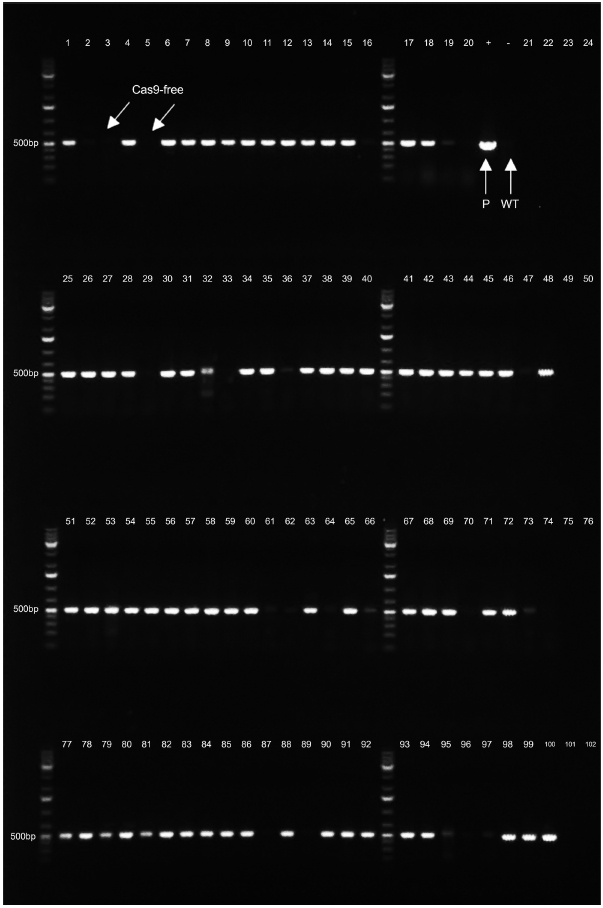
Fig. 3.Mutation patterns in the promoter region of OsGTL1 alleles of Cas9-free T1 plants. Gel electrophoresis images of PCR amplification products from 29 Cas9-free plants were evaluated to monitor the OsGTL1 modification in the T1 generation (a). Schematic diagram showing the mutation patterns from 10 Cas9-free T1 plants. Colored triangles and numbers among the triangles represent sgRNAs and the number of base pairs or the distance between each sgRNA (sgRNA no.1-7; left to right-hand side), respectively. There are different types of mutations, including insertion (+), deletion (-), big deletion (dashed line), and inversion (pink box) (b). The expected size of the amplified fragment from WT is 1461 bp.
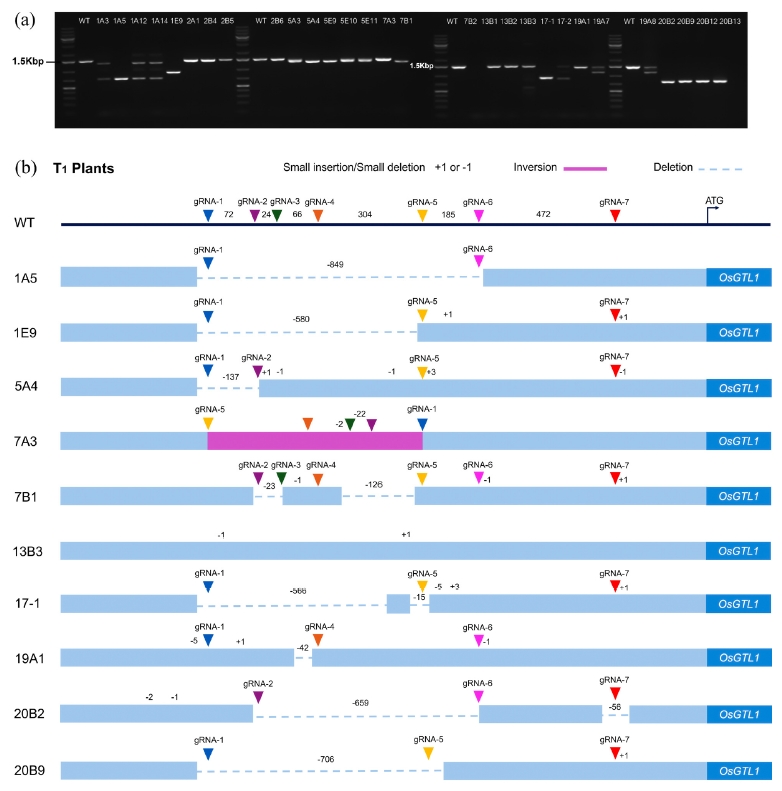
Table 1.Number of Cas9-free plants derived from germination of T1 seeds.
Table 1.
|
Lines (T0) |
Number of tested plants*
|
Number of Cas-free plants |
Cas9-free plants (%) |
|
1 |
24 |
5 |
20.83 |
|
2 |
8 |
4 |
50 |
|
5 |
13 |
5 |
38.46 |
|
7 |
10 |
3 |
30 |
|
8 |
4 |
0 |
0 |
|
13 |
3 |
3 |
100 |
|
16 |
12 |
0 |
0 |
|
17 |
3 |
2 |
66.67 |
|
19 |
12 |
3 |
25 |
|
20 |
13 |
4 |
30.77 |
|
Total |
102 |
29 |
|
References
- Abdelrahman M, Wei Z, Rohila JS, Zhao K. 2021. Multiplex genome-editing technologies for revolutionizing plant biology and crop improvement. Front. Plant Sci. 12: 721203.
- Aliaga-Franco N, Zhang C, Presa S, Srivastava AK, Granell A, Alabadí D, et al. 2019. Identification of transgene-free CRISPR-edited plants of rice, tomato, and Arabidopsis by monitoring DsRED fluorescence in dry seeds. Front. Plant Sci. 10: 1150.
- Bortesi L, Fischer R. 2015. The CRISPR/Cas9 system for plant genome editing and beyond. Biotechnol. Adv. 33(1): 41-52.
- Deriano L, Roth DB. 2013. Modernizing the nonhomologous end-joining repertoire: Alternative and classical NHEJ share the stage. Annu. Rev. Genet. 47(1): 433-455.
- Doudna JA, Charpentier E. 2014. The new frontier of genome engineering with CRISPR-Cas9. Science. 346(6213): 1258096.
- Endo M, Mikami M, Toki S. 2015. Multigene knockout utilizing off-target mutations of the CRISPR/Cas9 system in rice. Plant Cell Physiol. 56(1): 41-47.
- Gaillochet C, Develtere W, Jacobs TB. 2021. CRISPR screens in plants: Approaches, guidelines, and future prospects. Plant Cell. 33(4): 794-813.
- Gao X, Chen J, Dai X, Zhang D, Zhao Y. 2016. An effective strategy for reliably isolating heritable and Cas9-free Arabidopsis mutants generated by CRISPR/Cas9-mediated genome editing. Plant Physiol. 171(3): 1794-1800.
- Hall TA. 1999. BioEdit: A user-friendly biological sequence alignment editor and analysis program for Windows 95/98/NT. Presented at Nucleic Acids Symposium Series.
- Jang G, Lee S, Um TY, Chang SH, Lee HY, Chung PJ, et al. 2016. Genetic chimerism of CRISPR/Cas9-mediated rice mutants. Plant Biotechnol. Rep. 10(6): 425-435.
- Jinek M, Chylinski K, Fonfara I, Hauer M, Doudna JA, Charpentier E. 2012. A programmable dual-RNA-guided DNA endonuclease in adaptive bacterial immunity. Science. 337(6096): 816-821.
- Kawahara Y, de la Bastide M, Hamilton JP, Kanamori H, McCombie WR, Ouyang S, et al. 2013. Improvement of the Oryza sativa Nipponbare reference genome using next generation sequence and optical map data. Rice. 6(1): 4.
- Laforest LC, Nadakuduti SS. 2022. Advances in delivery mechanisms of CRISPR gene-editing reagents in plants. Front. Genome Ed. 4: 830178.
- Lei Y, Lu L, Liu H-Y, Li S, Xing F, Chen L-L. 2014. CRISPR-P: a web tool for synthetic single-guide RNA design of CRISPR-system in plants. Mol. Plant. 7(9): 1494-1496.
- Li J, Kong D, Ke Y, Zeng W, Miki D. 2024. Application of multiple sgRNAs boosts efficiency of CRISPR/Cas9-mediated gene targeting in Arabidopsis. BMC Biol. 22(1): 6.
- Li X, Qian Q, Fu Z, Wang Y, Xiong G, Zeng D, et al. 2003. Control of tillering in rice. Nature. 422(6932): 618-621.
- Nagasaki H, Itoh J-I, Hayashi K, Hibara K-I, Satoh-Nagasawa N, Nosaka M, et al. 2007. The small interfering RNA production pathway is required for shoot meristem initiation in rice. Proc. Natl. Acad. Sci. U. S. A. 104(37): 14867-14871.
- Nishimura A, Aichi I, Matsuoka M. 2006. A protocol for Agrobacterium-mediated transformation in rice. Nat. Protoc. 1(6): 2796-2802.
- Ricroch A, Clairand P, Harwood W. 2017. Use of CRISPR systems in plant genome editing: toward new opportunities in agriculture. Emerg. Top. Life Sci. 1(2): 169-182.
- Saini H, Thakur R, Gill R, Tyagi K, Goswami M. 2023. CRISPR/Cas9-gene editing approaches in plant breeding. GM Crops Food. 14(1): 1-17.
- Tsuda K, Ito Y, Sato Y, Kurata N. 2011. Positive autoregulation of a KNOX gene is essential for shoot apical meristem maintenance in rice. Plant Cell. 23(12): 4368-4381.
- Tuncel A, Pan C, Clem JS, Liu D, Qi Y. 2025. CRISPR-Cas applications in agriculture and plant research. Nat. Rev. Mol. Cell Biol. 26(6): 1-23.
- Waqas MAB, Awan MJA, Amin I, Arif M, Mukhtar Z, Mansoor S. 2025. Engineering high yield basmati rice by editing multiple negative regulators of yield. Mol. Biol. Rep. 52(1): 545.
- Xie K, Minkenberg B, Yang Y. 2015. Boosting CRISPR/Cas9 multiplex editing capability with the endogenous tRNA-processing system. Proc. Natl. Acad. Sci. U. S. A. 112(11): 3570-3575.
- Xu R-F, Li H, Qin R-Y, Li J, Qiu C-H, Yang Y-C, et al. 2015. Generation of inheritable and “transgene clean” targeted genome-modified rice in later generations using the CRISPR/Cas9 system. Sci. Rep. 5(1): 11491.
- Yin K, Tsai CJ. 2025. Turbo-charging crop improvement: harnessing multiplex editing for polygenic trait engineering and beyond. Plant J. 124(1): e70527.
- Yuan P, Usman M, Liu W, Adhikari A, Zhang C, Njiti V, et al. 2024. Advancements in plant gene editing technology: From construct design to enhanced transformation efficiency. Biotechnol. J. 19(12): e202400457.
- Zhang D, Zhang Z, Unver T, Zhang B. 2021. CRISPR/Cas: A powerful tool for gene function study and crop improvement. J. Adv. Res. 29: 207-221.
- Zhang H, Zhang J, Wei P, Zhang B, Gou F, Feng Z, et al. 2014. The CRISPR/C as9 system produces specific and homozygous targeted gene editing in rice in one generation. Plant biotechnol. J. 12(6): 797-807.